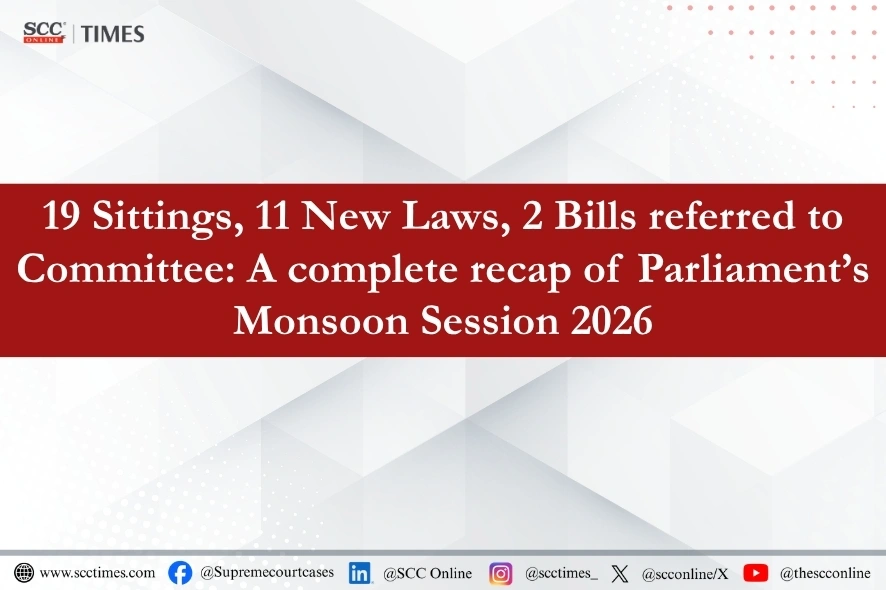
The Monsoon Session of Parliament 2026 was held from 20 July to 13 August 2026 and comprised 19 sittings, during which several important legislative measures relating to taxation, MSMEs, mining, public examinations, co-operatives, higher education, foreign contributions and the Supreme Court were taken up for consideration. At the commencement of the Session, 28 Bills were pending before Parliament, reflecting a substantial legislative agenda spanning multiple sectors.
The Session witnessed the enactment of several key laws, including those relating to tribunal reforms, MSME financing, mining regulation, public examination integrity, digital payments and the functioning of the Supreme Court. Parliament also approved the renaming of the State of Kerala as ‘Keralam’ and passed measures aimed at modernising evidentiary and regulatory frameworks.
In this Session:
-
11 Acts received Presidential assent.
-
1 Bill introduced and pending.
-
2 Bills referred to Committee.
From increasing the strength of the Supreme Court and introducing fast-track mechanisms to tackle examination malpractice, to expanding MSME financing, strengthening co-operative development and reforming mineral taxation, the Session reflected the government’s focus on institutional reform, regulatory modernisation and digital governance.
Below is a snapshot of the major Acts enacted, and important Bills considered during Parliament’s Monsoon Session 2026.
Key Acts
Bankers’ Books Evidence Act, 2026 | Ministry of Finance
On 13 August 2026, the President of India gave assent to the Bankers’ Books Evidence Act, 2026, replacing the 1891 law governing the use of bankers’ books as evidence in legal proceedings. The new Act updates the framework to recognise electronic and digital banking records and align evidentiary requirements with contemporary digital banking practices.
Also Read: Lok Sabha Replaces 135-Year-Old Banking Evidence Law; Passes Bankers’ Books Evidence Bill, 2026
Tribunals Reforms Act, 2026 | Ministry of Law and Justice
On 13 August 2026, the Tribunals Reforms Act, 2026 received the President’s assent, introducing a new framework aimed at improving the efficiency, independence, transparency and uniformity of tribunals in India.
Kerala (Alteration of Name) Act, 2026 | Ministry of Home Affairs
On 14 August 2026, the President assented to the Kerala (Alteration of Name) Act, 2026, providing for the official renaming of the State of Kerala as “Keralam”. The Act amends various provisions of the Constitution to substitute references to “Kerala” with “Keralam” and provides for consequential changes in existing laws and legal proceedings.
Also Read: From Kerala to Keralam: Parliament Clears Name Change Bill
MSME Development (Amendment) Act, 2026 | Ministry of Micro, Small and Medium Enterprises
On 13 August 2026, the Micro, Small and Medium Enterprises Development (Amendment) Act, 2026 received Presidential assent, introducing significant changes to the MSME regulatory framework. The amendments provide for mandatory routing of certain MSME receivable settlements through the Trade Receivables Discounting System (TReDS), tighter timelines for dispute resolution, stronger enforcement of awards and revised penalties.
Supreme Court (Number of Judges) Amendment Act, 2026 | Ministry of Law and Justice
On 11 August 2026, the President assented to the Supreme Court (Number of Judges) Amendment Act, 2026, increasing the sanctioned strength of the Supreme Court of India from 34 to 38 judges, including the Chief Justice of India.
The amendment seeks to enhance the Court’s capacity to deal with its growing caseload and improve the disposal of cases. It replaces the existing limit of 33 Judges other than the Chief Justice under the Supreme Court (Number of Judges) Act, 1956 with 37 such Judges, bringing the total sanctioned strength, including the Chief Justice, from 34 to 38.
The amendment seeks to enhance the Court’s capacity to deal with its growing caseload and improve the disposal of cases. It replaces the existing limit of 33 judges under the Supreme Court (Number of Judges) Act, 1956 with 37 judges. The Act is deemed to have come into force on 16 May 2026 and also repeals the Supreme Court (Number of Judges) Amendment Ordinance, 2026, while preserving actions taken under the Ordinance.
Also Read: Lok Sabha Passes Bill Raising Supreme Court Judge Strength to 38 Amid Mounting Pendency
Prevention of Insults to National Honour (Amendment) Act, 2026 | Ministry of Home Affairs
On 6 August 2026, the President assented to the Prevention of Insults to National Honour (Amendment) Act, 2026, amending the Prevention of Insults to National Honour Act, 1971. The amendment revises the provision relating to obstruction or disturbance of the singing of the National Anthem and extends similar protection to the National Song.
Under the amended Section 3, any person who intentionally prevents the singing of the National Anthem or the National Song or causes disturbance to an assembly engaged in such singing, shall be punishable with imprisonment for a term that may extend to three years, or with fine, or with both.
Also Read: Vande Mataram to Get the Same Legal Protection as the National Anthem
Registration of Births and Deaths (Amendment) Act, 2026 | Ministry of Home Affairs
On 6 August 2026, the President assented to the Registration of Births and Deaths (Amendment) Act, 2026, amending the Registration of Births and Deaths Act, 1969 to revise the procedure for delayed registration of births and deaths.
The amendment introduces separate mechanisms for registrations reported after one year and after two years of occurrence. Births or deaths reported after one year but within two years will require an order from the District Magistrate, Sub-Divisional Magistrate or an authorised Executive Magistrate after verification of the facts.
For registrations sought after two years of occurrence, an order of a Judicial Magistrate of the First Class will be mandatory. In both cases, registration will be subject to verification of the correctness of the information and payment of the prescribed fee.
Also Read: Delayed Birth and Death Registrations to Now Require Magistrates’ Approval
Public Examinations (Prevention of Unfair Means) Amendment Act, 2026 | Ministry of Personnel, Public Grievances & Pensions
On 31 July 2026, the President assented to the Public Examinations (Prevention of Unfair Means) Amendment Act, 2026, introducing stricter penalties and a fast-track enforcement framework to combat malpractice in public examinations. The amendment strengthens the existing law by substantially increasing imprisonment terms and monetary penalties for individuals, organisations and service providers involved in unfair means.
The Act also provides for the constitution of Special Task Forces for investigation, mandates time-bound completion of investigations, and requires States and Union Territories to designate Special Fast Track Courts for speedy trial of offences under the Act.
To ensure quicker disposal of cases, investigations must generally be completed within two months, trials must be conducted on a day-to-day basis and concluded within three months of filing of the chargesheet, while appeals before the High Court are, as far as possible, to be disposed of within three months of admission.
Also Read: Fast-Track Courts, Special Task Force, 3-Month Trial Deadline, Harsher Penalties
National Co-operative Development Corporation (Amendment) Act, 2026 | Ministry of Cooperation
On 14 August 2026, the President assented to the National Co-operative Development Corporation (Amendment) Act, 2026, introducing significant changes to the National Co-operative Development Corporation Act, 1962. The amendment expands the Corporation’s role in promoting and financing co-operative development and broadens its operational and funding framework.
The Amendment Act enables the National Co-operative Development Corporation (NCDC) to extend financial assistance not only to co-operative societies but also to entities engaged in co-operative development, subject to the utilisation of funds for co-operatives.
It empowers the Corporation to provide loans and grants, participate in the share capital of specified entities with Central Government approval, collect and share credit information with notified institutions, and undertake activities necessary for the effective discharge of its functions.
Taxation and Other Laws (Amendment) Act, 2026 | Ministry of Finance
On 17 August 2026, the President assented to the Taxation and Other Laws (Amendment) Act, 2026, introducing amendments to the Payment and Settlement Systems Act, 2007, the Income-tax Act, 2025 and the Finance Act, 2026. The legislation seeks to facilitate digital payments, refine certain income-tax provisions and provide targeted tax incentives for specified sectors and foreign investors.
Mines and Minerals (Development and Regulation) Amendment Act, 2026 | Ministry of Mines
On 17 August 2026, the President assented to the Mines and Minerals (Development and Regulation) Amendment Act, 2026, introducing significant changes to the regulatory framework governing mineral rights and mineral-bearing lands.
Bills introduced in Monsoon Session 2026
Indian Statistical Institute Bill, 2026
On 24 July 2026, the Indian Statistical Institute Bill, 2026 was introduced in the Lok Sabha to provide a comprehensive statutory framework for the Indian Statistical Institute (ISI), an institution of national importance. The Bill seeks to incorporate ISI as a body corporate and aims to replace Indian Statistical Institute Act, 1959.
Bills Listed for Consideration in Monsoon Session 2026
Foreign Contribution (Regulation) Amendment Bill, 2026 | Ministry of Home Affairs
Introduced in the Lok Sabha on 25 March 2026, the Foreign Contribution (Regulation) Amendment Bill, 2026 seeks to amend the Foreign Contribution (Regulation) Act, 2010 (FCRA), which regulates the acceptance, utilisation and reporting of foreign contributions in India.
The Bill introduces a new category of “key functionaries” covering directors, partners, trustees, kartas of Hindu Undivided Families (HUFs), office bearers and other persons responsible for the management of entities.
One of the most significant proposals in the Bill is the insertion of a new Chapter IIIA comprising Sections 16A to 16L. The proposed provisions seek to establish a comprehensive framework for the vesting, supervision, management and disposal of foreign contributions and assets created out of foreign contributions where an organisation’s FCRA registration is cancelled, surrendered, ceases to remain valid or the organisation becomes defunct.
The Bill also proposes the creation of a “Designated Authority” to oversee such foreign contributions and assets, including their provisional and permanent vesting, management, transfer and disposal. In addition, it seeks to introduce provisions relating to cessation of registration certificates, timelines for utilisation of foreign contributions received under prior permission, treatment of assets during suspension, and offences by key functionaries. Another significant proposal is the insertion of Section 43(2), under which no investigation for an offence punishable under the FCRA may be initiated without the prior approval of the Central Government. The amendment is intended to address operational and legal gaps relating to asset management, investigations, penalties and enforcement under the existing framework.
Viewed in that context, Nilesh Tribhuvann, Founder & Managing Partner, White & Brief — Advocates and Solicitors, opined:
“The Foreign Contribution (Regulation) Act is a cornerstone of responsible governance, built around five guiding principles: transparency, accountability, sovereignty, the enabling of genuine work, and public confidence. Every organisation receiving foreign funds must register, route contributions through a designated and verifiable banking channel, and disclose the donors, amounts and purposes involved creating an auditable trail from source to impact.
Annual audited returns, filed online, ensure full traceability, while the law’s safeguards protect India’s democratic institutions, electoral processes and national security from undue foreign influence. Far from obstructing legitimate charity, the FCRA facilitates education, healthcare, disaster relief, scientific research and cultural exchange within a framework that upholds India’s sovereign right to regulate cross-border financial flows, a right that democracies such as the United States, the United Kingdom, Australia and Canada exercise through comparable laws of their own.
The 2026 reforms carry this tradition forward: the FCRA (Amendment) Rules, 2026 are in force and the Amendment Bill, 2026, now before Parliament provides for orderly custody of foreign-funded assets when a registration ceases and rationalises the maximum penalty from five years to one. In 2024—25, some 16,200 registered associations received around ₹22,963 crore in foreign contributions and this is hardly the footprint of a prohibition. When citizens know that foreign funding is registered, disclosed and audited, it builds trust in both the organisations and the system that oversees them. This is not restriction; it is the exercise of accountable, sovereign governance in the service of India’s people.”
The FCRA Bill, 2026 has been referred to a Joint Parliamentary Committee for detailed examination after the motion was adopted by the Lok Sabha.1
Viksit Bharat Shiksha Adhishthan Bill, 2025
Seeks to replace the University Grants Commission (UGC), the All-India Council for Technical Education (AICTE) and the National Council for Teacher Education (NCTE) with a single regulator for higher education. The Bill was introduced in the Lok Sabha on 15 December 2025 and has been referred to a Joint Parliamentary Committee2.
1. https://www.ptinews.com/stories-detail/national/LS-refers-FCRA-bill-to-joint-committee–adjourned-for-the-day/3959137/1
2. https://prsindia.org/billtrack/the-viksit-bharat-shiksha-adhishthan-bill-2025