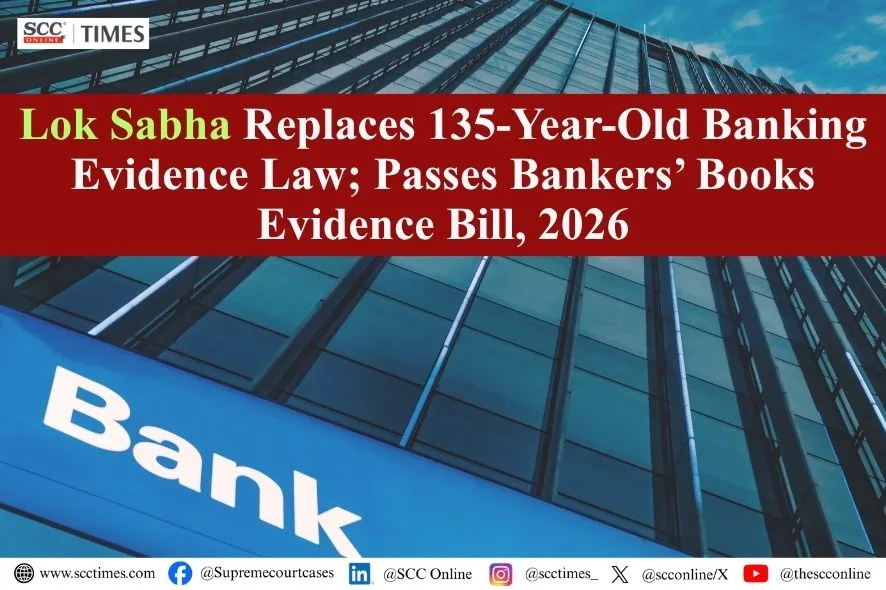
On 5 August 2026, the Lok Sabha passed the Bankers’ Books Evidence Bill, 2026, which seeks to provide a contemporary legal framework governing the evidentiary value of bankers’ records and align the law with digital banking practices.
The Bankers’ Books Evidence Act, 1891 was enacted at a time when banking records were maintained largely in physical form. Adapting to the rapid growth of electronic banking, digital record-keeping, cloud infrastructure and technology-driven financial services, the Bankers’ Books Evidence Bill, 2026 was introduced in the Lok Sabha on 3 August 2026. It seeks to update and modernise the legal framework governing the admissibility and proof of banking records in legal proceedings.
Key Points:
-
The Lok Sabha has passed the Bankers’ Books Evidence Bill, 2026, replacing the Bankers’ Books Evidence Act, 1891.
-
Section 2 expands the definition of “bankers’ books” to include records maintained in physical, electronic, digital, cloud-based and other data storage formats, including back-up and disaster recovery sites.
-
The Bill defines “legal proceeding” broadly to include court proceedings, arbitration, investigations and inquiries conducted under law for collection of evidence.
-
Section 3 recognises certified copies of both physical and electronic banking records and prescribes separate certification requirements for each.
-
Certificates relating to digital records may be signed manually or authenticated using digital or electronic signatures in accordance with the Information Technology Act, 2000.
-
Sections 6 and 7 provide that electronic and digital copies of banking records will not be denied admissibility merely because they are maintained in electronic or digital form and lay down detailed conditions for admissibility, including requirements relating to system integrity, authorised access, data accuracy, cybersecurity safeguards and absence of tampering.
-
Section 4 enables the Central Government to extend the application of the law to other entities or classes of entities operating in the financial sector.
-
Section 5 provides that certified copies of entries in bankers’ books will be admissible as prima facie evidence of the existence of such entries in legal proceedings.
-
Sections 8 states that bank officers cannot ordinarily be compelled to produce original bankers’ books or appear as witnesses where certified copies can be used, unless a court records special reasons.
-
Courts may also permit inspection of bankers’ books or direct banks to furnish certified copies relevant to proceedings, under Section 9.
-
Section 11 provides that where the provisions of Sections 8, 9 or 10 are applied for the conduct of an investigation or inquiry, any “order of Court” referred to in those sections shall instead be construed as an order made by an officer not below the rank of Superintendent of Police, or such other officer as may be specified by the appropriate Government.
-
Section 12 empowers the Central Government to modify the prescribed certificate formats.
-
Section 16 repeals the Bankers’ Books Evidence Act, 1891 while preserving actions, proceedings, rights and liabilities arising under the repealed law.
[Bankers’ Books Evidence Bill, 2026, dated 5-8-2026]