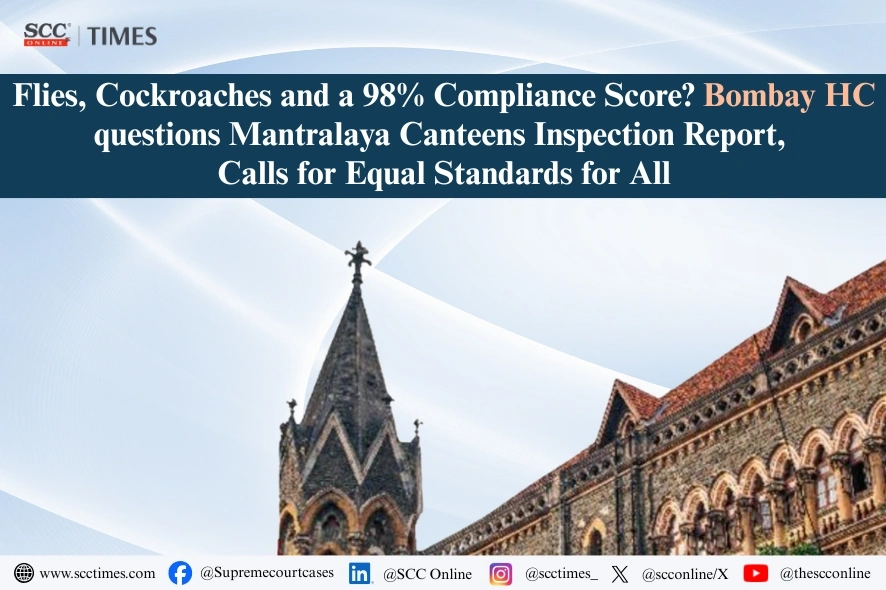
Bombay High Court: While considering a batch of petitions concerning inspections conducted by the Food and Drug Administration and the suspension of licences of food establishments, the Division Bench of Ravindra V. Ghuge, ACJ., and Gautam A. Ankhad, J., observed that food safety authorities must apply same standards to government canteens and private establishments. The Court expressed serious reservations regarding reports showing 98 per cent compliance in 3 canteens operating in the Mantralaya complex and directed scrutiny of those reports in light of independent inspection findings and photographic evidence.
Also Read: Bombay HC restores food licence despite two insects in hotel kitchen
Background
By an order dated 29 July 2026, the Court had directed the State to place on record the situation in canteens and eateries operating within the premises of statutory authorities, State instrumentalities and government establishments. Pursuant to the said direction, the State produced a compilation of documents and informed the Court that inspections had been carried out last year in:
-
Mantralaya canteen;
-
Square Meal Canteen in the Mantralaya Annexe Building; and
-
Vidhan Bhavan canteen.
According to the State, all 3 canteens were found to be 98 per cent compliant. The inspection reports recorded that no ant, insect, larvae, fly or cockroach was found in the establishments.
The petitioners, however, pointed out that during inspection of a private commercial establishment, even a banana bearing black dots and similar defects on vegetables had been treated as objectionable. It was further submitted that the inspection of the private establishment lasted approximately 5 hours, resulted in a score of 37 per cent, and was followed by immediate suspension action. The petitioners contended that if such strict standards were being applied to private establishments, the reports granting 98 per cent compliance to government canteens required closer scrutiny.
To verify the factual position, the Court sought assistance from 4 advocates, namely, Suresh Sabrad, Secretary of the Advocates Association of Western India, and Swanand Ganoo, Kainaz Irani and Phiroze Bharucha, Managing Committee Members of the Bombay Bar Association, who visited the canteens along with departmental officers. Following the inspection, the advocates reported that intensive cleaning activities were underway during their visit and that they noticed several deficiencies, including a refrigerator in shambles, ineffective cooling systems, flies, cockroaches and absence of mosquito nets. The inspection was videographed and colour photographs were produced before the Court.
Comparing these findings against the photographic evidence, the Court observed that the reporting authority “can be said to have taken a chance with the Court” by presenting reports showing a uniform 98 per cent compliance score across all three canteens.
Also Read: Food Safety Enforcement in India: Misbranding & Courts
Analysis and Decision
The Court identified the principal issue as whether the Food and Drugs Department was treating private commercial establishments fairly in comparison with establishments operated by State instrumentalities and government-controlled canteens.
The Court carefully examined the reports submitted by the State and noted that all 3 government canteens had been awarded a uniform 98 per cent compliance score. The Court observed that if the reports were accurate, the canteens ought to have been of “top notch quality” and free from flies, cockroaches, larvae and similar deficiencies. The Court also took note of the disparity in inspection duration. While inspections of government canteens lasted approximately 30 to 45 minutes, inspections of private establishments had continued for 5 hours and, in another case, 9 hours.
Referring to these circumstances, the Court emphasised that the Department is required to remain impartial irrespective of whether the establishment concerned is a private commercial entity, a statutory authority or a government canteen operated through contractors. The Court stressed that the law must be enforced uniformly and that no aggrieved party should feel that private commercial establishments are dealt with applying different standards.
The Additional Government Pleader (AGP) informed the Court that suspension notices issued to commercial establishments would be treated as show-cause notices for improvement or compliance under Section 32, Food Safety and Standards Act, 2006 (2006 Act), before any precipitative action such as suspension or cancellation of licences was initiated. The State further stated that similar improvement notices would also be issued to the Mantralaya canteens and that all establishments concerned would be granted time till 4 August 2026 to undertake corrective measures. The Court accepted the proposed course of action and directed fresh inspections on 5 August 2026.
Significantly, the Court expressed an expectation that the Commissioner of the Food and Drugs Department would scrutinise the reports allocating a uniform 98 per cent compliance score to the 3 canteens in light of the photographic material produced before the Court and inquire into how such reports came to be submitted.
The matters were directed to be listed on 6 August 2026 after completion of the fresh inspections.
[Sanjay Baburao Nirbhavne v. State of Maharashtra, 2026 SCC OnLine Bom 8067, decided on 31-7-2026]
Advocates who appeared in this case:
For the Petitioners: Mayur Khandeparkar a/w Shubhra Swami, Sagar Shetty, Megha Vijan and Akshay Naik i/b Sagar Shetty & Associates.
For the Respondents: Pooja C. Patil, AGP.