Disclaimer: This has been reported after the availability of the order of the Court and not on media reports so as to give an accurate report to our readers.
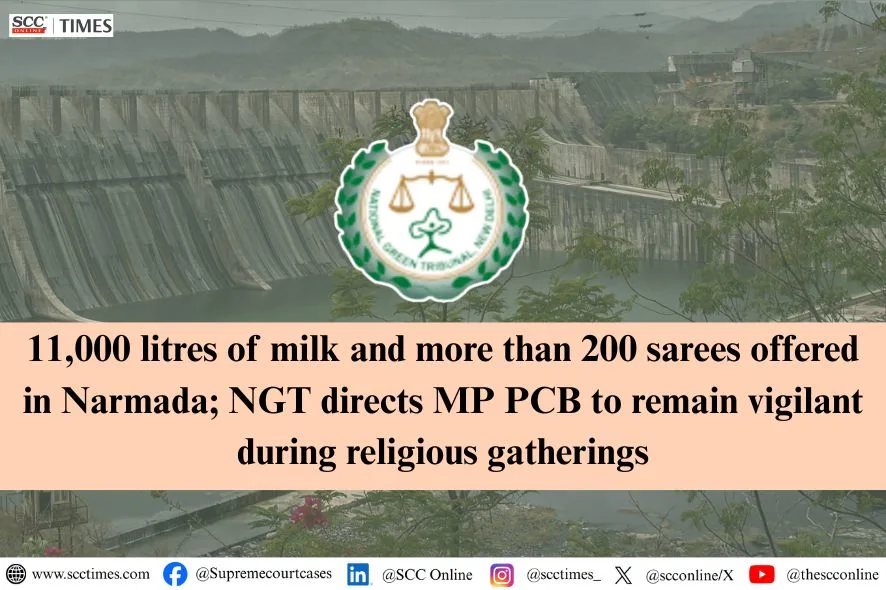
National Green Tribunal (Central Zone Bench): In an application alleging water pollution by the discharge of around 11,000 litres of milk and more than 200 sarees in the Narmada River following a religious gathering, the Bench of Justice Dinesh Kumar Singh and Sudhir Kumar Chaturvedi (Expert Member) held that no law was shown by the applicant which bars offering of milk; however, it should be avoided, as such large quantity of milk when poured into the river which might contaminate the water, if the water is found to be stagnant.
The NGT directed the Madhya Pradesh Pollution Control Board (MPPCB) to remain vigilant during such religious gatherings and ensure that such a large quantity of milk is not offered in future.
Background
The present application was filed seeking preservation and conservation of the Narmada rivulet/stream flowing through Villages Satdev and Bheruda in Tehsil Nasrullaganj, District Sehore, Madhya Pradesh.
The applicants alleged that, following a religious gathering organised at Gram Panchayat Satdev, the organisers, after performing puja and aarti of River Narmada, poured approximately 11,000 litres of milk into the river and discharged about 210 sarees. It was contended that the practice would pollute the river, adversely affect fish and other aquatic organisms; contaminate water used for drinking and irrigation by downstream villages; and violate the provisions of the Water (Prevention and Control of Pollution) Act, 1974 (Water Pollution Act).
Issue
Whether pouring of milk as a milk pooja may be considered as a significant organic pollutant causing aquatic mortality and depleting oxygen?
Previous Proceedings
While considering the matter earlier, the Tribunal noted that no scientific data had been placed before it to establish pollution caused by pouring milk into the river. The NGT also observed that there were no specific guidelines issued by the Central Pollution Control Board (CPCB) explicitly banning milk pouring, and it falls under the general prohibition of polluting rivers. The NGT noted that Section 24, Water Pollution Act prohibits discharge of polluting matter into streams or wells.
The NGT stated that the question of whether pouring milk into a river as part of a religious ritual constitutes a significant organic pollutant that causes oxygen depletion and aquatic mortality requires scientific examination.
Accordingly, it directed the CPCB and the MPPCB to submit a report indicating whether the activity was regulated under any existing guidelines and, if not, whether guidelines were required or whether such ritual offerings caused pollution of the river.
Joint Committee Report
Pursuant to the NGT’s direction, the Joint Committee submitted its report stating that laboratory dilution studies and theoretical dilution assessment indicated that, considering the flowing nature of River Narmada, its high dilution potential, natural assimilative capacity and continuous reaeration, no adverse impact on the river water quality could be established from the available evidence. However, the Committee observed that milk is an organic biodegradable substance having oxygen demand and that its direct discharge into any water body in such large quantity is environmentally undesirable. It further stated that the environmental impact of such practices is likely to be more significant in ponds, lakes, reservoirs and other stagnant or low-flow water bodies where dilution and natural reaeration are comparatively limited.
The Joint Committee recommended that all religious gatherings on the banks of River Narmada should be organised only after obtaining prior permission from the local administration and only at designated ghats in accordance with the standard operating Procedure (SOP) for River-Sensitive Gatherings Along Riverbanks (2024), with appropriate environmental management measures in place. It also noted that designated ghats already have facilities for separate collection of flowers, coconuts, cloth and other pooja material, and recommended that organisers of large gatherings should, in coordination with the local administration, make adequate arrangements for waste collection, sanitation, crowd management and environmental protection.
Final Order
Taking note of the report, the NGT observed that there was no existing law prohibiting the offering of milk during religious rituals and that the SOP only required prior permission for organising religious gatherings. The NGT further observed that the applicants were unable to point to any statutory provision prohibiting such ritual offerings. However, the NGT held that pouring large quantities of milk into the river should be avoided, particularly where the water is stagnant and may become contaminated.
Accordingly, the NGT disposed of the application with a direction to the MPPCB to maintain vigilance during such religious gatherings and to ensure that large quantities of milk are not offered into the river in future. The NGT further directed the MPPCB to act in coordination with the local administration in this regard.
[Siddharth Singh Rajpoot v. State of M.P., 2026 SCC OnLine NGT 274, decided on 17-7-2026]
Advocates who appeared in this case:
For the applicants: Siddharth Singh, Advocate
For the respondents: Parul Bhadoria, Advocate for MPPCB