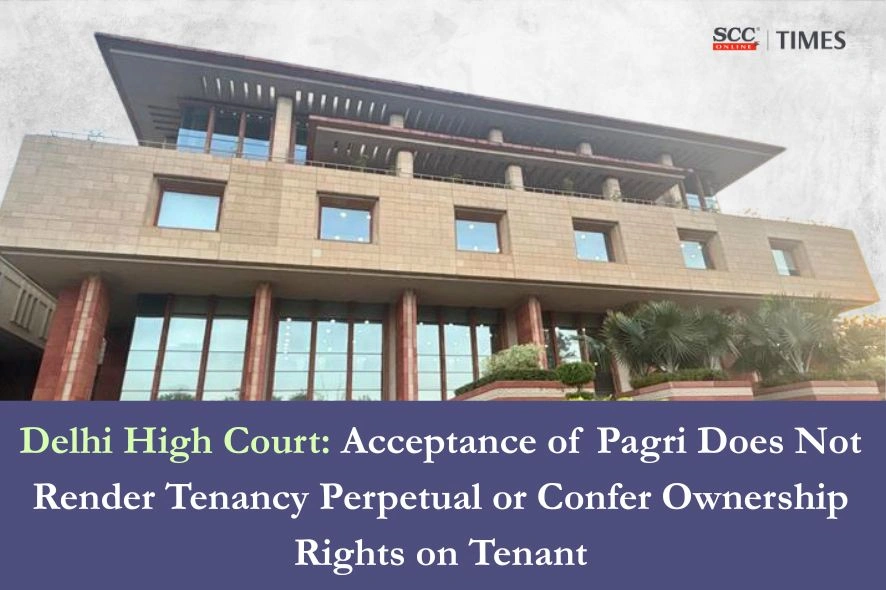
Delhi High Court: In a regular second appeal arising out of a landlord-tenant dispute concerning eviction from a commercial shop, a Single Judge Bench of Neena Bansal Krishna, J., held that acceptance of a pagri/advance amount by the landlord did not alter the nature of the relationship between the parties or render the tenancy perpetual and non-terminable. The Court observed that neither the rent agreement nor the memorandum of understanding (MoU) executed between the parties conferred any ownership rights upon the tenant or extinguished the landlord-tenant relationship. Holding that the Delhi Rent Control Act, 1958 was inapplicable to the suit premises and that institution of the eviction suit itself constituted sufficient notice of termination of tenancy, the Court found no infirmity in the concurrent findings of the courts below.
The Court further held that the rejection of the tenant’s application for amendment of the written statement at the appellate stage was justified, as the proposed plea based on the memorandum of understanding did not affect the fundamental nature of the parties’ relationship. Finding that no substantial question of law arose for consideration under Section 100, Civil Procedure Code, 1908 (CPC), the Court dismissed the regular second appeal and upheld the decree of possession passed in favour of the landlord.
Background
The present regular second appeal arose from a landlord-tenant dispute concerning a shop situated in property bearing No. WZ-12B, Gulab Bagh, Nawada, New Delhi. The respondent/plaintiff, an elderly widow, claimed ownership of the property and asserted that one shop therein had been let out to the appellant, Shyam Lal & Sons, under a rent agreement dated 1 January 2001 for running a shoe business. According to the plaintiff, the tenancy was initially created at a monthly rent of ₹1000, which was subsequently enhanced to ₹1460 per month. Pleading financial hardship and bona fide requirement of the premises for the sustenance of her joint family, she sought possession of the tenanted shop along with permanent and mandatory injunctions.
The appellant/defendant resisted the suit on several grounds, contending that the suit was barred under Section 50, Delhi Rent Control Act, 1958, that the plaintiff had failed to establish ownership over the suit property, and that the tenancy created under the rent agreement was perpetual and non-terminable. Reliance was placed upon a memorandum of understanding executed on the same date as the rent agreement, whereby the plaintiff had allegedly received ₹1,48,000 as advance/pagri, amounting to approximately three-fourths of the market value of the shop, and had undertaken not to seek eviction of the defendant. The defendant further asserted that the rent included electricity and water charges and raised objections regarding non-joinder of necessary parties and absence of a valid cause of action.
During the proceedings, the plaintiff moved an application under Order 12 Rule 6 CPC seeking a decree on admissions. The trial court held that the Delhi Rent Control Act was inapplicable to the suit property, found the landlord-tenant relationship to be admitted, and observed that the defendant was estopped from disputing the plaintiff’s title under Section 116, Evidence Act, 1872. Treating the institution of the suit as sufficient notice of termination of tenancy, the trial court decreed possession in favour of the plaintiff.
The first appellate court affirmed the trial court’s findings and dismissed the appeal. It also rejected the defendant’s application for amendment of the written statement at the appellate stage, holding that no exceptional circumstances existed to justify such amendment. Aggrieved thereby, the defendant preferred the present regular second appeal challenging the concurrent findings of the courts.
Issues
The appellants raised the following substantial questions of law for consideration:
1. Whether a suit for ejectment instituted by a landlord against a tenant is maintainable before lawful determination of tenancy through a notice under Section 106, Transfer of Property Act, 1882?
2. Whether a court can entertain a plaint which, on a holistic reading, does not disclose a cause of action entitling the plaintiff to the reliefs claimed?
3. Whether a suit allegedly lacking a cause of action can be summarily decreed under Order 12 Rule 6 CPC on the basis of purported admissions of the defendant?
4. Whether amendment of a written statement at the appellate stage is legally impermissible, particularly where the trial court has passed a decree under Order 12 Rule 6 CPC?
5. Whether a defendant can be permitted to amend his written statement at the appellate stage to further elucidate his pleadings after suffering a decree on admissions?
6. Whether a finding of the Rent Controller that it lacks jurisdiction because the Delhi Rent Control Act, 1958 is inapplicable to the premises can operate as res judicata between the parties in subsequent proceedings?
7. Whether a tenant loses the protection of the Delhi Rent Control Act, 1958 by denying the relationship of landlord and tenant in an eviction suit instituted before the civil court?
Analysis
The Court noted that the execution of the Rent Agreement dated 1 January 2001 and the rate of rent stipulated therein were not disputed by the appellants. The principal defence raised by the appellants was that the tenancy was non-terminable as the respondent had received a pagri/advance amount of ₹1,48,000, which was approximately three-fourths of the market value of the suit shop. Reliance was placed on the rent agreement and the MoU dated 1 January 2001, which allegedly recorded the payment and provided that the respondent would not seek eviction of the appellants.
The Court observed that even assuming that the pagri amount had been received, the same did not alter the nature of the relationship between the parties, which remained that of landlord and tenant. The rent agreement itself contemplated termination of tenancy by the tenant upon giving 2 months’ notice, thereby demonstrating that the tenancy was not inherently perpetual or non-terminable. The Court further held that the MoU merely recorded payment of the amount and certain preferential rights in the event of sale of the property, but did not confer ownership rights upon the appellants or extinguish the landlord-tenant relationship.
With regard to the amendment application filed at the appellate stage, the Court found no infirmity in its rejection. The proposed plea based on the MoU had not been taken before the trial court and, in any event, even if the contents of the MoU were considered, they would not affect the fundamental relationship between the parties.
On the issue of applicability of the Delhi Rent Control Act, 1958, the Court affirmed the concurrent findings of the courts below that the suit property was situated in an area to which the Act had not been extended by the requisite notification. The appellants failed to establish that the revenue estate concerned had been notified under the Act. Consequently, the bar under Section 50, Delhi Rent Control Act was held to be inapplicable.
Dealing with the contention that no notice terminating tenancy had been served, the Court relied upon the decision in Nopany Investments (P) Ltd. v. Santokh Singh, (2008) 2 SCC 728, and reiterated that institution of the suit itself constituted sufficient notice to the tenant to vacate the premises. The objection regarding non-joinder of partners of Shyam Lal and Sons was also rejected, the Court observing that the tenancy stood in the name of the firm and the suit had been validly instituted against it.
Decision
The Court concluded that the learned Civil Judge and the first appellate court had rightly held that there existed a relationship of landlord and tenant between the parties, that the Delhi Rent Control Act was not applicable to the suit premises, and that filing of the suit amounted to notice of termination of tenancy. Finding that no substantial question of law arose for consideration under Section 100 CPC, the Court dismissed the regular second appeal along with all pending applications.
Also read: SC quashes eviction orders for Sujan Singh Park Residential Premise
[Shyam Lal & Sons v. Mithlesh Devi, 2026 SCC OnLine Del 4748, decided on 16-6-2026]
Advocates who appeared in this case:
For the Appellant: Pankaj Vivek and Naveen Malik, Advocates
For the Respondents: Abhishek Grover, Advocates