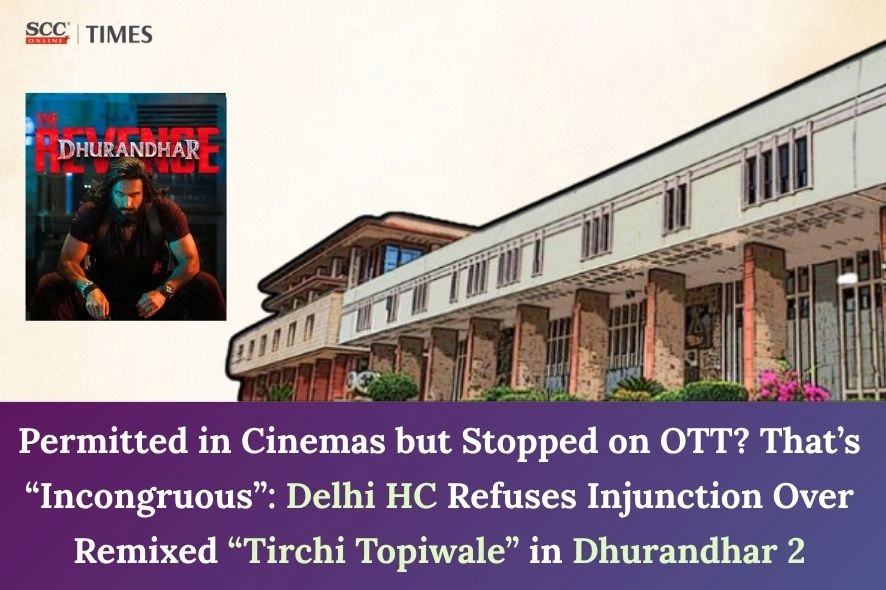
Delhi High Court: In an application under Order 39 Rules 1 and 2, Civil Procedure Code, 1908 (CPC) seeking interim injunction in a copyright infringement dispute concerning the iconic song “Tirchi Topiwale” from the film Tridev, a Single Judge Bench of Tushar Rao Gedela, J., declined to restrain the defendants from further use and exploitation of the remixed version of the song in the cinematograph film Dhurandhar: The Revenge.
The Court held that a party invoking equitable and discretionary jurisdiction must approach the Court with clean hands and cannot suppress material facts having a bearing on the grant of interim relief. The Court further observed that prolonged inaction and previous non-objection to similar exploitations of the copyrighted work, coupled with contradictory stands taken by the plaintiff, disentitled it from discretionary relief at the interim stage. Prima facie interpreting the agreement dated 30 June 1988 in favour of Defendant 3, the Court held that the rights assigned thereunder appeared to include the right to create and exploit remixed versions of the songs embodied in the cinematograph film Tridev. However, balancing equities, the Court directed Defendant 3 to deposit Rs 50 lakhs before the Registrar General of the Court pending adjudication of the suit.
Background
The plaintiff, a renowned film production house founded by late filmmaker Gulshan Rai and presently managed by Rajiv Rai, instituted the present suit under Order 39 Rules 1 and 2 CPC seeking an interim injunction against the defendants for alleged infringement of copyright in the iconic song “Tirchi Topiwale” from the film Tridev. The plaintiff asserted ownership over the literary work, musical composition, and sound recording of the song, including rights in any remixed adaptation thereof. It was contended that under an agreement dated 30 June 1988, only limited record-based exploitation rights, namely, manufacture and sale of cassettes and gramophone records, had been assigned to Defendant 3 and that no synchronisation or cinematographic incorporation rights were ever transferred.
The dispute arose when the plaintiff discovered in March 2026 that the defendants had allegedly created a remixed version of the song titled “Rang De Lal (Oye Oye)” and incorporated both the remixed track and portions of the original sound recording in the cinematograph film Dhurandhar: The Revenge, released on 19 March 2026. Alleging unauthorised adaptation, synchronisation and commercial exploitation of its copyrighted works without consent or licence, the plaintiff approached the Court seeking ad interim injunctive relief restraining the defendants from further use, distribution and exploitation of the impugned song and related materials pending adjudication of the suit.
Analysis
The Court, while considering an application under Order 39 Rules 1 and 2 CPC in a copyright dispute concerning the use and exploitation of the remixed version of the song “Tirchi Topiwale” in the cinematograph film Dhurandhar: The Revenge, reiterated that grant of interim injunction is governed by the settled triple test, namely,
-
existence of a prima facie case,
-
balance of convenience and irreparable injury, and
-
that the power to grant such relief is discretionary and equitable in nature.
Relying upon Wander Ltd. v. Antox India (P) Ltd., 1990 Supp SCC 727, the Court observed that a party seeking discretionary relief must approach the Court with clean hands and must not suppress or conceal material facts.
The Court found that the plaintiff had failed to disclose several crucial and material facts, including the issuance of legal notice dated 26 April 2016, the reply dated 2 May 2016 issued by Defendant 3 asserting complete rights under the agreement dated 30 June 1988, previous exploitations of the songs in the films Azhar and K.G.F: Chapter 1, and various litigations instituted by the plaintiff during the years 2016 to 2020 despite claiming that its promoter had lost touch with the industry after leaving India in 1997. The Court held that the affidavits filed by the plaintiff and its promoter contained inconsistencies and contradictory stands, which did not inspire confidence and amounted to suppression of material facts. Applying the principle of suppressio veri suggestio falsi, the Court held that such conduct disentitled the plaintiff from seeking equitable and discretionary relief.
On the interpretation of the agreement dated 30 June 1988, the Court prima facie held that the covenants, particularly clauses relating to “the said work”, when read conjunctively and harmoniously, appeared to assign all rights, title and interest in the literary, dramatic and musical works embodied in the cinematograph film Tridev in favour of Defendant 3, including the right to make or authorise remixed versions. Distinguishing the judgment in Shemaroo Entertainment Ltd. v. Amrit Sharma, 2012 SCC OnLine Del 3772, the Court observed that the agreement in the present case contained distinctive clauses and a broader definition of “the said work”, which prima facie conferred extensive rights upon Defendant 3. The Court further held that though every infringement may furnish a fresh cause of action, the plaintiff’s prolonged silence and complete inaction despite previous exploitations had evidently assured Defendant 3 regarding its asserted rights, leading it to alter its position and enter into commercial arrangements with third parties.
The Court observed that Defendants 1 and 2 had invested huge sums in producing the cinematograph film and could not now be subjected to enormous financial prejudice merely because the plaintiff chose to awaken after years of inaction. The Court also held that once the film had already been released theatrically, restraining only its OTT release would result in an incongruous situation where the same work would be permissible in cinema halls but infringing on digital platforms.
Decision
Holding that any injury suffered by the plaintiff could be compensated in damages, the Court declined to grant injunction. However, balancing equities, the Court directed Defendant 3 to deposit Rs 50 lakhs before the Registrar General within 4 weeks, to be kept in an interest-bearing FDR, considering the continued exploitation of the remixed songs on digital music platforms and the royalty-related clauses in the agreement. The interim application was accordingly disposed of, with the clarification that the observations were purely prima facie and confined only to adjudication of the interim application.
[Trimurti Films (P) Ltd. v. B62 Studios (P) Ltd., CS(COMM) 378 of 2026, decided on 14-5-2026]
Advocates who appeared in this case:
For the Plaintiff: Swathi Sukumar, Senior Advocate, R.A. Iyer, Ritik Raghuvanshi, Rishika Aggarwal, Anshu Tulsyan, Advocates with Mr. Umesh Mehta, AR of the plaintiff
For the Defendants: Ravi Prakash, Sandeep Sethi, Akhil Sibal, Senior Advocate with Nizam Pasha, Parag Khandhar, Anaheet Verma, Sidharth Kaushik, Astu Khandelwal, Charu Sharma, Ameet N., Madhu Gadolia, Harshvardhan Jha, Unnati Gambhani, Aman Pathak, Vinayika Shahi, Shruti Sharma, Krishna G., Shreya Sethi, Riya Kumar, with Harsh Kaushik, Aditya Gupta, Geetanjali Visvanathan, Asavari Jain, Shivansh Tiwari, Tarun Tripathi, Ridhie Bajaj and Krishnesh Bapat, Advocates