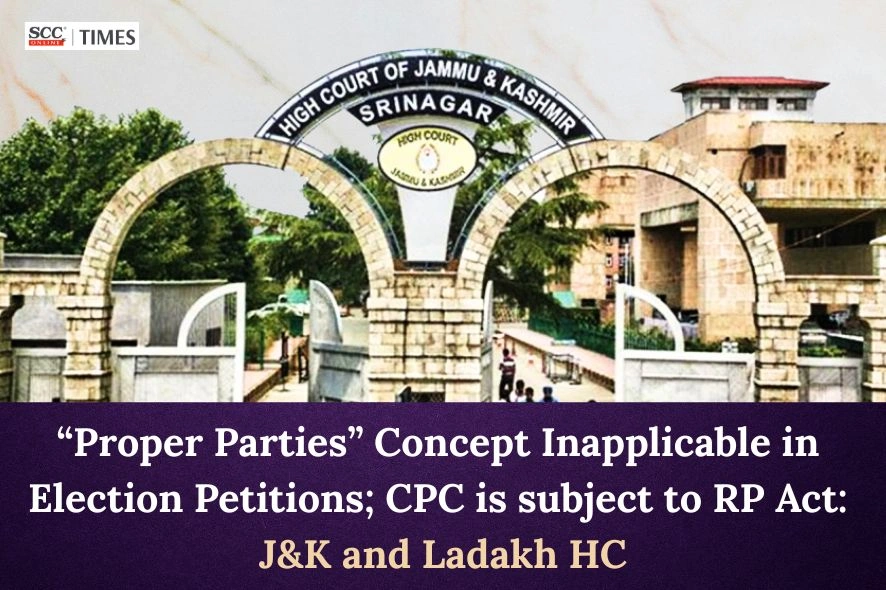
Jammu & Kashmir and Ladakh High Court: While examining the issue of misjoinder of parties in an election petition under the Representation of the People Act, 1951 (RP Act), particularly whether persons other than contesting candidates can be impleaded as respondents, a Single Judge Bench of Sanjay Dhar, J., held that the contest of an election petition is confined only to candidates at the election, and the concept of “proper parties” is inapplicable in election disputes as Civil Procedure Code, 1908 (CPC) is subject to RP Act. While holding that the impleadment of officers and officials amounted to misjoinder, the Court concluded that such defect does not warrant dismissal of the election petition and directed deletion of the improperly impleaded officials from the array of parties.
Also Read: Bombay HC Lays Test for Rejecting Election Petitions
Background
An election petition was instituted challenging the election process, wherein apart from the contesting candidates, several officers and officials were also impleaded as respondents against whom allegations of impropriety were levelled.
The counsel for Respondent 10 contended that there was a misjoinder of parties, since Section 82, RP Act provides that only the contesting candidates must be impleaded as parties to an election petition. However, the petitioner’s counsel argued that as per Section 87, RP Act, the procedure under CPC applies to election petitions, and therefore, all necessary and proper parties to the petition must be impleaded. It was also contended that in terms of sub-clause (ii) of Section 99(1)(a), RP Act, all persons who have been proved at the trial to have been guilty of any corrupt practice have to be named, therefore, it is not only the contesting candidates, who are to be impleaded as parties to the election petition but even those officers and officials, against whom there are allegations of corrupt practice, have to be impleaded as parties as well.
Issue
Whether there is misjoinder of parties? If so, to what effect?
Analysis
The Court opined that Section 82, RP Act provides that in a case where the petitioner, in addition to claiming a declaration that the election of all or any of the returned candidates is void, claim a further declaration that he himself or any other candidate has been elected, all the contesting candidates other than the petitioner have to be impleaded as respondents. However, in a case where no further declaration is claimed by the petitioner, only the returned candidates are to be impleaded as respondents. Further, as per clause (b) of Section 82, a candidate against whom there are allegations of any corrupt practice has to be impleaded as a party to the petition.
The Court relied on Jyoti Basu v. Debi Ghosal, (1982) 1 SCC 691, wherein it was observed that:
“The concept of ‘proper parties’ is and must remain alien to an election dispute under the Representation of the People Act, 1951. Only those may be joined as respondents to an election petition who are mentioned in Sections 82 and 86(4) and no others. However desirable and expedient it may appear to be, none else shall be joined as respondents.”
Further, while rejecting the petitioner’s argument that provisions of CPC would govern the procedure for dealing with an election petition, the Court observed that as per Section 87, RP Act, the procedure prescribed under CPC is applicable to trial of election petitions only subject to the provisions of RP Act. Therefore, any provision of CPC that is inconsistent with Section 82, RP Act, which specifies the persons to be impleaded in an election petition, cannot be invoked to implead a person who is otherwise not liable to be joined as a respondent under Section 82, RP Act.
Dealing with the argument founded on Section 99, RP Act, the Court again referred to Jyoti Basu (supra) and held that the stage of impleading such parties against whom charge of corrupt practices having been committed has been found established would come only after the trial of the case and not at the time of filing of the election petition, as the legislature in its wisdom has thought it proper to permit impleadment of those persons other than the candidates, who are found to have indulged in corrupt practices at the election, only after trial of the case.
The Court noted that the petitioner had impleaded as respondents not only the contesting candidates, but also Respondents 1 to 9, who were the officials. In the election petition, he had levelled several allegations against these respondents, but the Court observed that mere levelling of the allegations would not make them necessary parties to the present petition.
Regarding the effect of misjoinder of parties on the fate of the present petition, the Court relied on B.S. Yadiyurappa v. Mahalingappa, (2002) 1 SCC 301, wherein it was held that the election petition which does not comply with Section 82, RP Act would not necessarily entail its dismissal, and it can be amended by striking out from the array of the parties those who are additionally impleaded. Thus, impleading Respondents 1 to 9 would not result in dismissal of the petition and what is required is an order to strike them out as parties.
Also Read: Delhi HC dismisses Somnath Bharti’s Election Petition
Decision
Accordingly, the Court directed deletion of Respondents 1 to 9 from the array of parties and directed the petitioner to file an amended petition or memo of parties by next date of hearing. The matter was listed for further proceedings on 11 May 2026.
[Harsh Dev Singh v. State (UT of J&K), 2026 SCC OnLine J&K 243, decided on 20-4-2026]
Advocates who appeared in this case:
For the Petitioner: Aseem Kumar Sawhney, Sr. Advocate with Shabab Malik, Advocate and the petitioner-in-person.
For the Respondents: Chetna Manhas, Assisting counsel to Monika Kohli, Sr. AAG, Vilakshan Singh, Advocate.