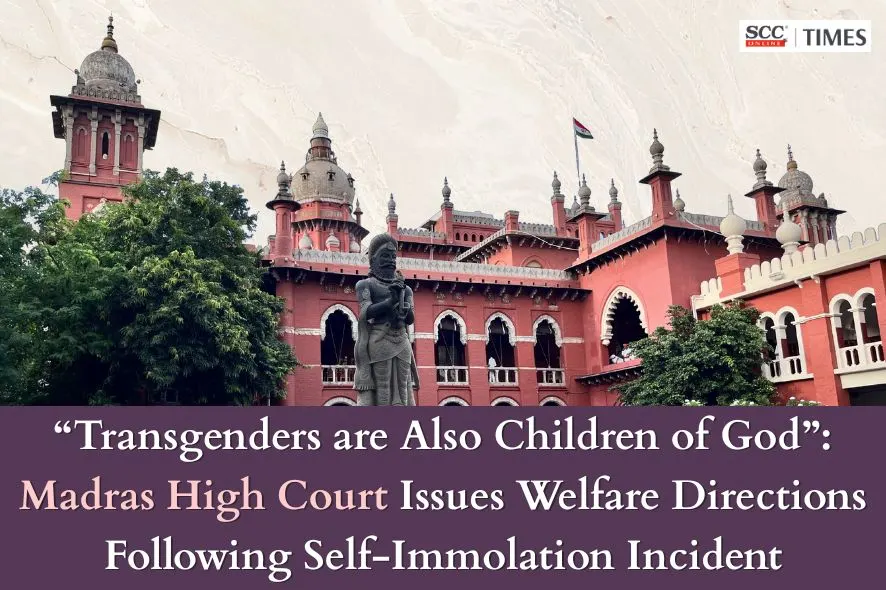
Madras High Court: While considering a petition filed under Section 482, Nyaya Suraksha Sanhita, 2023 (BNSS) for anticipatory bail, a Single Judge Bench of K.K. Ramakrishnan, J., held that the allegations in the FIR were confined to retransmission of news already in circulation and custodial interrogation was not warranted. The Court accordingly granted bail subject to conditions.
At the same time, the Court observed that the tragic self-immolation of a transgender individual demanded a broader judicial response. Emphasising compassion and constitutional obligations, directions were issued to the State Government to frame a comprehensive rehabilitation scheme for transgender persons, ensuring livelihood, education, healthcare, and meaningful inclusion in society. The petition was disposed of with these directions.
Background
The petitioner, a YouTuber, was alleged to have published a video concerning the self-immolation of a transgender individual inside a police station. The video projected that police had collected details of transgender persons based on complaints of coercive money collection. The petitioner contended that he merely retransmitted content already in circulation, removed the video upon realising its implications, and that his mobile phone had already been seized, making custodial interrogation unnecessary.
The prosecution, however, argued that the petitioner propagated false information against the police and Government, creating a misleading impression that grievances of the transgender community were not addressed. It was further submitted that serious allegations existed against certain members of the transgender community regarding illegal extraction of money from the public.
Analysis
The Court emphasised that the allegation against the petitioner was limited to retransmission of the news relating to the self-immolation incident. Even as per the FIR, the accusation was that the petitioner published or shared the said information. It was also evident that similar news had already been disseminated by several other media outlets prior to the petitioner’s transmission. In such circumstances, the Court was inclined to grant anticipatory bail to the petitioner, subject to appropriate conditions.
The Court further highlighted that it could not remain oblivious to the tragic incident of self-immolation, which shocked the judicial conscience. The members of the transgender community continue to face entrenched social stigma, resulting in deprivation of basic dignity and meaningful livelihood opportunities. The Court emphasised that transgenders are also children of God and they are not strangers to our social fabric and the tragedy is not in their birth, it is in the blindness of society which, by exclusion and prejudice, has driven them into conditions of extreme marginalisation, such as being forced to beg on the streets or to engage in activities inconsistent with societal norms merely to secure their livelihood, thereby deepening their vulnerability. The Court observed that there has been a total failure of society’s collective conscience to embrace diversity with empathy.
The Court noted that the absence of patience and tolerance in society cannot be a ground to deny them dignity, and thus they are entitled to be accepted as equals, as members of families, and as participants in the common destiny of this nation. It was further emphasised that where society has failed to cultivate tolerance, compassion, and fraternity, and instead seeks to deflect responsibility, the Court cannot be a mute witness to the indignities suffered by a vulnerable class. Thus, the charter of human dignity obligates the Court to intervene where society has faltered. Judicial compassion must translate into enforceable rights.
The Court also remarked that leaving this matter without issuing further directions for the welfare of transgender persons would amount to a failure on its part to discharge constitutional obligations. The Court expressed profound sorrow in noting that justice had not been adequately ensured to them and took judicial notice of the prevailing socio-economic conditions of transgender persons.
Decision
Consequently, the Court allowed the criminal original petition and directed that the petitioner be released on anticipatory bail in the event of arrest or appearance wherein the order required execution of a bond of Rs 10,000 with two sureties, identity verification through Aadhaar or bank passbook, and compliance with conditions such as daily reporting before the police for fifteen days, refraining from tampering with evidence or influencing witnesses, and not absconding during investigation or trial. The Court also clarified that breach of these conditions would empower the Magistrate or Trial Court to take appropriate action, and if the accused absconds thereafter, a fresh FIR could be registered under Section 269 BNSS.
Further, the Court directed the State Government to frame a comprehensive rehabilitation scheme for transgender persons at the Taluk level, ensuring avenues for self-employment, sustainable livelihood, education, healthcare, and meaningful inclusion in society. The Chief Secretary of Tamil Nadu was instructed to coordinate with all relevant departments for effective and time-bound implementation.
Accordingly, the matter was listed on 3 August 2026 for reporting compliance.
[V. Sarathkumar v. State of T.N., Crl OP (MD) No. 5185 of 2026, decided on 20-4-2026]
Advocates who appeared in this case:
For the Petitioner: Thayumanasundaram for K. Bhuvaneshwaran
For the Respondent: P. Kottaichamy, Government Advocate