








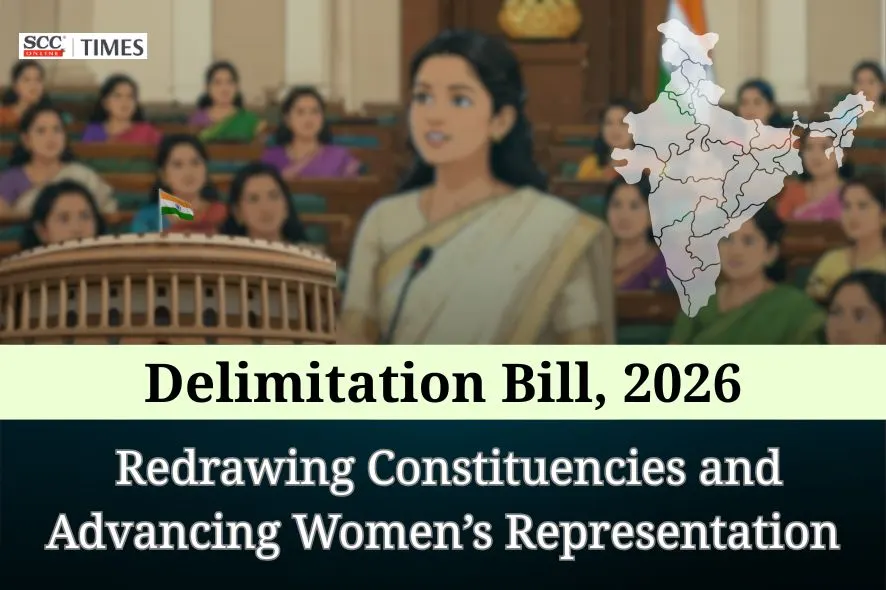
On 16 April 2026, the Delimitation Bill, 2026 was introduced in Lok Sabha with the objective of redefining electoral representation in India in accordance with contemporary demographic realities and recent constitutional amendments.
Key Takeaways of the Delimitation Bill, 2026:
-
The Bill proposes a comprehensive readjustment of Lok Sabha and State Assembly seats and the delimitation of territorial constituencies for elections across States and Union Territories, while repealing and replacing the Delimitation Act, 2002.
-
The primary objectives of the Bill are threefold:
-
Readjustment of seats in the Lok Sabha and State Legislative Assemblies based on the latest published census figures.
-
Redrawing of constituency boundaries to ensure population balance, geographical compactness, and administrative convenience.
-
Implementation of one-third reservation for women, including women belonging to Scheduled Castes (SCs) and Scheduled Tribes (STs), as mandated by newly inserted constitutional provisions.
-
-
Under Section 3 the Bill aims to provide for the constitution of an independent Delimitation Commission, consisting of:
-
A Chairperson who is or has been a Judge of the Supreme Court,
-
The Chief Election Commissioner or an Election Commissioner nominated by him, and
-
The State Election Commissioner of the concerned State, ex officio.
-
-
Section 8 is a key provision that proposes to empower the Delimitation Commission to determine Lok Sabha and State Assembly seat allocation, including reservations for SCs, STs, and nearly one-third of seats for women through rotational reservation to ensure fairness.
-
Section 9 lays down the guiding principles for delimitation, requiring constituencies to be geographically compact, aligned with administrative boundaries, and structured so that each Assembly constituency lies within a Parliamentary constituency, with reserved seats for SCs, STs, and women placed on the basis of population concentration and rotational fairness.
-
Section 10 proposes that all orders of the Delimitation Commission be published in the Gazette of India and the State Gazettes with wide publicity, and once so published, such orders shall have the force of law and be immune from judicial challenge, ensuring certainty and finality in the delimitation process.
Overall, the Delimitation Bill, 2026 seeks to establish a new legal framework for readjusting parliamentary and assembly constituencies based on the latest census figures, while also operationalising one-third reservation of seats for women in legislatures.
[Delimitation Bill, 2026, introduced on 16-4-2026]








0 replies