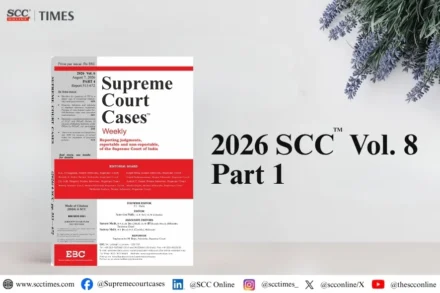
2026 SCC Vol. 5 Part 5: Key Supreme Court Cases on Arbitration, Constitution and IBC
Explore the latest Supreme Court Cases in 2026 SCC Vol. 5 Part 5 on international commercial arbitration, Panchayat elections, corporate debtor, and more.
“…the petitioner, instead of availing the statutory remedy available to him, has chosen to file a petition under Article 227 of the Constitution of India.”
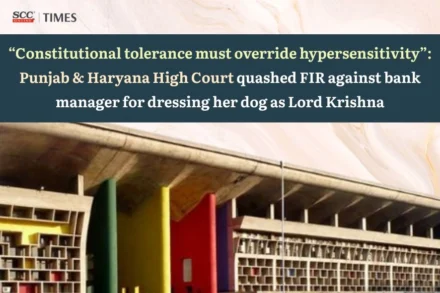
“The case in point is an exemplary instance of misconstruction of intent and a parochially narrow understanding of religious philosophy.”
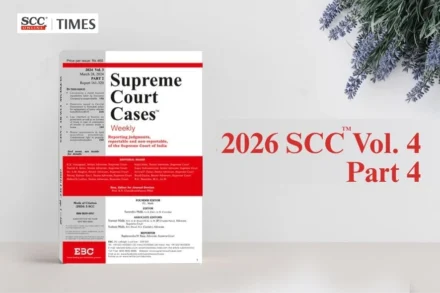
Explore the latest Supreme Court Cases in 2026 SCC Vol. 4 Part 4 on reference to arbitration, appointment of district judges, electricity distribution, tariff revision, and more.
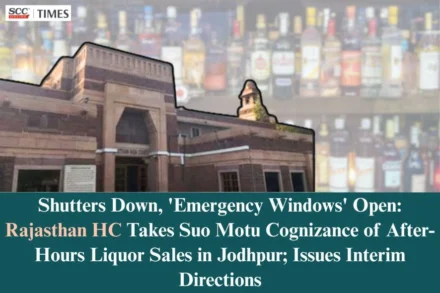
A detailed investigative report published in Rajasthan Patrika titled “शटर डाउन… ‘इमरजेंसी विंडो’ चालू: रात 8 बजें बाद भी धड़ल्ले से बिक रही शराब, supported by photographs, timestamps and field verification, indicated that despite statutory closing hours applicable to liquor vends, liquor sale allegedly continued openly after 8.00 p.m. through concealed openings, restricted access windows and partially shuttered premises at various locations within Jodhpur.
The makers of the Constitution of India advocated for Separation of Power and demarcated the limits, roles and functions of every organ
In Aashirward Films v. Union of India, (2007) 6 SCC 624, Supreme Court laid down that a taxing statute for the reasons of functional expediency and even otherwise, can pick and choose to tax some; so long as the classification is reasonable.
Supreme Court was quick to clarify that if prosecution was unable to prove its case on its own legs, then it won’t be able to derive advantage from the weakness of the defence and the Court would not be able to convict the accused on the strength of the evidence in the form of reply to the suggestions made by the defence counsel to a witness.
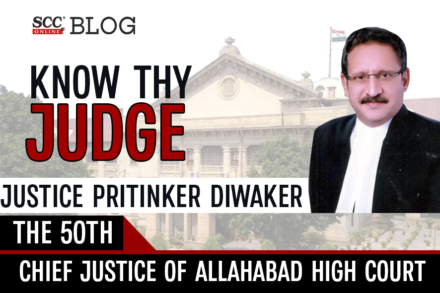
Prior to being appointed as Allahabad High Court’s 50th Chief Justice, Justice Pritinker Diwaker had been working as the High Court’s Acting Chief Justice after elevation of former Chief Justice, Rajesh Bindal
by Tarun Jain†
Cite as: 2023 SCC OnLine Blog Exp 20
Supreme Court directs appointment of Chief Election Commissioner and Election Commissioners on advise of the committee consisting of the Prime Minister, leader of opposition and the Chief Justice of India
Applicant submitted that the 2018 judgment may cause instability within the defence personnel’s services since they function in peculiar conditions who are separated from their families for long durations when posted on borders under challenging conditions, in view of the 2018 judgment, there will always be a concern in their minds about the family indulging in untoward activity.
Supreme Court said that the conduct of the judge and her/his decisions must reflect and show independence, adherence to the democratic and constitutional values. This is necessary as the judiciary holds the centre stage in protecting and strengthening democracy and upholding human rights and the Rule of law.
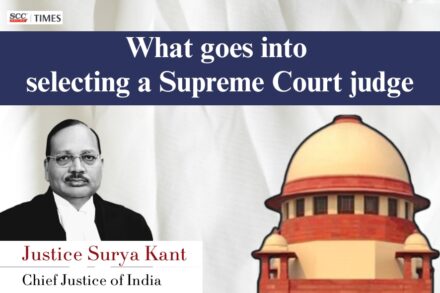
Born on 10-02-1962 in Hisar, Justice Surya Kant, has the distinction to be appointed as the youngest Advocate General of Haryana. Before being elevated as a Supreme Court Judge, Justice Surya Kant served as a Judge in the Punjab and Haryana High Court and as Chief Justice of Himanchal Pradesh High Court.
Imposing a prohibitory ban on merchant establishments and establishments that provide livelihood is contrary to the enshrined principles under Article 21.
by K. Vaitheeswaran*
Gujarat High Court denied entry to an American Passport holder who has been convicted as a sex offender and held that petition filed by the petitioner's father on petitioner's behalf, invoking Articles 14 and 19 of the Constitution of India, is not maintainable because life and liberty of a person not on the shore of India, cannot be invoked on his behalf when the individual himself is not in India
The Delhi High Court held that the engagement of BSNL VRS-2019 retirees in any Central Public Sector Enterprises/Government department on contractual/consultancy basis, for which the retired employees on superannuation in due course were eligible for consideration, was not in violation of Clause 8 (iii) of BSNL Voluntary Retirement Scheme-2019.