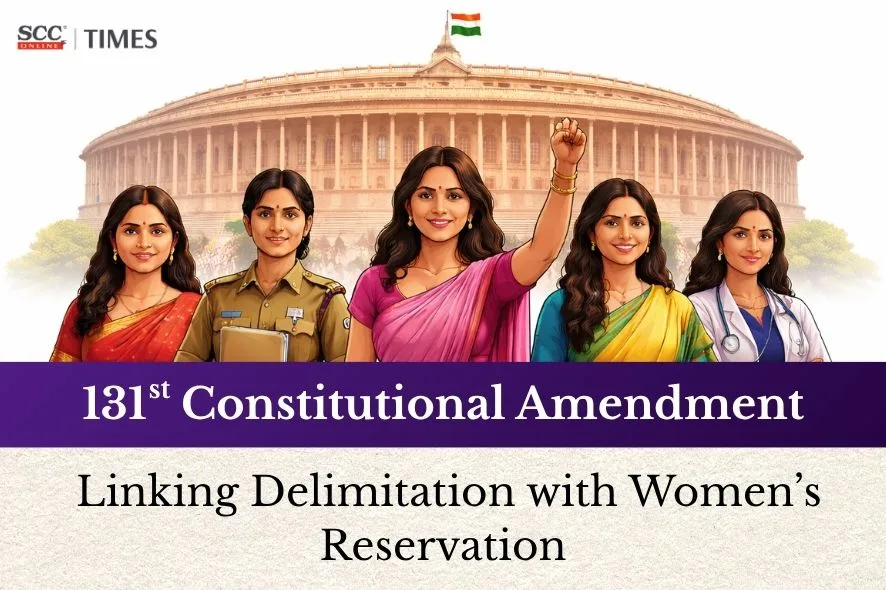
On 16 April 2026, during a special parliamentary session, the Constitution (One Hundred and Thirty First Amendment) Bill, 2026, was introduced in the Lok Sabha, marking a significant step towards enabling fresh delimitation and operationalising women’s reservation in legislatures.
Background:
Articles 82 and 170 of the Constitution of India mandate that parliamentary and legislative assembly constituencies be periodically readjusted after every census to reflect changes in population.
However, constitutional amendments enacted in 2001 and 2003 froze the allocation of seats on the basis of the 1971 Census, permitting only limited redrawing of constituency boundaries. While this freeze was intended to encourage population control and ensure political stability, it has over time created significant imbalances in representation due to population growth, migration, and rapid urbanisation.
Furthermore, the 106th Constitutional Amendment, which provides for one third reservation of seats for women, could not be implemented without a fresh delimitation exercise.
This One Hundred and Thirty First Amendment Bill was therefore introduced to revive the process of delimitation based on the latest census figures and to enable the timely implementation of women’s reservation, thereby making representative system more equitable, inclusive, and responsive to present demographic realities.
Key Points of the Constitution (One Hundred and Thirty First Amendment) Bill:
-
The amendment seeks to rationalise population-based representation by enabling a fresh delimitation of seats after the 2026 census and by operationalising women’s reservation in Parliament and State Legislative Assemblies through the removal of constitutional freezes.
-
It proposes to revise the definition of “population” under the Article 55 for Presidential elections, linking it to census figures as may be determined by Parliament, instead of the 1971 census.
-
Amendment to the Article 81 proposes to enhance democratic representation by increasing the maximum strength of the Lok Sabha to 815 members from States and 35 from Union Territories, along with updating the population criteria for seat allocation.
-
It seeks to amend Article 82 to remove the existing freeze on the readjustment of parliamentary constituencies and to explicitly authorise delimitation on the basis of the latest published census figures.
-
Article 170 is proposed to be amended to permit the readjustment of seats and constituencies in State Legislative Assemblies in accordance with updated population data.
-
The amendment to Article 330 seeks to align the reservation of seats for Scheduled Tribes in the Lok Sabha with revised population-based delimitation.
-
It aims to revise clauses (3A) and (3B) of Article 332 to update reservation provisions for Scheduled Tribes in State Legislative Assemblies, while retaining special constitutional safeguards for specified northeastern States.
-
Article 334A is proposed to be substituted to operationalise one third reservation for women in the Lok Sabha, State Legislative Assemblies and specified Union Territories after delimitation, for fifteen years from the commencement of the 106th Amendment, with rotational allocation of seats.
[Constitution (131st Amendment) Bill, 2026, introduced on 16-4-2026]