
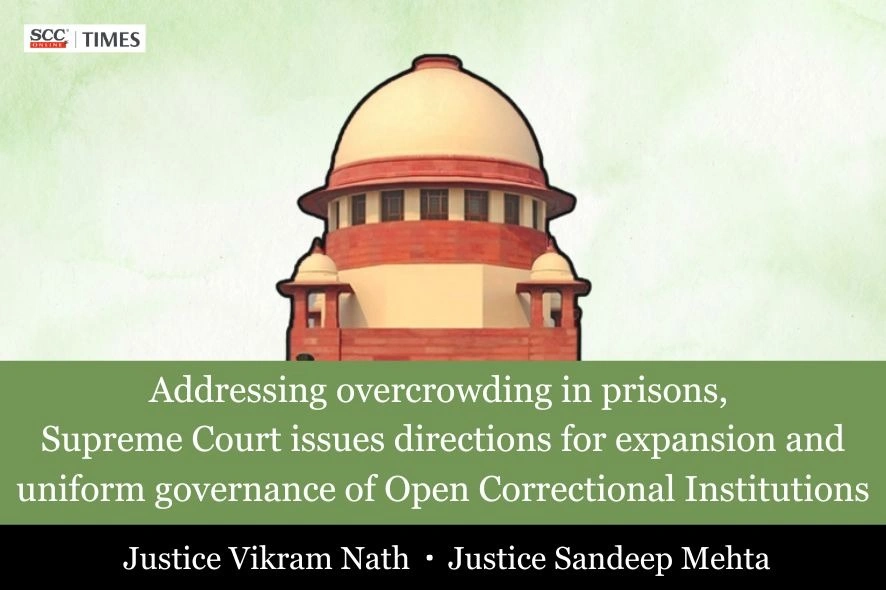
Supreme Court: The writ petition, instituted under Article 32 of Constitution, raised serious concerns regarding overcrowding in prisons and the resulting inhuman conditions of detention, which were asserted to violate the fundamental rights of prisoners. A Division Bench of Vikram Nath and Sandeep Mehta,* JJ., held that Open Correctional Institutions (OCIs) embody this constitutional promise by recognising that trust, responsibility and graded liberty are essential for meaningful reform.
The Court issued following operative directions to ensure that the constitutional mandate of equality, non-discrimination and the right to live with dignity, as guaranteed under Articles 14, 15 and 21, Constitution of India, is meaningfully realised in the administration of prisons across the country —
-
States/UTs to establish and expand OCIs in a time-bound manner.
-
No reduction of existing open-prison land or facilities.
-
Formulation of uniform minimum standards for eligibility, wages, healthcare, education and vocational training and family integration.
-
Inclusion of women prisoners and creation of dedicated facilities.
-
Rationalisation of eligibility criteria based on reformative potential.
-
Diversification of work and skill training aligned with contemporary employment.
-
Regular monitoring and compliance reporting.
Introduction
The petitioner sought directions for latest prison-wise occupancy data, permanent institutionalisation of High Powered Committees for monitoring overcrowding, mechanisms for transfer and release of prisoners from congested prisons and periodic reporting to High Courts to ensure humane conditions.
Initially the writ petition heard along with Contagion of COVID 19 Virus in Prison, In re, (2023) 19 SCC 515, but was later de-tagged. The Court identified open prisons as a viable and sustainable solution to overcrowding, appointed amici curiae, and directed a nationwide data-collection exercise through NALSA. The adjudication was bifurcated into legal aid to prisoners (already decided in Suhas Chakma v. Union of India, (2024) 16 SCC 1), and the framework and functioning of OCIs (subject matter of the present judgment).
The Union relied upon the Model Prison Manual, 2016 and the Model Prisons and Correctional Services Act, 2023 and contended that since “prisons” fall in the State List, the primary responsibility for establishing and expanding OCIs rests with the States and Union Territories. Despite repeated opportunities, States of Telangana, Haryana and Madhya Pradesh failed to furnish complete data.
Based on amicus reports, State responses and the BPR&D study, it was recorded that OCIs occupancy in many States ranged from 6% to 44%, while closed prisons remained overcrowded; absence of OCIs in several States and all Union Territories (except Delhi); in most States women were either ineligible or not transferred in practice; prisoners were required to spend 4 to 12 years, and up to 21 years in some States, in closed prisons before consideration; vocational training was not aligned with market-relevant skills. At the same time, the States of Rajasthan, Maharashtra and Kerala models demonstrated that OCIs reduce costs drastically, improve mental health, facilitate family life and promote self-reliance and reintegration.
International and Statutory Framework
The United Nations Standard Minimum Rules for the Treatment of Prisoners, 2015, (commonly known as the Nelson Mandela Rules), particularly Rule 4 and Rule 89, which recognises that the purposes of imprisonment can be achieved only if incarceration facilitates reintegration. Open prisons, which rely on self-discipline rather than physical security, were recognised internationally as providing conditions most conducive to rehabilitation.
Chapter 23, Model Prison Manual, 2016 (Model Prison Manual), and the Model Prisons and Correctional Services Act, 2023 (Model Prisons and Correctional Services Act) embodies a reformative philosophy and recognises OCIs as institutions intended to restore dignity, self-reliance and social responsibility. However, since “prisons and persons detained therein” fall under the State List, the responsibility of implementation lies primarily with States and Union Territories.
Constitutional Framework
The Court stated that this Court has, over decades, consistently articulated the prisoners’ rights jurisprudence under Article 21 that views incarceration not merely as punitive deprivation of liberty, but as an opportunity for reformation, rehabilitation and restoration of human dignity and traced it through landmark decisions including, D. Bhuvan Mohan Patnaik v. State of A.P., (1975) 3 SCC 185; Mohammed Giasuddin v. State of A.P., (1977) 3 SCC 287; Dharambir v. State of U.P., (1979) 3 SCC 645 and Francis Coralie Mullin v. Administrator, UT of Delhi, (1981) 1 SCC 608. The Court noted that “fundamental rights do not flee the person as he enters the prison,” and emphasised that incarceration does not denude a person of dignity and prisons must be “correctional houses, not cruel iron aching the soul.”
“The guarantee of life and personal dignity under Article 21 of the Constitution of India extends beyond the prison gates and obliges the State to ensure that incarceration does not degenerate into inhumanity.”
The Court asserted that “prison reform is not a matter of executive grace but a constitutional obligation… the transformation of prisons from sites of suffering to spaces of opportunity is thus integral to the promise of justice under the Constitution.” The Court further emphasised that OCIS represent a constitutionally aligned model of incarceration rooted in trust, responsibility, gradual reintegration and human dignity.
Court’s Analysis
At the outset, the Court reminded that “the strength of a constitutional democracy is tested not merely by the liberties it guarantees in abstraction, but by the manner in which it treats those who stand at its margins, including persons deprived of their liberty.” It reiterated that prisons are not enclaves where constitutional values are suspended and that the guarantee of life and personal dignity under Article 21 “extends beyond the prison gates”.
The Court located the present proceedings within its continuing effort, beginning with Inhuman Conditions in 1382 Prisons, In re, (2018) 16 SCC 636, to address systemic infirmities in prison administration and to operationalise the framework of OCIs as a reformative and decongestive mechanism. It was asserted that OCIs must not be treated as “peripheral experiments” but must be “firmly embedded as integral components of a humane, reformative and constitutionally compliant correctional system.”
Under-utilisation and absence of OCIs in several States
While noting the deeply concerning figures emerging from the National Crime Records Bureau Report titled “Prison Statistics India, 2023”, i.e., prisons across the country are operating at an occupancy level of 120.8%, with several States exceeding 150% occupancy level, the Court stated that chronic overcrowding, absence of humane living conditions and lack of rehabilitative opportunities were held to strike at the core of this constitutional promise and to demand a sustained institutional response rather than episodic measures.
The Court further noted that per-prisoner expenditure in open prisons (approximately ₹49.60 per day in Rajasthan) was substantially lower than in closed prisons (₹333.12 per day), demonstrating fiscal prudence in addition to rehabilitative efficacy.
The Court noted a “pervasive trend of under-utilisation” wherever OCIs existed. In several jurisdictions, occupancy levels remained strikingly low despite chronic overcrowding in closed prisons. At the same time, a large number of States and all Union Territories (save the NCT of Delhi) reported a complete absence of such institutions.
Despite repeated judicial directions and the availability of model frameworks under the Model Prison Manual, 2016 and the Model Prisons and Correctional Services Act, 2023, several States and Union Territories had either failed to establish such institutions altogether or had allowed existing facilities to remain grossly under-utilised.
The Court emphasised that “Reformation, rehabilitation and reintegration must lie at the heart of the criminal justice system. The constitutional guarantee of the right to life under Article 21, as interpreted by this Court, encompasses within its ambit the obligation of the State to facilitate rehabilitation and enable prisoners to lead a life of dignity and normalcy.” Therefore, it was held that the proper utilisation of existing capacities of OCIs is essential to fulfil these rehabilitative goals.
Exclusion and under-representation of women prisoners
The Court noted a deeply troubling pattern of exclusion of women prisoners from access to OCIs. It was noted that in several States women prisoners were either expressly declared ineligible for transfer to OCIs or were not, in practice, transferred at all. In certain jurisdictions, although eligibility was formally recognised, the quantitative data revealed that no woman had been shifted to an open facility.
The Court held that this systemic exclusion of women prisoners from having access to the OCIs is “plainly contrary to both domestic norms and internationally accepted standards governing prison administration.” The Court noted that Chapter 23, Model Prison Manual and Rule 2, Nelson Mandela Rules, nowhere excludes women from being eligibile for transfer to OCIs and mandates that prison rules shall be applied impartially, without discrimination on grounds of sex or any other status. Further, Rukes 40 and 45, United Nations Rules for the Treatment of Women Prisoners and Non-Custodial Measures for Women Offenders, 2010 (the Bangkok Rules) leave no room for doubt that denial of OCI access to women prisoners is inconsistent with internationally recognised obligations and reformative prison administration, and “cannot be reconciled with the constitutional vision of equality and dignity that animates our criminal jurisprudence.” The Court held this systemic exclusion to be incompatible with Articles 14 and 21.
“To deny women this right on speculative or generalised security grounds is nothing but an attempt to substitute administrative convenience for constitutional obligation. The State must, therefore, evolve gender-sensitive and security-conscious mechanisms that facilitate and enable, rather than frustrate, women’s access to OCIs, for constitutional obligations cannot be made contingent upon institutional convenience.”
The Court emphasised that reformative justice cannot be selectively applied. The absence of facilities for women and the failure to evolve gender-sensitive eligibility criteria amounted to denial of equal access to rehabilitative opportunities and reinforced structural invisibilisation of women within the prison system.
Strict eligibility criteria and inadequate rehabilitative avenues
The Court found that in many States prisoners were required to undergo prolonged incarceration in closed prisons, ranging from 4 to 12 years and extending up to 21 years in certain jurisdictions, before being considered for transfer. It held such criteria, based on fixed periods of sentence or the gravity of offence, to be inconsistent with the reformative philosophy underlying open institutions.
The Court emphasised that eligibility must be based on individualised assessment of conduct, progress in reformation, and capacity for responsible self-discipline, rather than rigid temporal thresholds tied solely to the gravity of offence or number of years served.
It further noted that in many States, vocational training remained confined to agriculture or traditional labour, with limited alignment to contemporary employment skills. Such narrow programming diluted the transformative potential of OCIs and reduced them to “agricultural camps” rather than institutions of structured rehabilitation.
“Reformation cannot be achieved through toil alone; it must be accompanied by structured opportunities that equip prisoners with skills relevant to contemporary social and economic realities.”
The Court further noted that family life and social integration remain severely constrained in many States as they do not permit marriage, cohabitation or residence of family members with OCI inmates, and in most States, families and children are not allowed to reside within OCIs. It opined that “this erosion of familial ties undermines the rehabilitative purpose of OCIs, as reintegration into society is intrinsically linked with preservation of family bonds.”
The Court noted that Model Prison Manual and the Model Prisons and Correctional Services Act contains detailed provisions relating to prisoners’ healthcare, mental health, education, vocational training, skill development, recreation and social reintegration, however, “the spirit and substance of these model frameworks have not been translated into practice in large parts of the country.”
“Failure to give effect to these frameworks does not merely reflect administrative apathy, but results in a substantive erosion of the constitutional guarantee under Article 21, which mandates that incarceration shall not extinguish the right to live with dignity or the opportunity for reformation.”
The Court emphasised on the urgent need to reorient eligibility criteria towards reformative indicators and to substantially strengthen rehabilitative infrastructure within OCIs, so that they operate as constitutionally compliant institutions of correction, dignity and social reintegration.
Lack of uniform governance standards
The Court found significant inter-State disparities in wages, healthcare facilities, educational access, family integration policies, and disciplinary consequences. Wages varied drastically, healthcare infrastructure was often limited to out-patient facilities and in several States, reversion to closed prisons permanently disqualified prisoners from future OCI eligibility.
The Court held that such lack of uniformity risks arbitrariness and inequality in the enjoyment of reformative opportunities. While the subject of “prisons and persons” falls within the State List, constitutional guarantees of dignity, equality and rehabilitation.
The Court observed that both the Model Prison Manual and the Model Prisons and Correctional Services Act attempt to promote uniform reformative standards. However, these instruments must be translated into binding statutory regimes and enforceable administrative practices to realise their reformative vision.
Cost-effectiveness and the imperative for expansion
As per data placed on record, the Court observed the per-prisoner expenditure in open prisons was substantially lower than in closed prisons. The figures “highlight not merely the rehabilitative efficacy of Open Correctional Institutions, but also their marked fiscal prudence and administrative sustainability.”
The Court held that expansion of OCIs is constitutionally aligned, penologically sound, and economically rational. It found the failure to meaningfully adopt and expand such cost-effective and humane alternatives to overcrowding in prisons and reformative theory of punishment as indefensible,
“Investment in OCIs aligns with the principles of efficient governance, fiscal prudence, and transformative justice, ensuring that correctional policy advances both economic sustainability and the rehabilitative objectives of the criminal justice system.”
Court’s Directions
The Court once again stated that “Prisoners do not cease to be bearers of constitutional rights upon incarceration, and the State’s obligation to treat them with humanity, fairness and compassion stands heightened where liberty is lawfully curtailed” and issued the following directions —
-
Establishment, Expansion and Non-Reduction of OCIs
-
Inclusion of Women Prisoners
-
Rationalisation of Eligibility Criteria
-
Common Minimum Standards
-
Diversification of Work and Skill Development
-
Healthcare and Welfare Infrastructure
-
Monitoring, Compliance and Accountability
All States and Union Territories were directed to take concrete and time-bound steps for the establishment and expansion of OCIs. Existing open-air camps and open prisons were ordered not to be reduced in area or capacity under any circumstances.
Where OCIs already exist, the States were directed to ensure their optimal utilisation by revisiting restrictive eligibility norms and evolving transparent, objective and reform-oriented criteria for transfer.
The Court made it clear that the creation and strengthening of OCIs is not discretionary but forms part of the State’s constitutional obligation to alleviate overcrowding and promote rehabilitative justice.
The States and Union Territories were directed to frame appropriate policies enabling transfer of eligible women prisoners to OCIs; establish dedicated facilities or suitable infrastructure for women; remove blanket exclusions inconsistent with constitutional guarantees and frame gender-sensitive eligibility norms. The Court emphasised that exclusion of women from reformative regimes is impermissible and must be rectified through affirmative institutional measures.
The Court directed that eligibility norms for transfer to OCIs must be based on conduct, self-discipline, progress in reformative programmes, potential for reintegration and not on rigid or mechanically applied periods of incarceration.
Further, direction to avoid unduly prolonged mandatory incarceration in closed prisons and align with the reformative philosophy embodied in Chapter 23 of the Model Prison Manual.
The Union of India was directed to evolve, in consultation with States and relevant stakeholders, common minimum standards for living conditions and sanitation; wages and remuneration; access to healthcare; educational and vocational training facilities; family contact and integration policies and fair and proportionate disciplinary procedures. These standards were to ensure uniformity consistent with constitutional guarantees while allowing for local adaptation.
States were directed to diversify skill development programmes beyond agriculture and traditional labour, aligning vocational training with contemporary employment and market-relevant skills, so that prisoners may “lead a law-abiding and self-supporting life” upon release.
Adequate medical facilities were to be established within OCIs to avoid routine reversion to closed prisons for treatment. Educational facilities for prisoners, their families and children residing with them were to be progressively expanded.
The Court required periodic reporting and monitoring to ensure compliance with its directions. Non-compliance, it cautioned, would invite further judicial scrutiny. The responsibility for implementation was placed squarely upon the States and Union Territories, consistent with their constitutional domain over prisons.
[Suhas Chakma v. Union of India, 2026 SCC OnLine SC 317, decided on 26-2-2026]
*Judgment by Justice Sandeep Mehta
Advocates who appeared in this case:
Mr. K. Parameshwar, Sr. Adv. (AC), Ms. Kanti, Adv., Mr. M.V. Mukunda, Adv., Ms. Raji Gururaj, Adv., Mr. Shreenivas Patil, Adv., Ms. Veda Singh, Adv., Mr. Prasad Hegde, aDv., Mr. Sai Kaushal Nuthalapati, Adv. Mr. Adit, Adv., Mr. Vijay Hansaria, Sr. Adv. (AC)
Mr. Satish Pandey, AOR, Ms. Jay Jaimini Pandey, Adv., Mr. Dwaipayan Chatterjee, Adv., Ms. Nitika Dubey, Adv., Ms. Sakshi Dubey, Adv., Counsel for the Petitioners
Mr. Suryaprakash V Raju, A.S.G., Mr. Rajan K Chourasia, Adv., Mr. Kanu Agrawal, Adv., Mr. Raghav Sharma, Adv., Ms. Priyanka Terdal, Adv., Mr. Zoheb Hussain, Adv., Mr. Arvind Kumar Sharma, AOR, Mrs. Aishwarya Bhati, A.S.G., Mr. Mukesh Kumar Maroria, AOR, Ms. Shivika Mehra, Adv., Mr. Ishaan Sharma, Adv., Mr. Sarthak Karol, Adv., Ms. Astha Singh, Adv., Mr. Jagdish Chandra Solanki, Adv., Mr. Ketan Paul, Adv., Mr. Mayank Pandey, Adv., Mr. Jaideep Gupta, Sr. Adv., Mr. Nishe Rajen Shonker, AOR, Mrs. Anu K Joy, Adv., Mr. Alim Anvar, Adv., Mr. Santhosh K, Adv., Mrs. Devika A.l., Adv., Mr. Riddhi Bose, Adv., Ms. Rachita Chawla, Adv., Ms. Sampriti Baksi, Adv., Ms. Rishi Agrawal, Adv., Mr. Shiv Mangal Sharma, A.A.G., Mr. Saurabh Rajpal, AOR, Ms. Saubhagya Sundriyal, Adv., Mr. Vinay Kumar Singh, Adv., Dr. Hemant Gupta, A.A.G., Mr. Samar Vijay Singh, AOR, Ms. Payal Gupta, Adv., Ms. Sabarni Som, Adv., Mr. Rony John, Adv., Mr. Aman Dev Sharma, Adv., Ms. Rashmi Nandakumar, AOR, Mr. Guntur Pramod Kumar, AOR, Ms. Prerna Singh, Adv., Mr. Keshav Singh, Adv., Mr. Dhruv Yadav, Adv., Ms. Eliza Barr, Adv., Ms. Disha Singh, AOR, Mr. Shuvodeep Roy, AOR, Mr. Deepayan Dutta, Adv., Mr. Saurabh Tripathi, Adv., Mr. Prashant Kumar Umrao, AOR, Ms. Swati Ghildiyal, AOR, Ms. Neha Singh, Adv., Mr. Akshay Girish Ringe, AOR, Mr. Kartikeya Rastogi, D.A.G., Ms. Inderdeep Kaur Raina, Adv., Mr. Ranjeet Saw, Adv., Ms. Tamanna Kavdia, Adv., Mr. Pashupathi Nath Razdan, AOR, Mr. Anand Dilip Landge, Adv., Mr. Siddharth Dharmadhikari, Adv., Mr. Aaditya Aniruddha Pande, AOR, Mr. Shrirang B. Varma, Adv., Mr. Pukhrambam Ramesh Kumar, AOR, Mr. Karun Sharma, Adv., Ms. Anupama Ngangom, Adv., Ms. Rajkumari Divyasana, Adv., Mr. Anando Mukherjee, AOR, Mr. Shwetank Singh, Adv., Ms. Pooja Singh, Adv., Ms. K. Enatoli Sema, AOR, Mr. Amit Kumar Singh, Adv., Ms. Chubalemla Chang, Adv., Mr. Prang Newmai, Adv., Ms. Yanmi Phazang, Adv., Mr. Akshay Amritanshu, AOR, Mr. Sarthak Srivastava, Adv., Mr. Mayur Goyal, Adv., Mr. Sameer Abhyankar, AOR, Mr. Rahul Kumar, Adv., Mr. Aakash Thakur, Adv., Mr. Maha Singh Rathore, Adv., Mr. Amit Kumar Chawla, Adv., Mr. Hitesh Kumar Sharma, Adv., Mr. Akhileshwar Jha, Adv., Mr. Varun Varma, Adv., Mr. Mahi Pal Singh, Adv., Mr. Anupam Kumar, Adv., Mr. Sabarish Subramanian, AOR, Ms. Devina Sehgal, AOR, Mr. Dhananjay Yadav, Adv., Mr. Yatharth Kansal, Adv., Mr. Srikanth Varma Mudunuru, Adv., Mr. Pradeep Misra, AOR, Mr. Daleep Dhyani, Adv., Mr. Manan Verma, AOR, Mr. Sumit Kumar, Adv., Mr. Pranjal Tandon, Adv., Ms. Mansi Diwakar, Adv., Mr. Kunal Mimani, AOR, Mr. Tadimalla Bhaskar Gowtham, Adv., Mr. Bhuvan Kapoor, Adv., Mr. Varun Chugh, Adv., Mr. Krishna Kant Dubey, Adv., Mr. Ankit Raj, Adv., Ms. Indira Bhakar, Adv., Mr. Yogesh Vats, Adv., Mr. Santosh Ramdurg, Adv., Mr. Shreekant Neelappa Terdal, AOR, Counsel for the Respondents
Buy Constitution of India HERE