Bombay High Court: In an appeal wherein the appellant-husband challenged his conviction and sentence under Sections 498-A and 306 of the Penal Code, 1860 (‘IPC’), passed by the Additional Sessions Judge, Pune, on the ground that the evidence on record did not establish cruelty or abetment to suicide beyond reasonable doubt, a Single Judge Bench of M. M. Sathaye, J., quashed the judgment of conviction passed by the Additional Sessions Judge, and held that the necessary ingredient of cruelty likely to drive a woman to suicide or harassment to coerce unlawful demands was not clearly spelt out, much less proved. The Court noted that no instance of instigation was attributable to the husband and that there was also no proximate link between the event of suicide and the alleged demand for money.
Background:
The case arose from the death of a woman who was married to the husband on 25-05-1997. Following the marriage, she was allegedly subjected to cruelty by the husband and his mother, including repeated demands for money from her parents and a sewing machine. On 13-11-1997, she left the matrimonial home and was reported missing by the husband the same day. Her body was later found floating in the river on 17-11-997, after which her father lodged a formal complaint.
The husband contended that he promptly reported his wife missing and noted that she left her ornaments at home. He argued that the essential elements of abetment to suicide, particularly the proximity between the alleged acts and the suicide, were not established. It was further submitted that the ill-treatment described by the wife’s parents lacked the severity required to constitute cruelty under Section 498-A IPC.
The deceased’s father testified that his daughter had mentioned demands for money and a sewing machine, and that he paid Rs 1,000 before Diwali 1997. He described her as unhappy and often weeping during that period. He further admitted that she expressed a desire for a better-looking husband and a more comfortable home and acknowledged that he did not report any cruelty to the police during the initial inquiry. The mother corroborated her daughter’s emotional distress and the alleged demands but conceded that she too had not informed the police initially and denied seeking advice from any women’s organisation. The neighbour, meanwhile, confirmed discovering the body and informing the father, however, he was not cross-examined.
Analysis and Decision:
The Court observed that apart from the payment of Rs 1000 around Diwali 1997, there was no other specific instance of money being paid to the husband. The Court further noted that except for the wife being unhappy and weeping, no witness including the parents stated any specific incident of physical or mental cruelty.
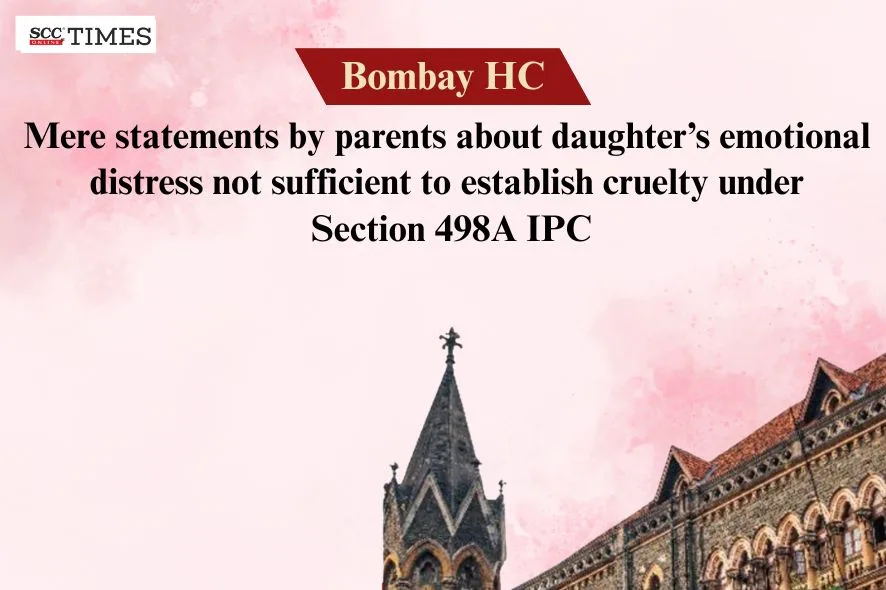
In such circumstances, the Court held that the necessary ingredient of cruelty likely to drive a woman to suicide or harassment to coerce unlawful demands was not clearly spelt out, much less proved. It was emphasised by the Court that mere statements that the deceased daughter used to be unhappy and used to weep were not sufficient to conclude beyond reasonable doubt that there was harassment or conduct of such nature and degree that it would drive a woman to commit suicide, or sufficient to establish cruelty as contemplated under Section 498-A IPC beyond reasonable doubt.
The Court noted that the Panch witness turned hostile, leaving no independent support for the seizure of the sewing machine. Even assuming the machine belonged to the father, the Court found no sufficient evidence to conclude it was given due to illegal demand. The Court emphasised that Section 107 IPC requires instigation, conspiracy, or intentional aid in committing suicide. In that case, the Court found no evidence of instigation or conspiracy by the husband.
Consequently, the Court held that the Trial Court erred in concluding persistent demands and mental torture. The Court found no evidence of the deceased realising her father couldn’t meet demands or deciding to end her life due to that. The Court relied on M. Mohan v. State, (2011) 3 SCC 626, wherein it was held that abetment requires commission of direct or active act by accused which led to the deceased to commit suicide seeing no other option and such act must be intended to push the victim into committing suicide. The Court noted that no instance of instigation was attributable to the husband and there was also no proximate link between the event of suicide and the alleged demand of money and sewing machine.
The Court referred to Sanju v. State of M.P., (2002) 5 SCC 371, where the Supreme Court held that suicide was not proximate to the quarrel and hence, not a direct result of the quarrel in which the accused used abusive language and told the deceased ‘go and die’, even though the accused was directly named in the suicide note. The Court observed that in the present case, there was no suicide note, much less the husband being named therein. Further, it was noted that there were also no quarrel and no direct utterances by the husband as well.
The Court held that apart from one instance of Rs 1000 payment, there was no other demand, and the sewing machine claim was doubtful. The Court found the allegations omnibus and general in nature. Therefore, the Court concluded that sufficient doubt existed, and the husband deserved the benefit of doubt. The judgment and order required interference.
The Court thus allowed the criminal appeal and set aside the judgment and order of conviction and sentence passed by the Additional Sessions Judge, Pune. The husband was acquitted of all charges and further directed to execute a bond of Rs 15,000 within two months under Section 481 of the Bharatiya Nagarik Suraksha Sanhita, 2023, to ensure his appearance if an appeal was preferred. The appeal was accordingly disposed of.
[Ramprakash v. State of Maharashtra, 2025 SCC OnLine Bom 4226, decided on 04-11-2025]
Advocates who appeared in this case:
For the Appellant: Pawan Mali i/b. Deepak More
For the Respondent: Vinit Kulkarni, APP
Buy Penal Code, 1860 HERE