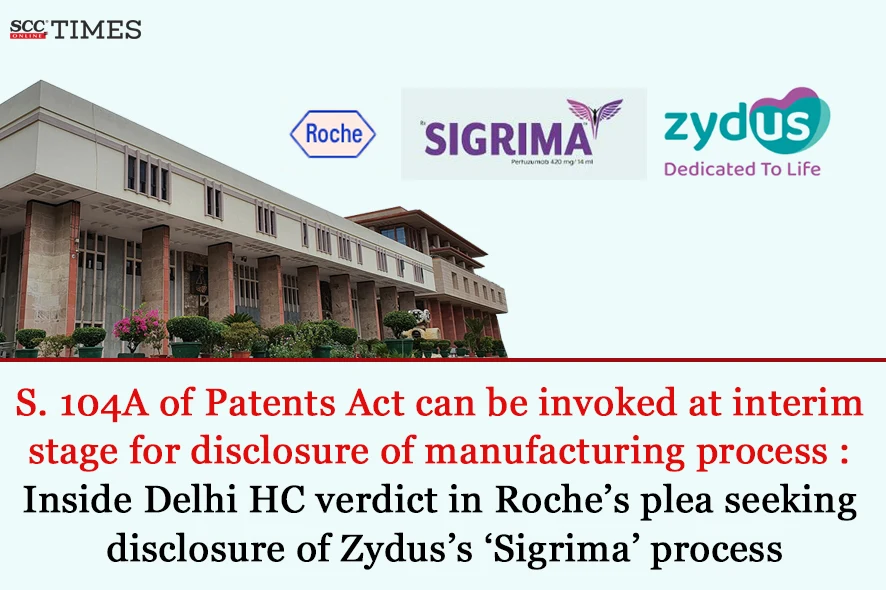
Delhi High Court: In a suit filed by F Hoffmann Roche Ltd. and Genentech (‘collectively referred to as the Roche Group’) seeking access to information shared with members of a confidentiality club for claim mapping of its formulation and manufacturing process of the product ‘Sigrima’ used for treating breast cancer , the Single Judge Bench of Justice Amit Bansal held that Roche Group are not entitled to access the Zydus Lifesciences Limited (‘Zydus’) manufacturing process, as they had failed to meet the mandatory requirements under Section 104A of the Patents Act, 1970 (‘the Act’). The Court further held that Section 104A may be used even at an interim stage to seek disclosure of process employed by Zydus and would prevail over provisions under the Civil Procedure Code, 1908 (‘CPC’) relating to discovery and disclosure.
Background
Plaintiff 1-F Hoffmann Roche Ltd. is a Switzerland based company operating in the fields of pharmaceuticals and diagnostics. Plaintiff 2- Genentech is an American biotechnology company, which was acquired by Plaintiff 1 in March 2009 as its wholly owned independent subsidiary. The plaintiffs are part of the Roche Group that has invested significantly in the field of research and development, particularly in the treatment of cancer.
A suit was filed by Roche Group seeking relief of permanent injunction restraining infringement of the following two Indian patents (collectively referred to as the ‘suit patents’):
a. Indian Patent, titled “Pharmaceutical Formulation Comprising HER2 Antibody” was a product patent relating to an aqueous pharmaceutical formulation comprising Pertuzumab and excipients such as sucrose, histidine acetate buffer, and polysorbate, wherein the pH of the formulation was maintained between 5.5 and 6.5.
b. Indian Patent titled “Pertuzumab Variants and Evaluation Thereof”, was a process patent relating to a method for manufacturing a composition comprising Pertuzumab and one or more of its variants.
Perjeta (Pertuzumab) is a prescription medicine for treating patients with early-stage breast cancer and metastatic breast cancer and has been approved by regulatory authorities in several countries across the world.
Zydus is an Indian pharmaceutical company, engaged in the manufacturing and sale of drugs, active pharmaceutical ingredients, etc. Zydus had filed an application with the Central Drugs Standard Control Organisation (‘CDSCO’) for grant of permission to manufacture a new drug formulation for sale and distribution of Pertuzumab as per the New Drugs and Clinical Trials Rules, 2019 and was conducting clinical trials for a similar biologic/ biosimilar of the Roche Group Pertuzumab for its product.
In light of the imminent threat of Zydus attempting to manufacture, launch and deal in Pertuzumab during the term of the suit patent without the authorization of the Roche Group, they filed an application.
By the order dated 23-2-2024, the Court accepted the application for interim injunction and ordered the constitution of a confidentiality club to which Zydus was directed to submit the process by which they developed their drug formulation.
Vide another application under Order 39 Rules 1 and 2 of CPC, the Roche Group had sought an interim injunction restraining the sale and distribution of the product. The Court, by order dated 21-11-2024, set aside the order extending the ad interim injunction as a result of which the Roche group had no injunction in their favour at the time of filing the instant application. However, at the instant stage, the Roche Group had not pressed for an interim injunction but had rather sought disclosure of Zydus’s manufacturing process submitted to the members of the confidentiality club.
Analysis, Law and Decision
The Court noted that since the instant application was concerned with the infringement of the Roche Group’ process patent and both sides had made submissions with regard to the applicability of Section 104A of the Act, one of the key issues in deciding the present application would be to determine the scope and interpretation of Section 104A of the Act.
The Court answered the question of applicability of Section 104A of the Act in the following parts:
-
Whether Section 104A of the Act can be invoked at the instant stage of the suit?
The Court noted that Roche Group themselves had admitted to the applicability of Section 104A of the Act by claiming in their interlocutory application that they had discharged the burden of proof under Section 104A of the Act. Earlier orders of the Court, wherein invocation of Section 104A of the Act was discussed, had not been challenged by the Roche Group at any stage. The Court held that there was nothing in the Section to suggest that Section 104A of the Act cannot be invoked at an earlier stage and may be invoked only at the stage of final adjudication.
-
Whether Section 104A of the Act would apply to ‘disclosure’ of the process adopted by the defendant?
The Court noted that the main requirement for discharging the aforesaid burden of proof by Zydus would be the disclosure of its process of manufacturing. Once Zydus is directed to disclose its manufacturing process, the Court only has to compare/ map the same with the process claimed in the process patent to see if they are identical/ similar. Therefore, disclosure of its manufacturing process by Zydus is the key mandate under Section 104A of the Act. Furthermore, the language of Section 104A (2) of the Act specifically uses the term ‘disclose’ in relation to the confidential aspects of the Zydus’s process. Therefore, the Court noted that the disclosure of Zydus’s process would be covered with the scope of Section 104A of the Act.
-
Whether Section 104A of the Act would prevail over the discovery provisions under CPC as amended by the Commercial Courts Act, 2015?
The Court noted that the Patents Act, 1970 is a specialised legislation dealing with patent infringement whereas the Commercial Courts Act, 2015 is a general legislation dealing with all commercial disputes. The Court referred to cases where the Courts had held that the Patents Act would prevail over other laws such as the Competition Act and the law of limitation. Thus, reiterating the principle of lex specialis derogat legi generali, the Court held that Section 104A of the Act would prevail over Order XI Rules 1(7), 1(12) and 5 of the CPC.
-
Whether Section 104A of the Act would apply in respect of biological drugs?
Roche Group’s contention that Section 104A would not be applicable in cases of biological drugs because biological drugs by their very nature cannot be identical was held to be unsustainable. The Court held that the threshold of identicality cannot be diluted in biologic cases merely because absolute replication is scientifically difficult. The statutory use of the term ‘identical’ reflects the legislature’s conscious choice, and to read the same in a lower threshold would amount to judicial dilution of the requirement.
-
Whether the Roche Group have fulfilled the requirements of Section 104A of the Act?
In determining whether Zydus’ product is identical to the product obtained by the patented process, the Court noted that Pertuzumab (Perjeta) was already known in the prior art and the end product of the process patent IN 646 was a distinct composition comprising Pertuzumab and one or more variants. Thus, it could not be said that the reference made by Zydus in its application filed with CDSCO was to the product obtained from the patented process IN 646. Therefore, the Court opined that Roche Group could not argue that the Zydus’s product was identical to Roche Group’ product directly obtained from the patented process, as mandated under Section 104A of the Act.
Considering the scope of application of Section 104A of the Act and the facts in the instant case, the Court held that the Roche Group had failed to fulfill the mandatory requirements under Section 104A of the Act and no direction could be issued to the Zydus to disclose its manufacturing process filed in a sealed cover.
[F-Hoffmann-La Roche AG v. Zydus Lifesciences, 2025 SCC OnLine Del 5027, decided on 23-7-2025]
Advocates who appeared in this case:
For Plaintiffs: Senior Advocate Arvind Nigam, Senior Advocate Sandeep Sethi, Pravin Anand, Shrawan Chopra, Prachi Agarwal, Achyut Tewari, Aayush Maheshwari, Krisha Baweja, Sumer Seth, Advocates.
For Defendant: Senior Advocate Dushyant Dave, Senior Advocate Rajshekhar Rao, Adarsh Ramanujan, Bitika Sharma. Vrinda Pathak, Sandhya Kukreti, Rajnish Singh S.L. Sojanya, Advocates.