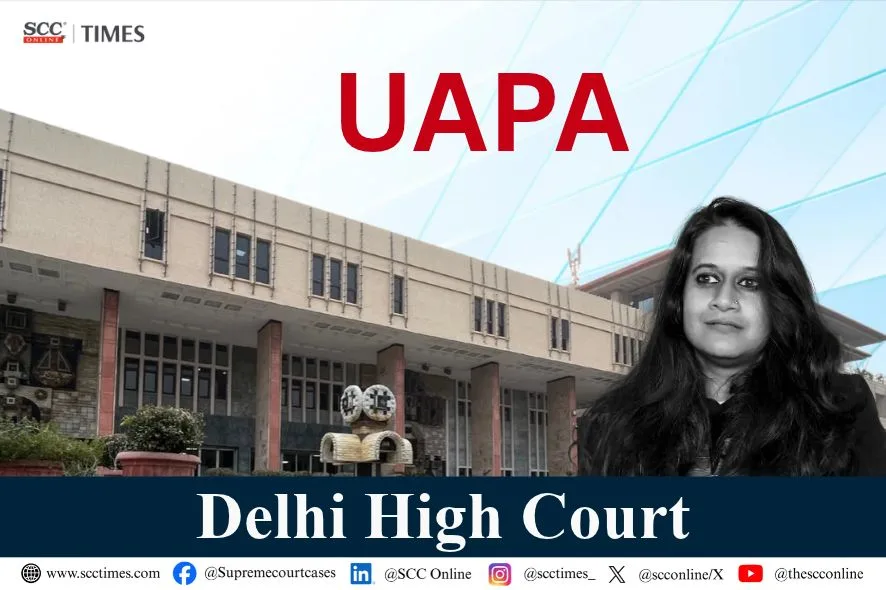
Delhi High Court: In two petitions challenging the orders dated 06.10.2026 passed by the Additional Sessions Judge (Special Judge), Shahdara District, Karkardooma Courts in Sessions Case 163/2020 and Sessions Case 354/2022, whereby the petitioner’s applications to travel to the United Kingdom (UK) from 02.11.2026 to 01.12.2026 were rejected, a Single Judge Bench of Amit Bansal, J., allowed the petitions and permitted the petitioner to travel, subject to safeguards. The Court noted that the petitioner has been on bail since 2020 and 2021 without any allegation of violation of bail conditions, that the trial is likely to take considerable time, and that her PhD supervisors had specifically sought her in-person presence for academic purposes. It held that the fact that she is charged with serious offences under the Unlawful Activities Prevention Act, 1967 (UAPA) does not curtail her right to travel abroad in a blanket manner.
Background
The petitioner is an accused in two cases arising from FIR No. 50/2020, registered at Police Station Jafrabad (now investigated by Police Station Crime Branch), and FIR No. 59/2020 dated 06.03.2020, registered at Police Station Special Cell. Among other provisions, the FIRs invoke various sections of the Penal Code, 1860, the Arms Act, 1959 and the Prevention of Damage to Public Property Act, 1984, and FIR No. 59/2020 additionally invokes Sections 13, 16, 17 and 18 of the UAPA.
In FIR No. 50/2020, the petitioner was granted bail by the Trial Court on 17.09.2020. In FIR No. 59/2020, she was granted bail by the Division Bench of the High Court on 15.06.2021, on conditions that she surrender her passport before the Trial Court and not travel out of the country without its prior permission. Charges are yet to be framed in both cases.
After being granted bail, the petitioner began pursuing a PhD at the School of Law, University of Warwick, UK, where she was admitted on 02.10.2023. Her paper “Gendered Carceral Labour as Social Reproduction” was accepted for presentation at the annual conference at the School of Oriental and African Studies (SOAS), London, from 05.11.2026 to 08.11.2026. Her passport remains deposited with the Trial Court. She applied for permission to travel to the UK from 02.11.2026 to 01.12.2026 to attend the conference and to meet her PhD supervisors. The application was opposed by the State and rejected on 06.10.2026, primarily on the ground that there were serious allegations against her under the UAPA.
The petitioner’s counsel submitted that the travel was purely for academic pursuits and relied on a letter dated 21.09.2026 from her supervisors inviting her to present her work. He submitted that she has deep roots in society, undertook to return on 02.12.2026, and that her brother, who resides in Haryana, was willing to stand surety.
The State, represented by the Additional Solicitor General, submitted that the UK has very strict extradition laws and that it would be difficult to extradite the petitioner if she decided to seek asylum there. It further submitted that the academic purposes could also be achieved virtually, so there was no need to travel.
Issues and Analysis
The Court was called upon to determine whether the petitioner, an accused on bail in cases involving offences under the UAPA, could be permitted to travel to the UK for academic purposes despite the State’s objections.
The Court began by noting that the Supreme Court in Maneka Gandhi v. Union of India, (1978) 1 SCC 248, held the right to travel abroad to be a facet of the fundamental right to life and personal liberty under Article 21 of the Constitution, of which no person can be deprived except in accordance with the procedure established by law.
On the State’s contention that the academic purposes could be achieved virtually, the Court noted that the petitioner has been pursuing her PhD at a renowned university for three years, since 2023, entirely virtually and without any earlier request to travel. The request had now been made when the programme was at its fag-end, to present her research paper and meet her supervisors. The Court then examined the letter dated 21.09.2026 from the supervisors. It noted that the letter records that she had never been physically present at the University and that all supervision and training had taken place by video conference and email, an arrangement with well-recognised limitations at doctoral level. The University invited her to visit its School of Law from 10.11.2026 to 22.11.2026 for her first in-person supervisory meetings, to present her work in progress, to take part in doctoral training sessions available only on campus, and to use offline archival collections such as those at the British Library. The supervisors considered the visit to be of material academic benefit to the quality of her thesis. The letter further recorded that her paper had been accepted, following competitive peer review, for the Twenty-Third Annual Historical Materialism Conference at SOAS, which it described as among the most significant scholarly gatherings in its field, and that acceptance of a paper by a doctoral candidate is a mark of academic distinction. The Court held that the letter indicates the visit is necessary for academic purposes and for qualification of the thesis she must submit to obtain her PhD.
The Court also noted that the trial is likely to take a considerable time to complete, that the petitioner has been on bail since 2021, and that it is not the State’s case that she has violated any bail condition. It held that the fact that she is charged with serious offences under the UAPA does not curtail her right to travel abroad in a blanket manner. It further observed that she has roots in society, as her close family resides in the National Capital Region. The Court did not separately deal with the State’s apprehension regarding asylum and extradition, and instead addressed it through safeguards, including an undertaking not to seek asylum and a surety.
Decision
The Court allowed the petitions and permitted the petitioner to travel to the UK from 02.11.2026 to 01.12.2026, subject to the following conditions:
-
The petitioner and her brother shall furnish an undertaking before the Trial Court that the petitioner will return to India on 02.12.2026, will not apply for asylum in the UK, and will not make any comments on the merits of the ongoing cases during her stay in the UK.
-
The petitioner shall furnish a cumulative personal bond of Rs 1,00,000 in both cases, with her brother as surety, to the satisfaction of the Trial Court.
-
She shall furnish a copy of her UK visa (when obtained), flight tickets and a detailed itinerary to the Investigating Officer before leaving India.
-
The Court’s order shall accompany her UK visa application.
The Trial Court was directed to release her passport immediately. The Look Out Circular, if any, shall remain suspended for the period of travel. The petitioner shall surrender her passport to the Trial Court within 48 hours of her return to India.
[Natasha Narwal v. State NCT of Delhi, CRL.M.C. 7711/2026 & CRL.M.C. 7724/2026, decided on 16-10-2026]
Advocates who appeared in this case :
For the Petitioner: Adv. Adit S. Pujari, Adv. Chaitanya Sundriyal, Adv. Manvender Singh Shekhawat and Adv. Harshvardhan Pushkin Sharma
For the Respondent: Mr. S.V. Raju, Additional Solicitor General, with Mr. Madhukar Pandey, SPP, and Advs. Ayodhya Prasad, Dhruv Pande, Aarush Bhatia, Saravjeet Singh and Ishika Singla