
Disclaimer: This has been reported after the availability of the order of the Court and not on media reports so as to give an accurate report to our readers.
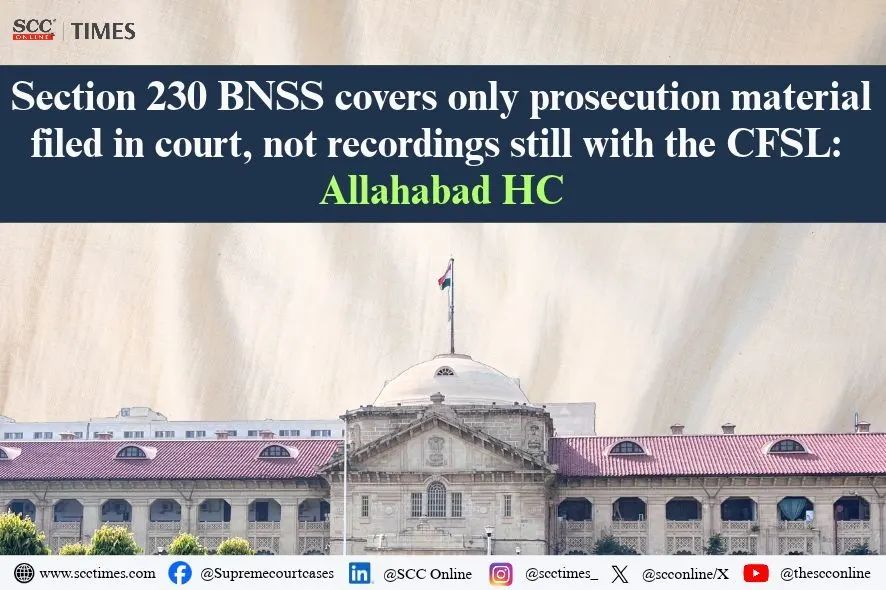
Allahabad High Court: In an application filed by an accused challenging the non-provision of copies of certain recordings and transcripts by the Central Bureau of Investigation (CBI), the Single Judge Bench of Subhash Vidyarthi, J., dismissed the application, holding that since the accused will receive the recordings in due course and had already been given copies of the transcripts and permitted to listen to the investigation copy,, no prejudice would be caused by the present non-supply of the same to her. The Court stated that the temporary non-supply of copies of the recordings of conversations, which are not in the custody of the CBI or the court, causes no prejudice to the accused.
Background
An FIR was filed against the accused under Section 61(2), Nyaya Sanhita, 2023 (BNS) read with Section 316(5) BNS and Sections 7, 8, 10, 13(2) read with Section 13(1)(a), Prevention of Corruption Act, 1988.
The accused filed an application requesting the trial court to direct the CBI to provide the copies of recordings of the conversations contained in the list of articles. The CBI objected, stating that it is mentioned in the charge-sheet that the recordings and handwritings were sent to the Central Forensic Science Laboratory (CFSL) for obtaining an expert opinion/report and the opinion/report is still awaited. The CBI stated that as and when the CFSL report/opinion is received, the copies of the recordings and the report shall be supplied to the accused person.
The accused responded that she had sought copies of certain conversations mentioned in the list of articles annexed with the charge-sheet and not the CFSL reports about the voice recordings or handwritings. She further contended that it was evident from the CBI’s memorandum that the CBI had made investigation copies of the alleged conversations during the course of investigation, which are available with the CBI and which have been used by the CBI during the entire course of investigation to prepare transcripts, etc. The accused contended that the recordings are an integral part of the case and are a vital piece of prosecution evidence and unless copies of the same are provided to the accused, the requirement of Section 230, Nagarik Suraksha Sanhita, 2023 (BNSS), which mandates providing copies of all the relied upon material to the accused, is not fulfilled.
The trial court has disposed of the accused’s aforesaid application via the impugned order, noting the submission that CBI would provide copies to the accused as soon as the recordings are received from CFSL. The trial court also directed the CBI to make correspondence with CFSL for obtaining a test report expeditiously and to ensure providing copies of the conversations to the accused under Section 230 BNSS without any delay.
Aggrieved, the accused filed the present petition under Section 528 BNSS challenging the validity of the impugned order passed by the trial court.
Issue
Whether the trial should be stopped merely because the recordings of telephonic conversations have been sent to the CFSL to obtain an expert’s report.
Analysis
At the outset, the Court noted that neither the CBI nor the trial court denied provision of copies of documents to the accused. The documents had been sent to CFSL for obtaining an expert’s report, and their copies could not be provided immediately due to the non-availability of the original, and the same would be provided as soon as the documents are received back from CFSL. After supply of the documents, the accused and/or her Counsel may inspect the documents before the trial court during hearing.
In this regard, the Court referred to Sarla Gupta v. Enforcement Directorate, (2025) 7 SCC 626, wherein the Supreme Court held that the accused is entitled to receive copies of the documents annexed with the complaint to defend himself. However, this principle would apply to the documents which are annexed with the complaint and produced before the trial court.
The accused relied on Arjun Panditrao Khotkar v. Kailash Kushanrao Gorantyal, (2020) 7 SCC 1, for the principle that the prosecution must supply all relied-upon documents before the trial begins. The Court noted that the same judgment requires that, where documents are produced later, the court must ensure no serious or irreversible prejudice to the accused. It held that the judgment did not help the accused, since supply had been deferred and not denied, and she had the transcripts and could listen to the investigation copy. The Court also distinguished V.K. Singh v. CBI, 2026 SCC OnLine SC 1047, as decided on a concession by the ASG and therefore not a binding precedent.
The Court also noted that under Section 230 BNSS, the obligation is attached to the prosecution material that has actually been filed before the court. The original recordings of the telephonic conversations were sent to CFSL for expert opinion and till date had not been filed before the trial court. Any material which has not been filed on the trial court’s record cannot be supplied to an accused person. The transcripts of certain conversations and copies of the transcripts filed were supplied to the accused. The CBI also undertook to supply copies of the recordings of conversations once they are received back from CFSL, and the trial court has directed it to do so without delay. Meanwhile, the accused was permitted to listen to the investigation copy and compare it with the transcripts. In these circumstances, the Court held that the temporary non-supply of copies of the recordings of conversations, which were not in the custody of the CBI or the Court, caused no prejudice to the accused.
On the aspect of Section 261 BNSS, the Court noted that the provision requires the Magistrate to satisfy himself that the provisions of Section 230 BNSS had been complied with. Therefore, the provisions of Section 261 BNSS were also not violated in the present case.
Furthermore, the Court relied on CBI v. R.S. Pai, (2002) 5 SCC 82, and Sameer Sandhir v. CBI, 2025 SCC OnLine SC 1206, to reiterate that the prosecution was not precluded from placing additional material on record after filing of the charge-sheet. The recordings and the CFSL opinion, when received, could be brought on record as additional material, and copies can thereafter be furnished to the accused. Thus, the Court held that since the accused will receive the recordings in due course and will have the opportunity to examine them before evidence is led, no prejudice would be caused by the present non-supply of the same to her.
Accordingly, the Court held that none of the conditions provided under Section 528 BNSS were made out in the present case warranting interference by this Court in exercise of its inherent powers.
Thus, the Court dismissed the application, holding that there was no error or illegality in the impugned order.
[Prabha Bhandari v. CBI, 2026 SCC OnLine All 34418, decided on 29-9-2026]
Advocates who appeared in this case:
For the applicant: Pranjal Krishna and Suhaib Ashraf
For the respondent: Aakash Prasad and Yash Joshi