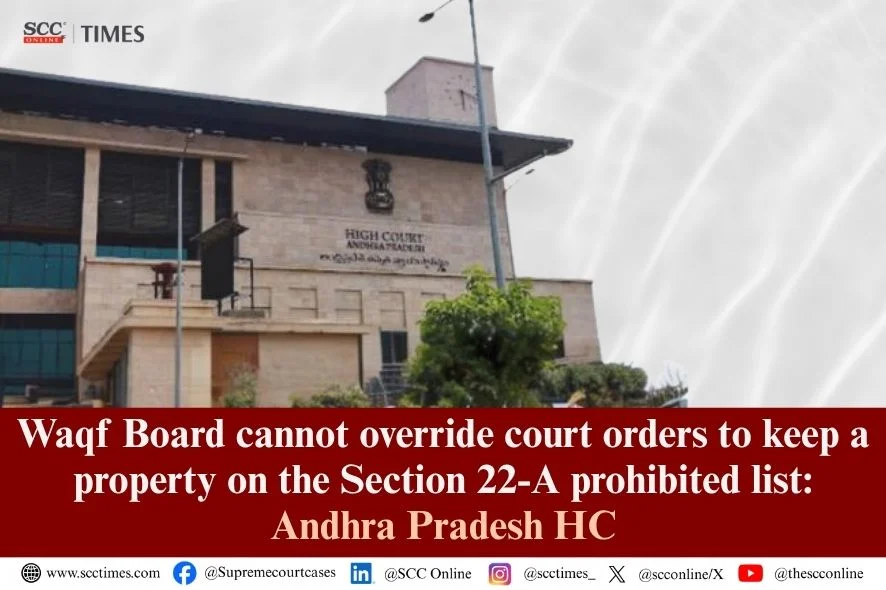
Andhra Pradesh High Court: In a writ petition filed against inclusion of the subject property in the list of prohibited properties under Section 22-A, Registration Act, 1908, on the basis of the claim made by the Waqf Board, a Single Judge Bench of Ravi Cheemalapati, J., held that the repeated communications made to registration authorities by the Waqf Board, despite the Court’s orders dismissing their claim, resulted in repeated litigation, causing inconvenience to the petitioners and was contrary to the judgment and decree passed by the Court and that the respondents were bound to act in accordance with the Court’s orders allowing the registration of the subject property. The Court directed the revenue authorities to ensure that the subject property is deleted from the list of prohibited properties under Section 22-A, Registration Act, 1908, if not already deleted. The registering authority was directed to receive and process the petitioners’ documents strictly in accordance with the Registration Act, the Indian Stamp Act, 1899 and the rules in force.
Background
The writ petition was filed with respect to the inclusion of the subject property in the list of prohibited properties under Section 22-A, Registration Act, on the basis of the claim made by the Waqf Board.
The subject property formed part of the layout of 1984, sanctioned by the Director of Town and Country Planning, purchased by the petitioners under a sale deed in 1999. In 1969, the Waqf Board had filed an original suit with respect to the subject property, seeking declaration and recovery of possession, which was dismissed on the ground of limitation and no appeal was preferred. Thus, the decree attained finality.
In 2011, the Waqf Board claimed the subject property as waqf property, through a letter to registration authorities, pursuant to which the subject property came to be included in the list of prohibited properties under Section 22-A, Registration Act. This led to filing of writ petitions against the registration authorities over their refusal to register the subject property, where the Court issued directions to process the registrations without considering the Waqf Board’s 2011 claim over the property.
Despite the Court’s directions, in 2016, Waqf Board requested the authorities to not entertain registrations with respect to the subject property claiming it belongs to Waqf Board. This resulted in the subject property still being in the list of prohibited properties under Section 22-A, Registration Act.
Thus, the petitioners approached the Court regarding the refusal of registration authorities to entertain the documents with respect to the subject property.
As per the petitioners, the Waqf Board cannot continue to assert their claim over the subject property without questioning the 1970 judgment and decree. Waqf Board’s actions have resulted in repeated rounds of litigation before this Court on substantially the same issue.
Analysis and Decision
The Court observed that the 1970 decree and judgment had attained finality. Moreover, the Court had passed orders in the earlier writ proceedings directing the registration authorities to process the registrations without reference to the Waqf Board’s 2011 communication.
The Court stated that the Waqf Board cannot send communications to the registration authorities and try to cancel or ignore the orders already passed by the Court. If the Waqf Board was aggrieved with the civil court’s judgment and decree, or believed that it still had rights over the property, it could use the legal remedies available to it. The Waqf Board cannot repeatedly ask the registration authorities to stop registrations when this Court had already passed orders allowing them.
The Court rejected the Waqf Board’s contention that the petitioners had not submitted an application before the competent authority for deletion of the subject property from the prohibited list. Since the Court had already issued directions in the earlier proceedings, the petitioners were not required to submit an application for deletion of the property from prohibited list, resulting into another round of litigation and multiplicity of proceedings.
The Court noted that the respondents did not place any material showing that the 1970 judgment and decree and the subsequent orders passed by this Court had been set aside, modified or stayed. The Court held that the respondents were bound to act in accordance with the orders passed by the Court. The Court further held that the respondent’s repeated communications to the registration authorities despite the Court’s orders resulted in repeated litigation, causing inconvenience to the petitioners.
The Court held that such conduct warranted costs and imposed costs of ₹50,000 on the Waqf Board, payable to the A.P. High Court Legal Services Committee within four weeks from receipt of a copy of the order, with a memo of compliance to be filed before the Registry. The Court declined to impose costs on the registering authority, as there was no specific material to show that respondent no. 4 had independently and deliberately disobeyed the earlier orders. The Court directed the registration authorities to adhere to the Court orders with respect to the subject property, delete the subject property from the list of prohibited properties under Section 22-A, Registration Act and process the documents presented by the petitioners in accordance with Registration Act, Stamp Act and rules in force.
Also Read: Waqf Board Has No Jurisdiction Over Property Declared As Ancient Monument: MP High Court
[Alivelu Challa v. State of A.P., writ petition no. 26247 of 2026, decided on 15-9-2026]
Judgment Authored By: Justice Ravi Cheemalapati
Advocates who appeared in this case:
For the petitioners: T. Nikhilesh, representing Vivekananda Virupaksha, Advocates.
For the State: Venkata Satyanarayana, Assistant Government Pleader for Revenue.
For the Waqf Board: Shaik Khaja Basha, Standing Counsel