On 14 October 2026, day 3 of AIAC Asia ADR Week 2026 featured a session titled “Truth.exe: AI, Digital Evidence and Technology Disputes”, in which legal practitioners examined the growing challenges of authenticating digital evidence, identifying AI-generated material and maintaining confidence in arbitration and other dispute resolution processes. The discussion explored practical verification methods, the role of forensic experts, the limitations of AI detection tools and the need for clearer protocols governing the use of AI by counsel, experts and arbitral tribunals.
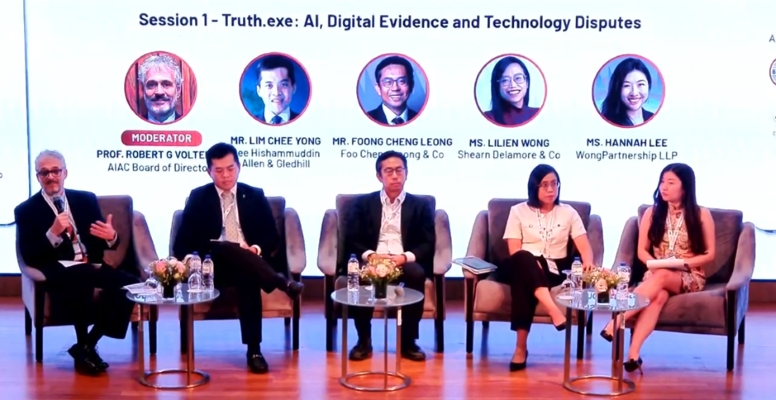
[In picture left to right: Prof. Robert G Volterra, Lim Chee Yong, Foong Cheng Leong, Lilien Wong and Hannah Lee]
The session was moderated by Prof. Robert G Volterra, member of the AIAC Board of Directors and Partner at Volterra Fietta. The panellists were:
-
Lim Chee Yong, Partner at Lee Hishammuddin Allen & Gledhill (LHAG);
-
Foong Cheng Leong, Partner at Foong Cheng Leong & Co;
-
Lilien Wong, Partner at Shearn Delamore & Co; and
-
Hannah Lee, Partner at WongPartnership.
Digital evidence requires early and layered verification
Opening the discussion on the authentication of digital evidence, Lim Chee Yong highlighted the risks associated with deepfake videos and AI-generated documents being presented in arbitration proceedings. Referring to a case involving AI-generated video material, he explained that inconsistencies in the subjects’ movements and speech, together with metadata indicating that the video could not have been produced on the device and software identified, raised questions about its authenticity.
Lim emphasised that lawyers could no longer take evidence at face value. He recommended examining inconsistencies in the documentary trail, seeking certificates of origin where available and involving forensic experts at an early stage when necessary. Challenges to authenticity should be addressed within the procedural timetable rather than deferred until the merits hearing. He also cautioned that AI detection tools should be treated as guidance rather than conclusive evidence, given the pace at which AI generation is developing.
Foong Cheng Leong highlighted the practical difficulty of distinguishing genuine material from AI-generated or manipulated photographs. Drawing on examples involving manipulated intimate images and alleged AI-generated trademark evidence, he observed that material which may appear identifiable as artificial today could become considerably more convincing as the technology develops. This creates challenges not only for legal practitioners but also for individuals and decision-makers who must assess the reliability of digital material.
Lilien Wong emphasised that digital evidence often leaves a trace, even when the underlying device is no longer operational. Referring to a data breach matter involving an old laptop, she explained how forensic imaging of a hard disk enabled technical experts to retrieve historical information, including records of transactions and browsing activity. She observed that lawyers need not master every technical concept, but should understand what digital traces may exist and when expert assistance is required.
Hannah Lee added that forensic scrutiny must remain proportionate to the nature of the dispute. Rather than commissioning extensive forensic investigations in every case, counsel could begin by seeking native files and examining metadata to determine whether documents correspond with the events in dispute. More intensive forensic examination could follow where preliminary checks reveal concerns about the integrity of the evidence.
Bridging the technical knowledge gap for tribunals
The panel next considered the difficulty faced by lawyers and arbitrators when disputes involve source code, system logs, algorithmic outputs, databases and other technical material that may be unfamiliar to legal decision-makers.
Hannah Lee described the resulting comprehension gap as a significant challenge in technology disputes. She suggested that, where a tribunal requires assistance on a narrowly defined technical question, a tribunal-appointed expert could provide an independent explanation alongside the evidence of party-appointed experts. She also proposed short technical sessions, similar to a “science day”, to familiarise tribunals with the technology before they assess the dispute.
Foong Cheng Leong supported the value of allowing decision-makers to understand the underlying systems. Based on his experience in court proceedings involving technical evidence, he observed that judges may not have sufficient time during a hearing to understand unfamiliar technology through conventional witness questioning alone. A short briefing involving the experts could explain the basic operation of a system and help the judge evaluate the evidence more effectively.
Lilien Wong also highlighted the value of explaining technical concepts in accessible language, supported by diagrams where appropriate. In her view, a preliminary counsel-to-counsel discussion could help establish a common understanding of the relevant systems before experts engage in more technical exchanges.
Detecting AI-generated content requires more than visual inspection
The panellists cautioned against assuming that the length, fluency or technical detail of a document establishes its authenticity or reliability.
Lilien Wong illustrated how an AI tool could expand a short passage into a longer, technical-sounding text despite having been given no substantive context. She argued that lawyers should consider whether the information is supported by the underlying records, relevant to the issues, and genuinely grounded in the material before the tribunal. She also discussed how examination of an expert’s AI prompts and the sources used to prepare a report may help reveal the extent and nature of AI involvement.
The discussion highlighted an important distinction: detecting the use of AI is not the same as establishing that the resulting evidence is false. The focus must remain on the authenticity, relevance and reliability of the material, rather than merely on whether an AI tool was involved in its preparation.
AI may assist adjudication, but must not replace independent reasoning
The panel considered the implications of a 2026 Quebec case, referred to during the session as ARIC v. Santé Québec1, in which an arbitral award was set aside after its reasoning relied on authorities described by the panellist as fictitious. Lim Chee Yong explained that the case illustrated the risks of unverified AI-generated material entering adjudicative reasoning.
He emphasised that AI could assist the process but should not drive it. Referring to the principle discussed in the case, he stressed that decision-making authority must remain with the arbitrator. He also highlighted the importance of discussing intended AI use with the parties at an early procedural stage, including the extent to which AI might be used and whether its role would be administrative or connected to the decision-making process.
Hannah Lee distinguished between different categories of AI use. Assistance with drafting or formatting was described as relatively low risk, while processing large volumes of data could carry a low-to-moderate level of risk. The greater concern arises when AI is used to generate conclusions from evidence. The central issue, she noted, is not the use of AI in itself, but whether the decision-maker has effectively delegated the exercise of judgment to it.
Discussing AI use by experts, Lee stated that an expert must remain responsible for every proposition advanced in a report and must provide an independent, reasoned opinion. As she put it, “AI should be used as a tool, but not a source of opinion.”
Foong Cheng Leong added that AI could assist experts with drafting, particularly where language and presentation need improvement. However, the reliability of the output depends on factors such as the information supplied to the AI system, the quality of the underlying evidence and the way the resulting material is assessed. The discussion therefore underscored the importance of evaluating the substance and verification of an expert’s work rather than treating AI involvement as automatically disqualifying.
Disclosure of AI use must be considered in context
The panel also examined whether experts should be required to disclose their use of AI. Lilien Wong suggested that the purpose and extent of the use should inform the assessment. Routine assistance, such as spelling and typographical checks, may raise different concerns from the use of AI to generate substantive analysis or conclusions that could affect the evidence or the outcome of the arbitration.
She cautioned that disclosure alone could not cure a report that lacked a reliable evidentiary or analytical foundation. Merely stating that AI was used would not establish the quality of the expert’s reasoning or make an otherwise unreliable opinion acceptable.
Lim Chee Yong similarly questioned whether disclosure, on its own, necessarily changes how a report should be assessed. The discussion pointed towards a substantive inquiry into what AI was used for, what material it processed and whether the expert continued to take responsibility for the final opinion.
Panellists call for clearer protocols on authentication and verification
The discussion turned to whether existing institutional rules and guidelines adequately address the challenges posed by AI and digital evidence. Hannah Lee observed that the current framework comprised guidance, arbitration software and emerging case law, but did not sufficiently address how to determine whether digital evidence was genuine or had been fabricated using AI.
As a practical response, she proposed developing protocols that could be agreed upon at the outset of proceedings and incorporated into procedural orders. Such protocols could address the preservation of metadata and native files, deadlines for raising authenticity challenges, and the circumstances in which a tribunal could direct forensic access to underlying data.
Lim Chee Yong also called for a framework capable of providing greater assurance that documents, videos and other forms of digital material could be independently verified. The discussion favoured addressing potential authenticity disputes early, rather than waiting until the hearing or merits stage to investigate the integrity of the evidence.
The session further considered whether courts and tribunals might increasingly use AI to manage large volumes of documents and evidence. Foong Cheng Leong highlighted the potential efficiency benefits of using AI to search and organise extensive records, while also raising questions about how future protocols might address the systems used, costs, data and procedural safeguards. Lilien Wong referred to existing AI guidelines and template agreements and procedural orders as potential starting points for managing AI use in arbitration.
Access to AI and the importance of data
In the concluding discussion, Foong Cheng Leong drew attention to the potential cost barriers faced by smaller legal practices as sophisticated AI platforms become more widely adopted. He argued that access to high-quality data could become an important differentiator, noting that firms could develop their own databases to support legal research and drafting.
The discussion highlighted that the effective use of AI depends not only on access to the technology but also on the quality of the data, the reliability of its outputs and the ability of practitioners to verify what it produces.
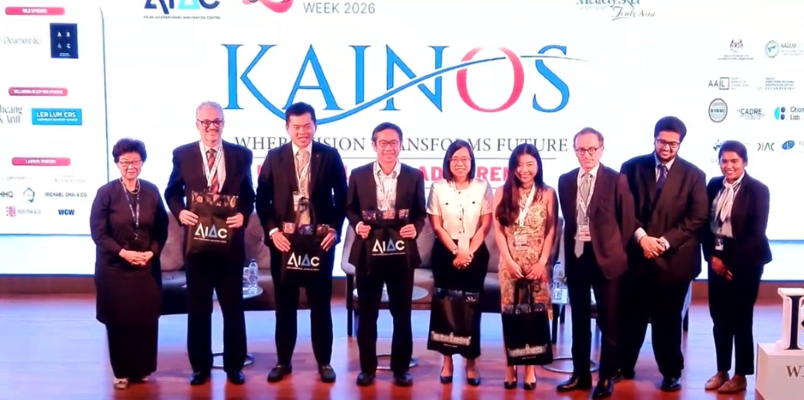
The session concluded with a broader reflection on the need for practitioners to adapt to technological change without compromising the integrity of dispute resolution. Across the discussions, a consistent theme emerged: digital evidence must be scrutinised, AI outputs must be verified, and responsibility for legal submissions, expert opinions and adjudicative decisions must remain with the relevant human decision-makers.
SCC Times is the official media partner for AIAC Asia ADR Week 2026. Read more reports from the week.
1. 2026 QCCS 1360