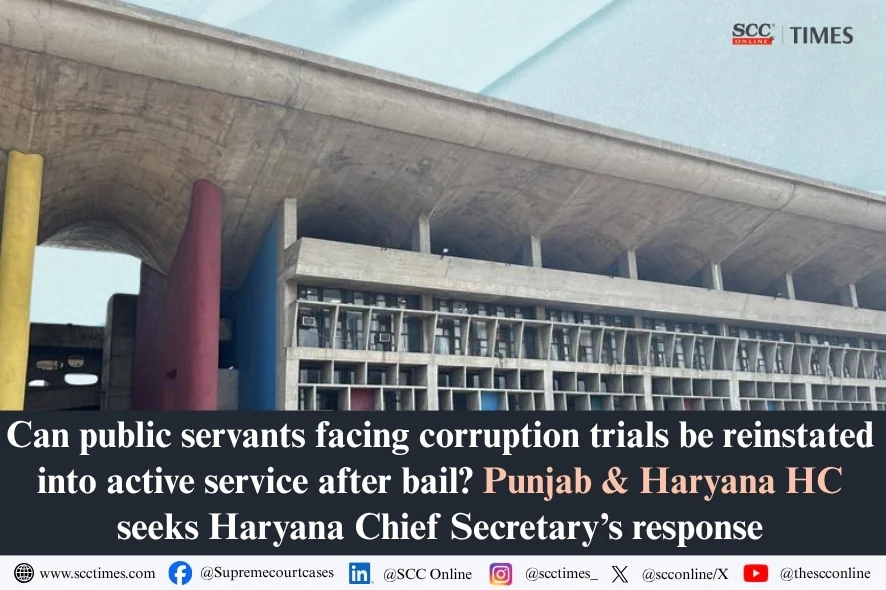
Punjab and Haryana High Court: In a petition filed under Section 483, Nagarik Suraksha Sanhita, 2023 (BNSS), a Single Judge Bench of Sumeet Goel, J., granted interim regular bail to the accused, a Sub-Inspector of Police. The Court noted that the challan had been filed, that none of the 28 cited prosecution witnesses had been examined, that the accused had undergone four months and 23 days of incarceration, and that he was not shown to be involved in any other FIR. Invoking its inherent powers under Section 528 BNSS, the Court took serious note of the trend of public servants accused under the Prevention of Corruption Act, 1988 (PC Act)being reinstated into active service after bail, and directed the Chief Secretary, Haryana to file an affidavit on the issue.
Background
The accused, a Sub-Inspector of Police, was arrested on 2 April 2026 in an FIR dated 7 December 2025, registered for offences under Sections 7 and 7A ,PC Act and Sections 61(2) and 308(2), Nyaya Sanhita (BNS).
The complainant alleged that on 5 December 2025 he received a call from a person who told him that his friend had been detained by the E.O. Wing, Sector-12, Panchkula in a loan fraud case, and that the Investigating Officer was a Sub-Inspector. That person allegedly demanded Rs 7 lakh, failing which more cases would be registered against the friend. The complainant alleged that he later handed over Rs 50,000 to that person outside the E.O. Wing, and that the money was seen being passed to an employee inside. He further alleged that the person then asked for instalments, including Rs 75,000 the next day. The complainant stated that he did not wish to pay the bribe and wanted the accused to be caught red-handed.
Before the High Court, the petitioner’s counsel submitted that he had been falsely implicated and that the bribe money had been recovered from the co-accused. Counsel also submitted that the challan had been filed and that the trial would take long to conclude.
The State opposed the petition, submitting that the accused was serving as a Sub-Inspector of Police and that the allegations against him were direct and serious. It was also argued that, if released, he was in a position to tamper with prosecution evidence and intimidate the complainant.
Issues and Analysis
The Court was called upon to determine whether the accused was entitled to regular bail, and whether the reinstatement of public servants accused under the PC Act during trial warranted the Court’s intervention.
On the question of bail, the Court noted that the investigation had been completed and the challan against the accused was presented on 26 May 2026. Of the 28 prosecution witnesses cited, none had been examined so far. The Court observed that the rival contentions raised a number of debatable issues to be decided during trial, and it declined to examine them in depth at this stage so as not to prejudice the trial.
The Court further observed that nothing tangible had been brought before it to show that the accused was likely to abscond or interfere with the prosecution evidence. As per the custody certificate dated 25 August 2025, the accused had already suffered incarceration for four months and 23 days and was not involved in any other FIR. In view of these circumstances, the Court was inclined to grant bail for the present.
The Court then turned to what it described as another vital aspect of the matter. It held that the powers of the High Court under Section 528 BNSS are plenary in nature and are meant to secure the ends of justice, prevent abuse of the process of law and Courts, and ensure the observance of due process. The Court relied on the Supreme Court’s decision in Sanjay Dubey v. State of M.P., (2023) 17 SCC 187, where it was held that a High Court, being a Constitutional Court, could not shut its eyes to grave lapses in the investigative machinery even while deciding a bail petition.
Applying these principles, the Court noted that it had repeatedly observed a concerning trend of public servants, once granted anticipatory or regular bail during the pendency of trial for offences under the Prevention of Corruption Act, being reinstated into active service. The Court observed that the situation becomes especially prejudicial when the reinstatement results in the accused being posted to the same department, office or geographical jurisdiction that is the subject-matter of the prosecution. The Court held, such action carries a grave propensity for the accused to abuse official clout, tamper with documentary or oral evidence, coerce prosecution witnesses and subvert a fair and impartial trial.
The Court acknowledged that suspension, reinstatement, and place of posting fall primarily within the administrative domain of the employer. It nonetheless held that it could not remain oblivious to ground realities where administrative oversight undermines the administration of justice. The Court added that the hazard is magnified when the accused belongs to a law enforcement or investigating agency and is reinstated to a sensitive post, giving unhindered access to records and subordinate personnel involved in the very case against him.
Recognising the gravity of the issue, the Court directed the Chief Secretary, Haryana to file a comprehensive response setting out the framework, procedures, service rules and guidelines governing the reinstatement of such public servants. The response must specifically clarify whether existing protocols require consultation with the prosecuting agency or the trial court before a suspension is revoked, and how the authority directing reinstatement assesses the threat of witness tampering or record manipulation.
Decision
The Court ordered the accused to be released on interim regular bail till the next date of hearing, on furnishing bail and surety bonds to the satisfaction of the trial court or Duty Magistrate. The accused was made subject to the following conditions, in addition to any imposed by the trial court or Duty Magistrate:
1. He shall not misuse the liberty granted.
2. He shall not tamper with any oral or documentary evidence.
3. He shall not absent himself on any date before the trial.
4. He shall not commit any offence while on bail.
5. He shall deposit his passport, if any, with the trial court.
6. He shall give his cellphone number to the investigating officer or SHO and shall not change it without the permission of the trial court or Illaqa Magistrate.
7. He shall not try to delay the trial.
The State was granted liberty to move for cancellation of bail in case of breach of any condition or on showing other sufficient cause. The Chief Secretary, Haryana, was directed to file an affidavit three days before the next date of hearing, with an advance copy to the petitioner’s counsel.
[Jora Singh v. State of Haryana, CRM-M-33101-2026 (O&M), decided on 27-8-2026]
Advocates who appeared in this case:
For the Petitioner: Adv. Shivansh Malik
For the Respondent: Ms. Mahima Yashpal Singla, Senior DAG, Haryana