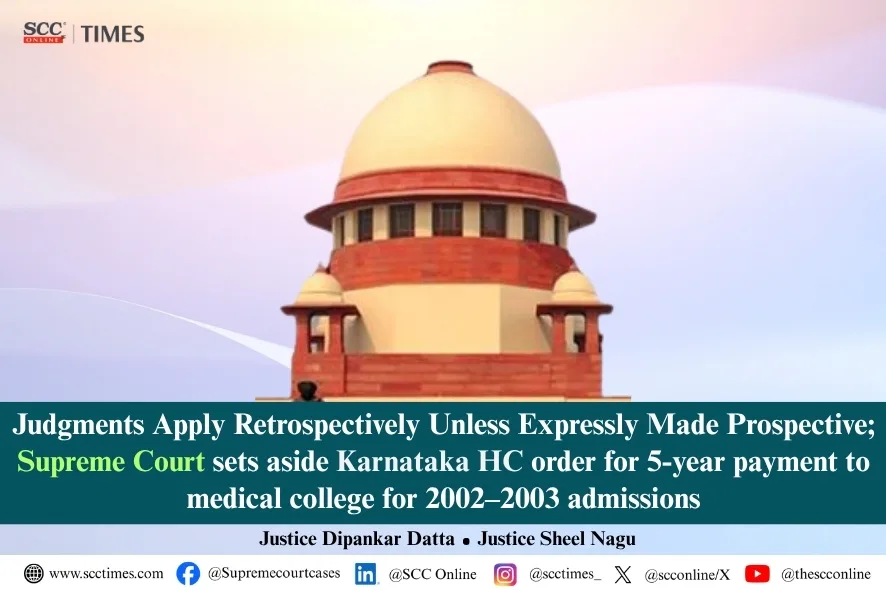
Supreme Court: In an appeal filed by the Government of India, against the Karnataka High Court’s order directing the Government of India to pay the subvention amount in respect of students admitted up to the Academic Year 2002—2003, for 5 years or until completion of the course, whichever was earlier, the Division Bench of Dipankar Datta and Sheel Nagu*, JJ., held that the subvention scheme ceased to operate upon the final decision in T.M.A. Pai Foundation v. State of Karnataka, (2002) 8 SCC 481, pronounced on 31 October 2002. The scheme could not be treated as continuing for the entire 5-year course merely because the students had been admitted while the interim scheme was in force. The Court further reiterated that a declaration of law by the Supreme Court has retrospective effect unless expressly stated otherwise. The prospective protection contemplated in T.M.A. Pai Foundation was held to apply only to statutory provisions inconsistent with the judgment and did not preserve executive schemes such as the subvention scheme. The Court also emphasised that a party seeking relief based on factual assertions must properly plead and substantiate those facts with supporting material.
Accordingly, the Court partly allowed the appeal and set aside the High Court’s direction requiring payment of the subvention amount for the entire 5-year course in respect of students admitted during the Academic Year 2002—2003.
Background
The respondent-medical college sought payment of subvention amounts under a scheme introduced pursuant to the Supreme Court’s interim order dated 11 August 1995 in T.M.A. Pai Foundation v. State of Karnataka, (1995) 5 SCC 220. Under the scheme, the Central Government extended ₹5,000 per student per annum to eligible colleges, excluding NRI students, payable until the student completed the course or for five years, whichever was earlier. The Karnataka High Court directed the Government of India to pay the subvention amount for students admitted up to the Academic Year 2002—2003 for 5 years or until completion of the course, whichever was earlier. The High Court had, however, denied the benefit of the subvention scheme to students admitted from the Academic Year 2003—2004 onwards, in view of the final decision of the 11-Judge Bench in T.M.A. Pai Foundation. The government challenged this direction before the Supreme Court.
Issue: Whether the final decision of the 11-Judge Bench in T.M.A. Pai Foundation, pronounced on 31 October 2002, extinguished the respondent-college’s entitlement to subvention payments under the earlier interim scheme, particularly for students admitted in 2002—2003.
Analysis and Decision
The Court examined whether a medical college could continue to claim the benefit of the subvention scheme introduced pursuant to the interim order dated 11 August 1995 in T.M.A. Pai Foundation, particularly in respect of students admitted in the Academic Year 2002—2003.
The Court first considered the legal effect of the final judgment in T.M.A. Pai Foundation. The subvention scheme had been introduced pursuant to the interim order of 11 August 1995, under which eligible colleges were provided ₹5000 per student per annum, subject to the final outcome of the proceedings. The underlying objective was to prevent capitation fees and ensure that merit remained the principal consideration in admissions to professional courses. However, the 11-Judge Bench in T.M.A. Pai Foundation overruled the scheme framed in Unni Krishnan, J.P. v. State of A.P., (1993) 1 SCC 645, holding it unconstitutional, while reaffirming that capitation fee and profiteering were impermissible.
A significant aspect of the Court’s analysis concerned the absence of factual material from the respondent-college. During the hearing, the Court specifically asked whether the college had produced data concerning the fees charged and expenses incurred for the Academic Year 2002—2003 and the surrounding years. The college had furnished no such data. The Court also took judicial notice that only two colleges nationally had approached it against the stoppage of the subvention amount, despite the stoppage having affected a large number of professional colleges. While the Court noted that this data was insufficient to draw an adverse inference against the respondent-college, it observed that the fact certainly carried persuasive force. Consequently, the Court was unable to determine whether the revenue generated through tuition fees and other sources was sufficient to meet the expenses incurred in running the institution. Relying on Bharat Singh v. State of Haryana, (1988) 4 SCC 534, the Court reiterated that where a legal contention depends upon facts, those facts must be properly pleaded and supported by evidence. In the absence of the necessary pleadings and supporting material, the Court held that such a contention could not be entertained.
The Court then examined the Karnataka High Court’s understanding that the final judgment in T.M.A. Pai Foundation operated prospectively and therefore did not affect the college’s entitlement arising from the earlier interim order. The Court found this interpretation to be erroneous. It noted that the clarificatory order dated 1 April 2003 in State of Karnataka v. T.M.A. Pai Foundation, (2003) 6 SCC 790 did not expressly declare the ratio of the 11-Judge Bench judgment to be prospective. Rather, that order directed the High Courts to reconsider pending matters in light of the final decision and expressly required statutory enactments, orders, schemes and regulations to be brought into conformity with T.M.A. Pai Foundation.
In determining the temporal operation of the judgment, the Court relied on the principle stated in P.V. George v. State of Kerala, (2007) 3 SCC 557 that a declaration of law by the Supreme Court has retrospective effect unless the Court specifically states otherwise. The Court also considered para 393 of the T.M.A. Pai Foundation judgment and held that the intended prospective protection was confined to statutory provisions that were contrary to the ratio laid down by the 11-Judge Bench. This protection did not extend to executive schemes or instructions such as the subvention scheme.
The Court therefore concluded that the subvention scheme ceased to operate on 31 October 2002, when the 11-Judge Bench declared the relevant scheme unconstitutional. The Court further emphasised that the obligation under the subvention scheme was an annual obligation to make payment to eligible colleges and did not create an entitlement to payment for the entire 5-year course in advance. Once the scheme itself became unconstitutional on 31 October 2002, the High Court could not direct payment of the subvention amount for the remaining years of a 5-year course merely because the students had been admitted during the Academic Year 2002—2003.
Accordingly, the Supreme Court partly allowed the appeal. It upheld the High Court orders to the extent that they denied payment of the subvention amount beyond the Academic Year 2002—2003. However, it set aside the direction requiring payment of the subvention amount for the entire 5-year course to students admitted in 2002—2003.
[Union of India v. Sri Devraj URS Medical College, 2026 SCC OnLine SC 1479, decided 4-8-2026]
*Judgment Authored by: Justice Sheel Nagu
Advocates who appeared in this case:
For Appellant(s): Mr. Brijender Chahar, A.S.G. Ms. Madhulika Upadhyay, AOR Ms. Rekha Pandey, Adv. Mr. Rohitash Singh Nagar, Adv. Mr. A Deb Kumar, Adv. Ms. Sunita Sharma, Adv. Ms. Neelakshi Bhadauria, Adv.
For Respondent(s): Dr. Sushil Balwada, AOR Mr. Kaushal Yadav, Adv. Mr. Nandlal Kumar Mishra, Adv. M/S. Lawyer S Knit & Co, AOR Mr. Mahesh Thakur, Adv. Mr. Siddharth Sati, Adv. Mr. Narveer Yadav, Adv. Ms. Ruchi Kumari, Adv. Mr. Dushyant Pratap Singh, Adv. Mr. Ranvijay Singh Chandel, Adv. Dr. Sushil Balwada, AOR Mr. Mahesh Thakur, Adv. Mr. Siddharth Sati, Adv. Mr. Narveer Yadav, Adv. Ms. Ruchi Kumari, Adv. Mr. Dushyant Pratap Singh, Adv. Mr. Ranvijay Singh Chandel, Adv. 1 Dr. Sushil Balwada, AOR