


Disclaimer: This has been reported after the availability of the order of the Court and not on media reports so as to give an accurate report to our readers.
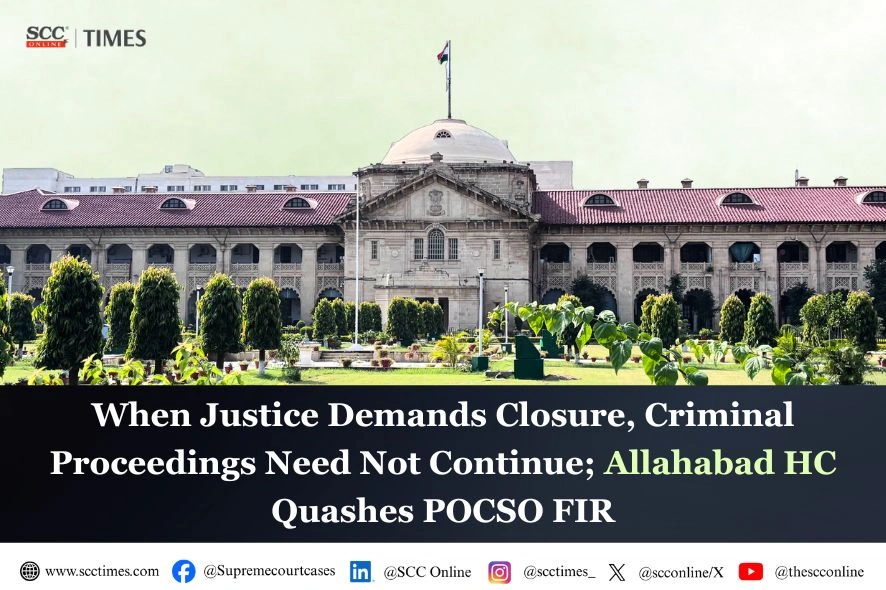
Allahabad High Court: In a writ petition seeking quashing of an FIR registered under Sections 64(1), 87 and 137(2), Nyaya Sanhita, 2023 (BNS) and Sections 5(j)(ii) and 6, Protection of Children from Sexual Offences Act, 2012 (POCSO), the Division Bench of Rajesh Singh Chauhan and Ram Manohar Narayan Mishra, JJ., allowed the petition, holding that the peculiar facts of the case, including the prosecutrix carrying the petitioner’s child, the compromise between the parties, the complainant’s unwillingness to pursue the prosecution, and the parties living together with the intention to solemnise their marriage upon the prosecutrix attaining majority, warranted quashment of the FIR to secure the ends of justice.
The petitioner and the prosecutrix were in a consensual relationship, during which the prosecutrix, who was a minor at the relevant time, became pregnant and was carrying a five-month pregnancy. The complainant, being the prosecutrix’s mother, accepted the relationship, expressed her unwillingness to pursue the criminal proceedings, and agreed to solemnise the marriage of the prosecutrix with the petitioner after she attained majority. A compromise was also executed between the parties. The State, based on the ultrasound report, verified the prosecutrix’s pregnancy. In these circumstances, the petitioner approached the High Court seeking quashing of the FIR.
Also Read: Grabbing Child’s Chest with Sexual Intent Amounts to Sexual Assault Under POCSO: Kerala HC
The Court, taking note of the peculiar facts and circumstances of the case and relying on Harmeet Singh v. State of NGCT Delhi, 2026 SCC Online Del 1707, observed that although the relationship between the petitioner and the prosecutrix was consensual, the prosecutrix was a minor when physical relations were established. The Court further noted that the prosecutrix was carrying a five-month pregnancy, the parties had entered into a compromise, the complainant and prosecutrix had agreed not to pursue the FIR, the petitioner had undertaken to solemnise the marriage with the prosecutrix upon her attaining majority, and the parties were presently living together as husband and wife.
In Harmeet Singh, the Delhi High Court had laid down a structured framework requiring courts to satisfy themselves, before quashing a POCSO case on the basis of a victim’s consent to closure, that the victim is acting on her own genuine free will and has not been misled or pressured; that she has consistently sought closure since the inception of proceedings; that the arrangement underlying the settlement is not a ruse to evade conviction; whether the parties have lived together as a family and whether children have been born of the relationship; whether the accused has been violent or coercive towards the victim; and the respective ages of the parties and the implications of any age gap. The Court also held that these considerations require it to personally interact with the parties before reaching a decision.
The Court observed that quashing the FIR would serve the ends of justice and that no fruitful purpose would be served by permitting the charge-sheet to proceed or consequential orders to be passed by the trial court. Accordingly, the Court directed the supervisory authority not to proceed further with the charge-sheet.
Allowing the writ petition, the Court quashed the impugned FIR registered under Sections 64(1), 87 and 137(2) BNS and Sections 5(j)(ii) and 6 POCSO. The Court further directed the supervisory authority not to proceed with the charge-sheet and clarified that, even if the charge-sheet had already been forwarded to the trial court, no cognizance should be taken, and no further proceedings should be conducted. The Court also directed the petitioner to properly look after the prosecutrix and provide her with all necessary care and comfort during her pregnancy.
[Pritesh Khare v. State of U.P., CRLP No. 5888 of 2026, decided on 6-7-2026]
Advocates who appeared in this case:
For the petitioner: Aviral Raj Singh, Aditya Vikram Singh, Mohd. Yasir, Mohd.Altaf Mansoor
For the respondent: G.A.