


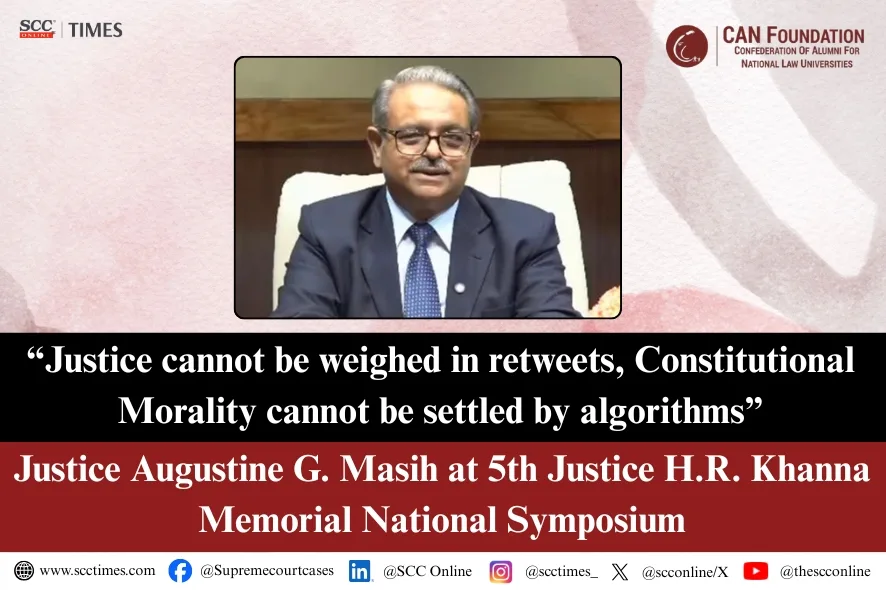
The Confederation of Alumni for National Law Universities (CAN Foundation), in collaboration with the West Bengal National University of Juridical Sciences (WBNUJS), Kolkata, and Damodaram Sanjivayya National Law University (DSNLU), Visakhapatnam, organised the 5th Justice H.R. Khanna Memorial National Symposium on 1 August 2026 to commemorate the enduring legacy of Justice H.R. Khanna. The Symposium organised under the theme “Without Fear or Favour: Reimagining Perspectives on Independent Indian Judiciary in the Digital and Globalised World”, brought together Judges, legal professionals, academicians and students to deliberate upon the evolving dimensions of judicial independence in a rapidly changing world.
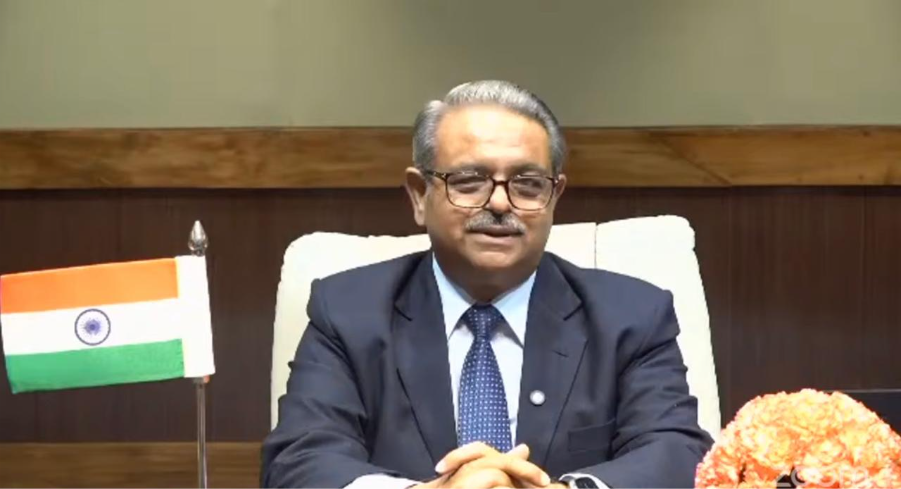
Delivering the Chief Guest address, Justice Augustine G. Masih, Judge, Supreme Court of India, paid tribute to Justice H.R. Khanna’s unparalleled constitutional legacy and reflected on the challenges confronting the judiciary in the digital age. From the meaning of judicial courage and constitutional independence to the impact of social media, artificial intelligence and technology on the administration of justice, Justice A. G. Masih’s address explored how the values embodied by Justice H.R. Khanna continue to guide courts in contemporary times.
Justice H.R. Khanna’s legacy and the meaning of judicial courage
Beginning his address, Justice A. G. Masih remarked that constitutions do not protect themselves, they derive their strength from individuals who are willing to defend constitutional values even at considerable personal cost. Reflecting on Justice H.R. Khanna’s lone dissent during the Emergency, when the Supreme Court was called upon to decide whether the State could imprison a citizen while suspending even the right to life, he observed that Justice H.R. Khanna knowingly sacrificed the office of the Chief Justice of India to uphold constitutional principle.
As Justice A. G. Masih put it:
“History has done what it does the best. It has forgotten the majority and remembered the dissent of the principled Judge. That is the anatomy of courage. Not the absence of fear but the mastery of it.”
Linking Justice H.R. Khanna’s legacy with the theme of the Symposium, Justice A. G. Masih explained that judging without fear means remaining unmoved by power, while judging without favour requires a Judge to remain free from preference. Together, these principles demand allegiance to not the Government, not the crowd, not the loudest voice of the age, but the Constitution and the Constitution alone.
He further observed that judicial independence exists not as a privilege for Judges but as a guarantee for citizens. Every litigant, he said, deserves an impartial hearing before an independent Judge, adding that public confidence remains the judiciary’s greatest asset, but also its most fragile one, taking generations to build and only a single careless act to diminish.
Courts exist to protect rights, especially when they are unpopular
Justice A. G. Masih observed that the Constitution did not establish an independent judiciary as a courtesy to Judges but as a guarantee to citizens. According to him, the doctrine of separation of powers was never intended to elevate one constitutional organ above another; instead, it ensures that the Legislature, the Executive and the Judiciary each function within their constitutional limits while remaining accountable for their own actions.
Describing the role of constitutional courts, Justice A. G. Masih noted that while they are often regarded as guardians of fundamental rights, they are equally guardians of our limits. Their greatest responsibility, he said, arises at the least convenient moment, when they are required to protect rights that may not enjoy popular support.
“Rights are never in danger when they are popular. They are in danger precisely when they are not.”
Elaborating on this idea, Justice A. G. Masih observed that freedoms applauded by society rarely require judicial intervention. Rather, it is the unpopular claim, the despised litigant, the cause with no constituency that truly tests whether a court remains independent. He cautioned that if constitutional rights were determined by counting the crowd outside the courtroom, they would cease to be rights and instead become privileges enjoyed only so long as they retained majority approval. A court that simply follows public sentiment, he remarked, has already surrendered its independence and impartiality.
Judicial independence in the digital age
Justice A. G. Masih then turned to the changing nature of the challenges confronting the judiciary. Unlike the generation of Justice H.R. Khanna, whose institutional adversaries were visible and identifiable, today’s pressures are decentralised, instantaneous and amplified by digital platforms and algorithms.
Drawing a contrast between the pace of judicial proceedings and the speed of online discourse, he observed that while a case is argued over months, it is often judged online in minutes. Evidence is tested through pleadings, arguments and cross-examination, whereas public opinion is increasingly shaped by circulation, repetition and captions rather than by the judicial record itself.
Justice A. G. Masih explained that the architecture of social media rewards qualities fundamentally different from those that define judicial decision-making. Algorithms favour speed over deliberation, emotion over reason and certainty over doubt, whereas the judicial process demands patience, openness, careful evaluation and the discipline to hear every side before reaching a conclusion.
Perhaps the greatest challenge, according to Justice A. G. Masih, is that modern pressure does not require direct interference with the judiciary. It creates what he described as a climate of expectation that surrounds the courtroom from every direction.
“This new pressure needs no messenger, no approach nor a word whispered to a Judge. Still an atmosphere simply forms. A climate of expectation so dense cultivates, that it presses upon the walls of the courtroom from every direction at once. This is the digital panopticon.”
He also cautioned against equating judicial independence with decisions that align with public expectations. Referring to an observation of a former Chief Justice of India, Justice A. G. Masih noted that courts are increasingly described as independent only when they decide cases in a manner that pleases particular sections of society, while contrary decisions invite allegations that the judiciary has been “captured.” Such an approach, he observed, fundamentally misunderstands judicial independence because a Judge who seeks to satisfy the crowd merely replaces one master with another instead of remaining faithful to the Constitution.
Technology must democratise justice, but every light also casts a shadow
Having reflected on the challenges posed by the digital age, Justice A. G. Masih was equally emphatic that technology should not be viewed only through the lens of risk. Describing it as one of the greatest democratising forces in the history of the Indian judiciary, he observed that technological innovation has fundamentally transformed access to justice by bringing courts closer to citizens across the country.
Recalling the evolution of India’s justice delivery system, Justice A. G. Masih remarked that for most of our judicial history, justice had a geography. It existed in a particular court building, in a particular city, and for many citizens, the inability to reach that courtroom often meant the inability to secure justice. Technology, however, has steadily dismantled those barriers through initiatives such as the e-Courts Project, electronic filing, digitised court records and virtual hearings, making judicial services accessible even in the remotest parts of the country.
Justice A. G. Masih also highlighted the transformative impact of the live-streaming of court proceedings. Referring to the Supreme Court’s decision in Swapnil Tripathi v. Supreme Court of India, (2018) 10 SCC 639, he observed that live-streaming has given practical effect to the long-standing principle of open justice. Students, lawyers and citizens can now witness constitutional adjudication in real time, strengthening transparency and fostering a deeper public understanding of the judicial process.
Technology, he noted, has also begun dismantling another longstanding barrier, language. Through translation initiatives, judgments that were once available only in English are increasingly becoming accessible in Indian languages.
“A law you cannot read is a law that does not fully belong to you. Every translated judgment is a small act of belonging restored.”
Justice A. G. Masih further pointed to digitised, searchable judgments carrying neutral citations and the National Judicial Data Grid (NJDG) as examples of how technology has improved transparency and public access to legal information. Reflecting on the COVID-19 pandemic, he observed that virtual hearings ensured continuity of judicial work even when physical courtrooms remained closed, while continuing to benefit undertrials, senior citizens, persons with disabilities and others for whom travelling to court poses a significant hardship.
Turning to the growing role of artificial intelligence, Justice A. G. Masih acknowledged its potential to enhance judicial administration. Research, transcription, translation and other repetitive tasks, he noted, consume considerable judicial time and can increasingly be handled through technological tools, enabling Judges to devote greater attention to adjudication. He emphasised that the judiciary has never been reluctant to embrace technological advancement.
At the same time, Justice A. G. Masih reminded the audience that technological progress inevitably brings new challenges.
“The question was never whether to embrace the light or not. But the question is what to do about the shadow that every light we embrace would now cast.”
It is precisely that shadow, he observed, which now confronts the judiciary in the form of social media trials, instantaneous public opinion and the distortion of judicial proceedings in the digital space.
Social media trials, courtroom clips and the challenge of digital justice
Turning to what he described as the darker side of technological advancement, Justice A. G. Masih observed that the greatest challenge posed by the digital age falls not upon Judges in the first instance, but upon the accused and one of the most fundamental principles of criminal jurisprudence, the presumption of innocence. Drawing lessons from the K.M. Nanavati v. State of Maharashtra, 1961 SCC OnLine SC 69, he recalled how public sentiment had once threatened to overwhelm the judicial process, ultimately leading to the abolition of jury trials in India.
While jury trials may no longer exist, Justice A. G. Masih observed that a similar phenomenon has resurfaced through digital platforms.
“The crowd has again let itself back into the courtroom. It was never reappointed. It simply walked in through everybody’s phone.”
He explained that social media has created what he described as a “shadow res judicata” – a verdict delivered by public opinion long before a court has had the opportunity to examine evidence. Even where an accused is eventually acquitted, the individual often returns to a society that had already pronounced guilt months earlier.
Drawing a cricket analogy, Justice A. G. Masih observed that social media resembles spectators celebrating an appeal before the umpire has even raised a finger. “By the time the real decision comes, the match in the mind of the spectator is already over”, he remarked, cautioning that the presumption of innocence increasingly risks becoming a courtesy we extend on paper to a man the world has already convicted on the screen.
Justice A. G. Masih also reflected on the implications of live-streaming court proceedings. Reaffirming his support for open justice, he observed that Judges routinely test arguments, pose difficult questions and think aloud during hearings. Those present in court understand that such questions are part of the deliberative process and do not represent final conclusions. However, once extracted from a lengthy hearing and circulated online without context, they can easily assume an entirely different meaning.
“Inside the courtroom, everyone present understands that a question is not a conclusion. But lift a 90-second clip out of a six-hour hearing, strip away the context, add a caption written by someone with no stake in the accuracy and a passing question hardens into a settled verdict in the public mind.”
According to Justice A. G. Masih, this phenomenon has fundamentally altered the way judicial reasoning is perceived. While legal principles ordinarily evolve through careful interpretation and precedent over time, selective clips and captions now circulate with extraordinary speed, often acquiring the appearance of authoritative judicial pronouncements despite lacking the context in which they were made.
Reflecting on the position of Judges in this environment, Justice A. G. Masih observed that the traditional image of the Judge as a detached figure no longer reflects contemporary reality. “The hermit of the twenty-first century no longer withdraws in a mountain or a forest. He sits in a glass house”, he remarked, noting that today’s judiciary functions under constant public scrutiny. While traditional legal remedies such as criminal contempt and postponement orders continue to exist, he observed that they often struggle to address the speed with which digital content is reproduced and disseminated across multiple platforms.
Transparency, judicial restraint and returning to Justice H.R. Khanna’s legacy
Justice A. G. Masih clarified that his observations were not intended to discourage transparency or openness in the judicial process. On the contrary, he emphasised that open justice remains one of the cornerstones of the legal system, observing that transparency is not the malady, but it is the medicine. The challenge, according to him, is to ensure that transparency does not give way to spectacle.
Calling for transparency without tokenism and visibility without vanity, Justice A. G. Masih cautioned Judges against the temptation to seek public approval or trade the painstaking process of writing reasoned judgments for the immediate gratification of quotable observations.
“That is the precise moment a Judge ceases to be an oracle of the law and becomes merely one more voice in the noise.”
Drawing upon the metaphor of a lighthouse, Justice A. G. Masih observed that Judges are not expected to respond to every criticism or public controversy. Instead, like a lighthouse that remains unmoved by the storm while continuing to guide those at sea, the judiciary must remain steadfast in its constitutional duty. Referring to the Bangalore Principles of Judicial Conduct, 2002, he reiterated that Judges must not be swayed by parties, public clamour or fear of criticism, reminding the audience that the Judge speaks through his judgments, and only through judgments, and that justice cannot be weighed in retweets, and constitutional morality cannot be settled by algorithmic trends.
Justice A. G. Masih further observed that preserving judicial independence is a shared responsibility. It extends beyond the Bench to advocates, law students, teachers, journalists and every stakeholder associated with the legal system. Referring to the increasing trend of converting court proceedings into edited videos, short clips and artificially generated content, he noted the Bar Council of India’s Guidelines issued on 17 July 2026 on the responsible use of social media by advocates, law students and law educators. He also referred to the Supreme Court’s recent consideration of the unregulated circulation of live-streamed court proceedings1, observing that while open justice and responsible reporting must remain protected, courtroom proceedings should not be distorted through selective editing or misleading circulation. Ultimately, however, he emphasised that neither judicial directions nor regulatory measures can substitute individual conscience, observing that while they may restrain conduct, they cannot engender the conscience.
Returning to the legacy of Justice H.R. Khanna, Justice A. G. Masih observed that although Justice H.R. Khanna lived in an era without social media or digital platforms, he confronted pressures far greater than those generated by online discourse. His enduring lesson, Justice A. G. Masih said, was that a Judge’s true shield was never contempt, nor secrecy, nor a silence imposed on others, it is the character. Judicial independence, he remarked,
“… is not a wall you raise around yourself. It is a spine you carry within.”
Concluding his address, Justice A. G. Masih reflected that while the judicial oath is administered only once, it is honoured every day through restraint, integrity and fidelity to constitutional values. Refusing to pursue applause while doing justice, he observed, is itself the unbroken oath of judicial office. Invoking the enduring example of Justice H.R. Khanna, he concluded with a call to preserve that constitutional conscience, expressing hope that it would continue to shine like a lighthouse, never to fade or go out, giving hope and showing the way to the seekers of justice.
He also thanked the CAN Foundation for organising the Symposium and expressed hope that such discussions would continue to strengthen the collective resolve of the Bench, the Bar, academia and students to preserve judicial independence and uphold the constitutional ideals that Justice H.R. Khanna so courageously embodied.
1. Harshita Grover v. Union of India, 2026 SCC OnLine SC 1393