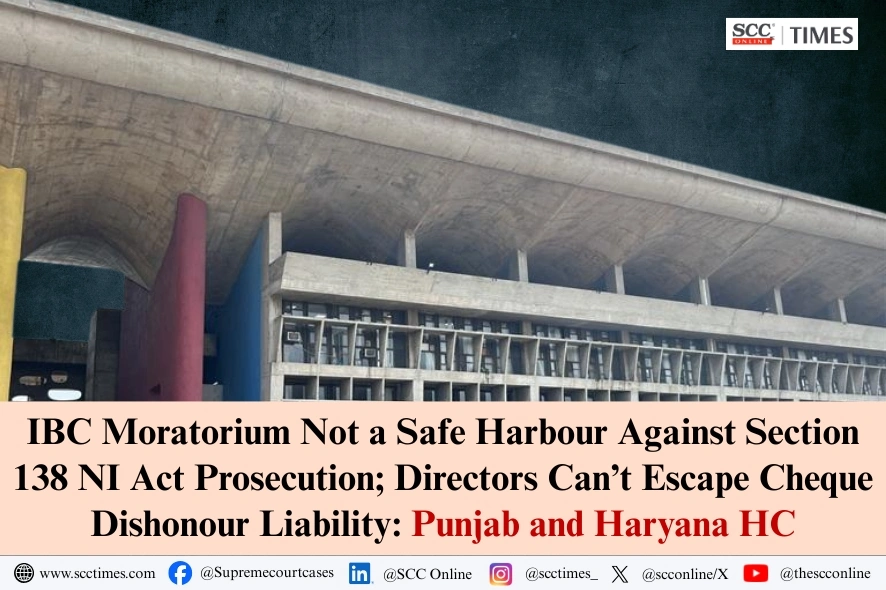
Punjab & Haryana High Court: In a petition filed under Section 482, Criminal Procedure Code (CrPC), 1973, seeking quashing of a complaint under Sections 138 and 141, Negotiable Instruments Act, 1881 (NI Act) on the ground that the accused-company had subsequently undergone the corporate insolvency resolution process (CIRP) and liquidation under the Insolvency and Bankruptcy Code, 2016 (IBC), the Single Judge Bench of Manisha Batra, J., dismissed the petition, holding that subsequent insolvency proceedings cannot efface or obliterate criminal liability already crystallised upon dishonour of cheques, and that prosecution of the persons in-charge remains maintainable despite the moratorium or liquidation.
Background
The respondent-Financial Institution extended a factoring credit facility of ₹5 crore to the accused-company. Towards discharge of its outstanding liability, the Company issued several cheques, all of which were dishonoured with the remarks “exceeds arrangement”. In total, the eight dishonoured cheques amounted to approximately ₹4.07, a substantial portion of the ₹5 crore factoring facility extended to the company. After service of the statutory demand notice and failure to make payment within the prescribed period, the respondent instituted a complaint under Section 138, NI Act, pursuant to which the petitioners were summoned to face trial as persons in charge of and responsible for the affairs of the Company.
Subsequently, the National Company Law Tribunal admitted an application under Section 7 IBC, declared a moratorium under Section 14 IBC, and thereafter ordered liquidation of the Company. The petitioners contended that continuation of the criminal proceedings was impermissible in view of the insolvency proceedings, liquidation, and appointment of an interim resolution professional and liquidator.
Analysis and decision
The Court rejected the petitioners’ contention that initiation of the CIRP and the subsequent liquidation of the accused-company rendered the proceedings under Section 138, NI Act legally impermissible. The Court observed that the cheques had been issued and dishonoured in 2015, the statutory notice had remained uncomplied with, and the complaint as well as the summoning order had been passed much before commencement of the CIRP in 2017. Since the offence under Section 138 had already stood completed before initiation of the insolvency proceedings, the subsequent CIRP and liquidation could not efface or obliterate the criminal liability arising from dishonour of the cheques.
The Court observed that the legal position was no longer res integra and relied upon P. Mohanraj v. Shah Bros. Ispat (P) Ltd., (2021) 6 SCC 258 and Ajay Kumar Radheshyam Goenka v. Tourism Finance Corpn. of India Ltd., (2023) 10 SCC 545, and reiterated that the moratorium under Section 14 IBC protects only the corporate debtor and does not absolve directors or persons in charge from their independent criminal liability under Sections 138 and 141, NI Act. The Court held that such liability is determined with reference to the accused’s status when the offence was committed, and subsequent appointment of an interim resolution professional or liquidator cannot erase the criminal liability that had already crystallised.
The Court rejected the petitioner contention that simultaneous proceedings under the IBC and the NI Act amounted to parallel proceedings, and noted that the proceedings under Section 138, NI Act are predominantly criminal in nature and the moratorium provisions under Part III of the IBC do not operate to stall or terminate the criminal prosecution. The object of the moratorium is merely to postpone civil debt enforcement and not to shield an accused from criminal accountability arising out of dishonour of cheques.
The Court noted that the petitioners sought quashing of the complaint and summoning order solely on the basis of subsequent insolvency proceedings, which was impermissible in view of the settled legal position. The Court observed that whether the petitioners were in charge of and responsible for the affairs of the Company, and whether the ingredients of Sections 138 and 141, NI Act were established, were matters to be decided by the trial court on the basis of evidence. Finding no ground to exercise its inherent jurisdiction, the Court dismissed the petition while clarifying that its observations would not influence the merits of the trial.
[Ajay Gupta v. Can Bank Factors Ltd., 2026 SCC OnLine P&H 22396, decided on 20-7-2026]
Advocates who appeared in this case:
For the petitioner: Sandeep Wadhawan, Nimanyu Gautam, Advocate
For the respondent: Ajay Gupta Advocate
Buy Code of Criminal Procedure, 1973 HERE