Disclaimer: This has been reported after the availability of the order of the Court and not on media reports so as to give an accurate report to our readers.
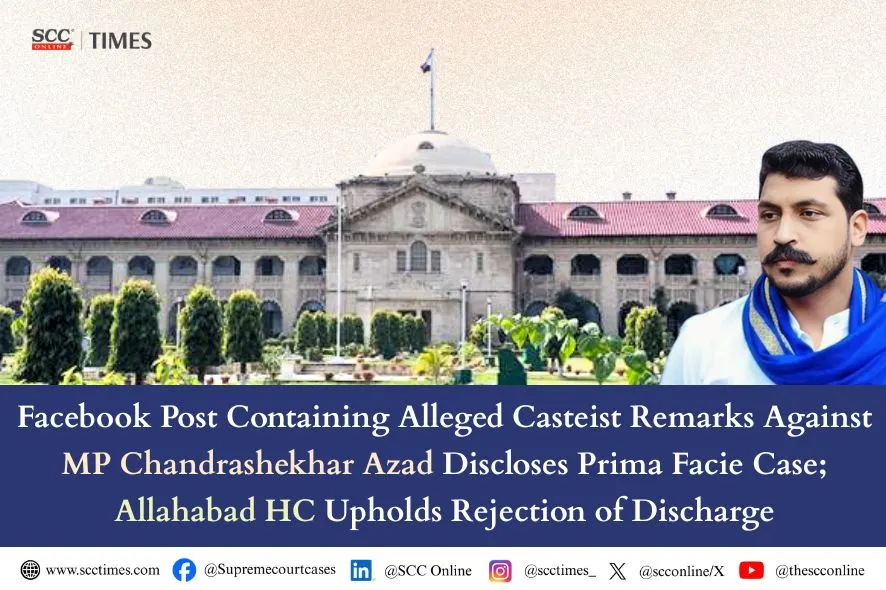
Allahabad High Court: In an appeal against the rejection of a discharge application, arising from an alleged casteist Facebook post against Member of Parliament (MP) Chandrashekhar Azad, registered under Section 352, Nyaya Sanhita, 2023, Section 66, Information Technology Act, 2000 and Section , 3(1), Scheduled Castes and Scheduled Tribes (Prevention of Atrocities) Act, 1989 (SC/ST Act), the Single Judge Bench of Santosh Rai, J., dismissed the appeal, holding that at the stage of discharge or framing of charge, the Court is only required to ascertain whether the material on record discloses a prima facie case or raises grave suspicion against the accused, and cannot undertake a mini-trial. The Court held that the Facebook post collected during investigation, coupled with the statements of prosecution witnesses referring to the alleged caste-based abuses, constituted sufficient material to proceed with the trial.
Background
The appeal arose from an order rejecting the appellant’s discharge application in a case registered under Section 352, Nyaya Sanhita, 2023, Section 66, Information Technology Act, 2000 and Section , 3(1), SC/ST Act. The appellant contended that the FIR suffered from an unexplained delay of about 7 days, omitted the specific casteist words allegedly used, and failed to disclose the essential ingredients of the offence under the SC/ST Act and further submitted that the trial court had mechanically rejected the discharge application without properly appreciating the material placed on record.
Analysis and decision
The Court noted that though the FIR does not possess the specific casteist words allegedly used but later during investigation, the investigating officer (IO) recovered the Facebook post containing the alleged objectionable statements and placed the relevant material on record. On a prima facie examination, the Court found that the remarks appeared to have been directed against a Scheduled Caste community. The Court also noted the statements of prosecution witnesses, including who specifically referred to the alleged abusive caste-based remarks, supporting the prosecution case.
The Court observed that, at the stage of summoning or framing of charge, the Court is only required to examine whether a prima facie case is made out and is not expected to conduct a mini-trial or meticulously appreciate the evidence. Reiterating the settled principles governing discharge and framing of charge, the Court observed that at this stage of consideration of discharge or framing of charges, the Court is required to determine whether the material on record is sufficiently strong to indicate the commission of the alleged offence, the charge is liable to be framed.
Holding that the trial court had rightly rejected the appellant’s discharge application, the Court found that the impugned order was well-reasoned and suffered from no illegality, perversity or infirmity warranting interference. Accordingly, the Court dismissed the criminal appeal and directed the Registrar (Compliance) to serve a copy of the order to the Court concerned through the District & Sessions Judge within 1 week.
[Chandra Prakash Singh v. State of U.P., 2026 SCC OnLine All 22862, decided on 21-7-2026]
Advocates who appeared in this case:
For the appeallant: Ajatshatru Singh, Prem Shankar
For the respondent: G.A.