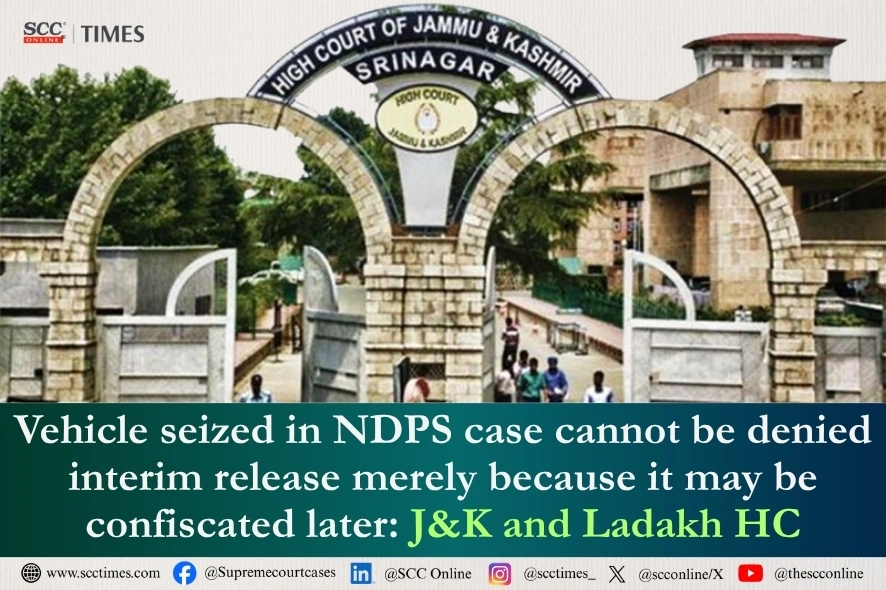
Jammu & Kashmir and Ladakh High Court: While deciding a criminal revision petition challenging an order of the Additional Sessions Judge (NDPS Cases), Rajouri, refusing interim release of a vehicle seized in an NDPS case, a Single Judge Bench of M.A. Chowdhary, J., held that vehicle seized in NDPS case cannot be denied interim release merely because it may be confiscated later. The Court set aside the impugned order and held that a vehicle seized in NDPS case can be released on supardari pending trial.
Also Read: Cal HC: Driver Not in Constructive Possession of Passenger’s Contraband
Background
The revision petition arose from an order dated 6 September 2025 whereby the trial court rejected the application seeking release of a vehicle seized in connection with an FIR registered for offences under Sections 8/21/22/25/29, Narcotic Drugs and Psychotropic Substances Act, 1985 (NDPS Act).
According to the prosecution, on 14 May 2025 a police party during naka duty checked the vehicle while it was travelling from Rajouri towards Bufliaz. 4 persons, including the driver, were present in the vehicle. During the search, 2 white polythene pouches containing heroin-like substance weighing approximately 18—19 grams in total were allegedly recovered from the dashboard. Certain tablets, a silver foil piece and a 10-rupee note were also recovered. An FIR was thereafter registered, the accused were arrested and the vehicle was seized during investigation.
The petitioner challenged the refusal to release the vehicle, contending that the trial court had rejected the application without due application of mind. It was argued that the vehicle had been lying outside the police station for a long period and was likely to suffer damage by being subjected to natural decay. It was further submitted that the quantity allegedly recovered was only an intermediate quantity and that the petitioner was willing to furnish superdnama and comply with any conditions imposed by the Court. The petitioner also contended that the mere fact that a vehicle may be subject to confiscation proceedings at the conclusion of trial cannot be a valid basis for refusing interim release.
On the other hand, the respondents submitted that the vehicle was used for transportation of narcotic drugs, that the owner himself was involved in the commission of the offence, and that the vehicle constituted material evidence directly linked to the offence. It was further contended that the vehicle was required for confiscation proceedings and that there was a possibility of its being used again for transportation of contraband if released.
Analysis
The Court examined Section 497, Nagarik Suraksha Sanhita, 2023 (BNSS) and noted that the trial court/Magistrate is obligated to deal with seized property within prescribed timelines. Within 15 days of its production, the court must prepare an inventory and ensure its photography/videography for evidentiary purposes. Thereafter, within 30 days of preparing such inventory and visual record, the court is required to pass appropriate orders for the property’s disposal, including destruction, confiscation, or delivery.
The Court further noted that Sections 60(3) and 63, NDPS Act provide for confiscation of conveyances used in the commission of offences under the Act but do not prohibit consideration of an application seeking interim release of a vehicle during investigation or trial. The Court observed that any order granting interim custody is temporary in nature and remains subject to the final outcome of confiscation proceedings.
The Court further noted that Sections 52 and 52-A, NDPS Act primarily deal with disposal of seized narcotic substances and do not confer power upon the Drugs Disposal Committee to adjudicate ownership claims in respect of seized conveyances. The Court observed that the power to examine such claims, remains with the Special Court under Sections 60 and 63, NDPS Act.
The Court highlighted that confiscation under Section 60(3) is not automatic. A seized conveyance becomes liable to confiscation only when the owner fails to prove that it was used without his knowledge or connivance. Determination of such issues necessarily arises at the stage of conclusion of trial. The Court therefore opined that interim custody cannot be denied merely because the vehicle may eventually become liable to confiscation.
The Court relied on Sunderbhai Ambalal Desai v. State of Gujarat, (2002) 10 SCC 283, wherein it was held that powers relating to release of seized property are intended to prevent deterioration and unnecessary retention of property in official custody.
The Court further observed that the object and scheme of both the procedural law and the NDPS Act indicate that seized property ought not to remain in police or court custody longer than absolutely necessary. Addressing the argument that the vehicle constituted material evidence, the Court observed that such concerns could adequately be addressed by directing preparation of videography, still photographs and authenticated inventories.
The Court emphasised that there is no specific bar under the NDPS Act against interim return of a vehicle used for transportation of narcotic drugs or psychotropic substances. The Court observed that continued retention would only reduce the vehicle’s value and subject it to avoidable deterioration.
Also Read: Del HC Grants Bail in NDPS Case Over Section 42 Compliance
Decision
Allowing the revision petition, the Court set aside the impugned order and directed release of the vehicle on interim supardari in favour of the registered owner. The Court directed preparation of videography and still photographs of the vehicle and required authentication of all identification records by the investigating officer, the owner and the accused.
The Court further directed the petitioner to furnish an undertaking that he would neither sell nor transfer the vehicle during pendency of the trial and that he would surrender the vehicle within 1 week of any such direction, or pay its value as determined in accordance with income-tax law at the time of release, if ultimately ordered by the Court.
[Anjum Rafiq v. State (UT of J&K), Crl R No. 89 of 2025, decided on 6-7-2026]
Advocates who appeared in this case:
For Petitioner: Mahmood A. Shaad, vice Abrar Ahmed Khan, Advocate.
For Respondents: Bhanu Jasrotia, GA.