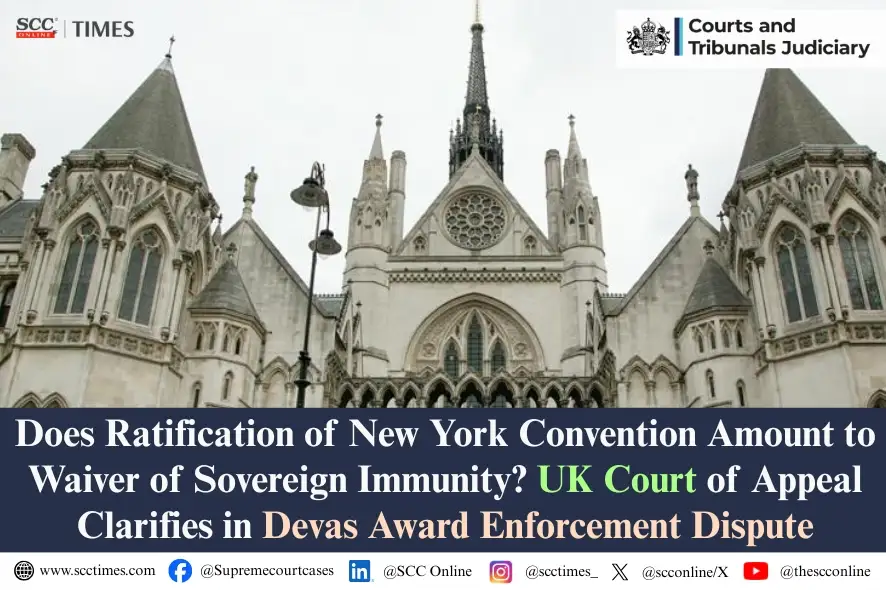
United Kingdom Court of Appeal: In an appeal concerning Devas Award Enforcement Dispute rendered under the India—Mauritius Bilateral Investment Treaty, Lewson, Newey, and Phillips, LJJ., considered whether India’s ratification of the Convention on the Recognition and Enforcement of Foreign Arbitral Awards, 1958 (New York Convention) amounted to a submission to the jurisdiction of English courts. The Court held that Article III of the Convention does not waive sovereign immunity, as recognition and enforcement of arbitral awards remain subject to the procedural law of the enforcing State, within which State immunity is a recognised procedural bar. Consequently, ratification of the New York Convention does not constitute a clear and unequivocal consent by a State to enforcement proceedings before English courts under the State Immunity Act, 1978 (SIA), and accordingly dismissed the present appeal.
Background
The dispute arose from investments made by the Mauritian claimants in Devas Multimedia Private Limited (‘Devas’), an Indian company. In 2005, Devas entered into an agreement with Antrix Corporation Limited (‘Antrix’), a Government of India-owned entity, for the lease of a portion of India’s S-Band spectrum to provide multimedia services across India. In 2011, India’s Cabinet Committee on Security decided to terminate the project on the ground that the spectrum was required for national purposes, following which Antrix terminated the agreement.
The claimants commenced investment treaty arbitration alleging that India’s actions breached protections under the India-Mauritius Bilateral Investment Treaty. Rejecting India’s principal jurisdictional objections, the Tribunal held that India had breached its obligation to accord fair and equitable treatment to the claimants and made awards in their favour. On 29-6-2021, the Commercial Court granted permission to enforce the awards as judgments of the English court. India subsequently challenged the enforcement order and asserted sovereign immunity under Section 1 SIA.
India contended that the arbitration exception under Section 9 SIA was unavailable because the dispute did not fall within a valid written agreement to arbitrate. The claimants, meanwhile, advanced an independent argument that India, by ratifying the New York Convention, had already submitted to the adjudicative jurisdiction of English courts and thereby waived immunity under Section 2 SIA.
The Commercial Court directed trial of a preliminary issue on whether India’s ratification of the New York Convention amounted to a prior written agreement submitting it to the jurisdiction of English courts under Section 2(2) SIA. Answering the issue in the negative, Sir William Blair held that Article III New York Convention preserves State immunity, as enforcement under the Convention remains subject to the procedural law of the enforcing State. Aggrieved, the claimants preferred the present appeal.
Analysis, Law, and Decision — Devas Award Enforcement Dispute
1. Meaning of “Rules of Procedure” under Article III
Examining Article III of New York Convention, the Court observed that the obligation to recognise and enforce arbitral awards is not absolute. Rather, it is expressly qualified by the requirement that enforcement be carried out “in accordance with the rules of procedure of the territory where the award is relied upon”. The Court emphasized that under both English and international law, State immunity is consistently regarded as a procedural rule. Since sovereign immunity operates as a bar to the exercise of jurisdiction rather than affecting the substantive merits of a claim, the ordinary meaning of the phrase “rules of procedure” naturally includes domestic rules relating to State immunity.
2. Article III New York Convention Preserves Rather Than Excludes Sovereign Immunity
The Court rejected the appellants’ contention that the phrase “rules of procedure” should be interpreted narrowly to exclude sovereign immunity. It held that Article III of New York Convention must be read as a whole, and that the obligation to recognise and enforce arbitral awards cannot be separated from the qualification that such enforcement must be carried out in accordance with the procedural rules of the enforcing State. The Court further observed that accepting the appellants’ interpretation would lead to the far-reaching consequence that States could be treated as having waived not only adjudicative immunity but also immunity from execution, even though the New York Convention contains no express reference to either form of immunity.
3. Distinction Between the New York Convention and the Convention on the Settlement of Investment Disputes 1965 (ICSID Convention)
The Court further distinguished the New York Convention from the ICSID Convention, observing that the ICSID Convention establishes a self-contained enforcement framework specifically designed for disputes between Contracting States and foreign investors. In contrast, the New York Convention governs the recognition and enforcement of foreign arbitral awards generally and expressly makes such enforcement subject to the procedural law of the enforcing State. In these circumstances, the Court held that the Supreme Court’s reasoning in Infrastructure Services Luxembourg SARL v. The Kingdom of Spain, [2024] EWCA Civ 1257, could not simply be read across to Article III of the New York Convention or lead to the conclusion that it constitutes a submission to jurisdiction.
Thus, the Court held that Article III of the New York Convention does not amount to a clear and unequivocal waiver of sovereign immunity and does not constitute a prior written agreement submitting a State to the jurisdiction of English courts and accordingly dismissed the present appeal.
[CC/Devas (Mauritius) Limited v. Republic of India, [2026] EWCA Civ 797, decided on 24-6-2026]
Advocates who appeared in this case:
For the Appellants: Tom Sprange KC, Ruth Byrne KC and Kabir Bhalla (instructed by King & Spalding International LLP).
For the Respondent: Sudhanshu Swaroop KC (instructed by White & Case LLP).