Disclaimer: This has been reported after the availability of the order of the Court and not on media reports so as to give an accurate report to our readers.
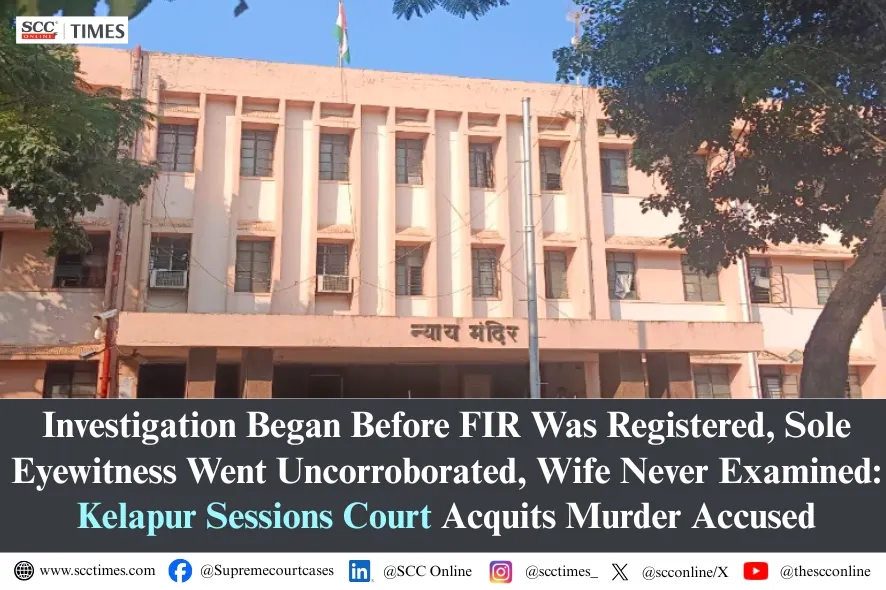
Additional Sessions Judge, Kelapur, District Yavatmal: In a sessions trial arising out of Section 302 of the Penal Code, 1860 (IPC), the Single Judge Bench of Manish A. Kothari, J., held that although the prosecution successfully established that the deceased died a homicidal death, it failed to prove beyond reasonable doubt that it was the accused who had committed the offence. The Court observed that the investigation had commenced even before registration of the FIR, documents prepared prior to the FIR bore the crime number, and the testimony of the sole eyewitness remained uncorroborated by reliable independent evidence. The Court found that the prosecution had failed to prove the charge beyond reasonable doubt, and thus, extended the benefit of doubt to the accused and acquitted him.
Background
The prosecution alleged that on 16 June 2022, at about 4.00 a.m., the accused, who was a tenant of the deceased, assaulted the deceased on the head with a grinding stone (“Pata”) following a dispute over arrears of rent and vacating the rented premises. The deceased’s brother claimed to have witnessed the incident and subsequently lodged a report, based on which FIR under Section 302 IPC was registered.
After completion of investigation, a charge-sheet was filed against the accused. The Sessions Court framed charge under Section 302 IPC. The accused pleaded not guilty and claimed false implication.
Analysis
The Court at the very outset reiterated the golden rule of criminal jurisprudence, that entire duty to prove each and every ingredient of the offences under charge lies on the shoulder of the prosecution, and that the prosecution has to prove every element of criminal charge beyond reasonable doubts, whereas the accused is required to prove the defence by preponderance of probability. The Court observed that the prosecution evidence must satisfy the test of consistency, with the evidence of all witnesses forming a coherent chain.
The Court noted that the prosecution primarily relied on the testimony of the informant and brother of the deceased, who alleged that the accused assaulted the deceased with a grinding stone (“Pata”) following a dispute over the rented premises. While the medical evidence established that the deceased had suffered a homicidal death due to intracranial haemorrhage caused by a severe head injury, the Court found the timing and chronology of the incident and investigation to be of crucial significance. The Court observed that although the alleged incident occurred at about 4.00 a.m. on 16 June 2022, the FIR under Section 302 IPC was registered only at 9.58 a.m., despite the informant admitting that, prior to lodging the report, the police had already visited the spot, prepared the inquest panchanama, issued notices to panch witnesses and sent the body for post-mortem. The Court further observed that while the informant had not informed the police immediately after the incident, the Investigating Officer (I.O.) claimed to have acted on information received from an unidentified villager, whose identity, the relevant station diary entry, and the source of such information were neither brought on record nor investigated.
“Neither formal statement of that person was recorded during the investigation nor the I.O. had taken pains in finding the person who has given information on the strength of which he had visited the spot.”
The Court observed that the I.O. had commenced the investigation even before registration of FIR. The murder case was officially registered only at 9:58 a.m., while the police issued notices for inquest and spot panchanama at 6:00 a.m. mentioning that exact crime number, this mismatch in timing casts doubt on the fairness and legality of the investigation, the Court noted this to be an important lacuna in the prosecution case. The Court found that the summons issued under Section 175 Criminal Procedure Code, 1973 (CrPC), to the panch did not specify the date, place or time for the panchanama, yet the panch witnesses remained present for the inquest. The Court also found discrepancies in the prosecution’s evidence based on cross-examination of Siddharth (PW-2), who admitted that the dead body was not lying at the spot during the panchanama and that the recital to the contrary in the spot panchanama was incorrect. He further admitted that the seizure and sealing of the alleged weapon was not proved to have been effected in his presence and that he could not identify the clothes allegedly seized from the accused, as the accused was not present at the time of seizure.
The Court found it highly improbable that the inquest panchanama commenced at 6.15 a.m., the very time at which the panch witness received intimation to remain present as a panch despite residing about 3 km from the spot. The Court noted material contradictions regarding the place of preparation of the inquest panchanama, as the informant and the panch witness stated that it was prepared at the deceased’s house, whereas the I.O. deposed that it was prepared at the hospital after the deceased had been shifted there. The Court noted that the spot panchanama records the dead body as being present at 11:00 a.m., whereas the evidence and PW2’s testimony indicate that the body had been removed several hours earlier, casting doubt on the credibility of the panchanama.
The Court found that the testimony of the sole eyewitness, the informant, did not inspire confidence, as despite allegedly witnessing the assault, he neither attempted to apprehend the accused nor raised any alarm or immediately informed the police. The Court noted that no independent witness was examined to corroborate either the alleged tenancy dispute or the occurrence of the incident, and even the informant’s wife, who was stated to have accompanied him, was not examined. The Court observed that the unexplained delay in lodging the FIR, the doubtful investigation conducted prior to its registration, the absence of independent corroboration, and the material inconsistencies in the prosecution evidence cumulatively created serious doubt about the prosecution case. The Court further observed that in spite of knowing the fact that the investigation carried out by him will be illegal, the I.O had continued the investigation and prepared document which is damaging to the case of the prosecution. The Court concluded that the prosecution had failed to corroborate the testimony of the sole eyewitness and that the investigation suffered from serious lapses, rendering the inquest, spot and seizure panchanamas unreliable. The unexplained delay in lodging the FIR and the commencement of investigation before its registration, with documents bearing a crime number not then in existence, further undermined the prosecution case.
Decision
Holding that the prosecution had failed to prove beyond reasonable doubt that the accused had intentionally caused the death of the deceased by assaulting him with a grinding stone, the Court extended the benefit of doubt to the accused and acquitted him of the charge. The Court directed the accused to be released forthwith, if not required in another case, upon furnishing bail bonds.
[State of Maharashtra v. Rakesh Babulal Kewat, 2026 SCC OnLine Dis Crt (Bom) 8, decided on 4-7-2026]
Advocates who appeared in this case:
For the petitioner: R.D.More, A.P.P
For the respondent: S.M. Lodha