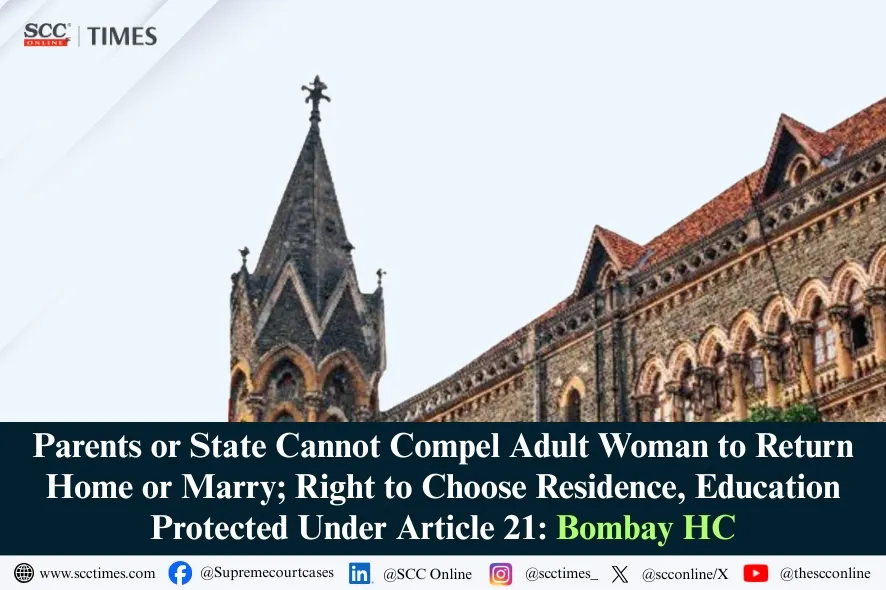
Bombay High Court: While hearing a writ petition filed by a 21-year-old woman seeking protection against coercion from her parents and the State, the Division Bench of Ravindra V. Ghuge, ACJ., and Gautam A. Ankhad*, J., observed that the petitioner, being an adult, is legally competent to decide her residence, marriage, and education. The Court noted that she had voluntarily left her parental home as she was unwilling to marry against her wishes and expressed her desire to pursue higher education. The Court held that neither her parents nor the State could compel her to return home and further emphasised that such matters of personal choice are protected under Article 21 of the Constitution.
Background
The petitioner had completed her education up to the 12th Standard and was residing with her parents in Hyderabad. On 15 June 2026, she voluntarily left her parental home as she was unwilling to marry her cousin, who was approximately 10 years older. She asserted her aspiration to pursue higher education and attain financial independence, but her parents were unwilling to permit her to do so. She described her family as extremely conservative and orthodox, where she had little freedom to express her views and was subjected to emotional trauma.
Following her departure, her parents lodged a missing person complaint with the Hyderabad Police. Apprehending coercion to marry against her wishes and alleging threats from her family, she filed the present petition seeking protection and restraint against coercive action.
It was contended that she should not be coerced into returning home and must be protected from threats. The parents, represented through counsel, assured the Court that she would not be compelled to marry against her wishes and that her education would not be obstructed. The State opposed coercive relief but participated in the proceedings.
Analysis
The Court further noted that the petitioner clarified that apart from her apprehension of being compelled to marry against her wishes and being prevented from pursuing her education, she has no grievance against her adoptive parents, with whom she has been since the age of 2 months. However, she expressed a genuine apprehension that certain members of her biological family and community may attempt to compel her to return to Hyderabad or otherwise cause harm.
After hearing the petitioner and her parents separately, the Court afforded them an opportunity to interact with each other. However, despite the earnest requests and assurances extended by her parents, the petitioner unequivocally reiterated that she was not willing to return to her parental home at present. At the same time, she assured her parents that she would remain in regular communication with them and that they need not have any concern regarding her safety and well-being and should not track her.
Having interacted extensively with the petitioner as well as her parents and having considered the pleadings, the Court is satisfied that the petitioner has voluntarily left her parental home and is acting out of her own free will. The Court emphasised that she is an adult, being 21 years of age, and is legally competent to decide where she wishes to reside, whether she wishes to marry, and whether she desires to pursue higher education.
The Court further opined that these are matters of personal choice and part of the rights under Article 21 of the Constitution. Neither her parents nor the State can compel her to return to her parental home against her wishes. The Court observed that the assurances stated in the affidavit tendered by the petitioner’s parents are accepted, however, such assurances cannot override the petitioner’s choices, which she has repeatedly affirmed before this Court.
In these circumstances, the Court noted that there is no justification for treating the petitioner as a missing person or for continuing any coercive process intended to secure her return to Hyderabad. Since the Court has personally interacted with the petitioner and is satisfied that she is acting voluntarily, the Telangana Police shall take appropriate steps to close the missing person report lodged by the petitioner’s parents in accordance with law. The Court further held that the petitioner shall not be compelled, directly or indirectly, to return to her parental home or be subjected to any pressure under the threat of criminal proceedings or otherwise.
Decision
Accordingly, the petition was allowed in terms of prayer clause and the rule was made absolute.
[Safia Sultana v. State of Maharashtra, 2026 SCC OnLine Bom 5211, decided on 2-7-2026]
*Judgment authored by: Justice Gautam A. Ankhad
Advocates who appeared in this case:
For the Petitioner: Mihir Desai, Senior Advocate a/w Devyani Kulkarni, Rishika Agarwal, Sanskruti Yagnik,
For the Respondent: M. M. Deshmukh, APP, Swati Sinha, Advocates
Buy Constitution of India HERE