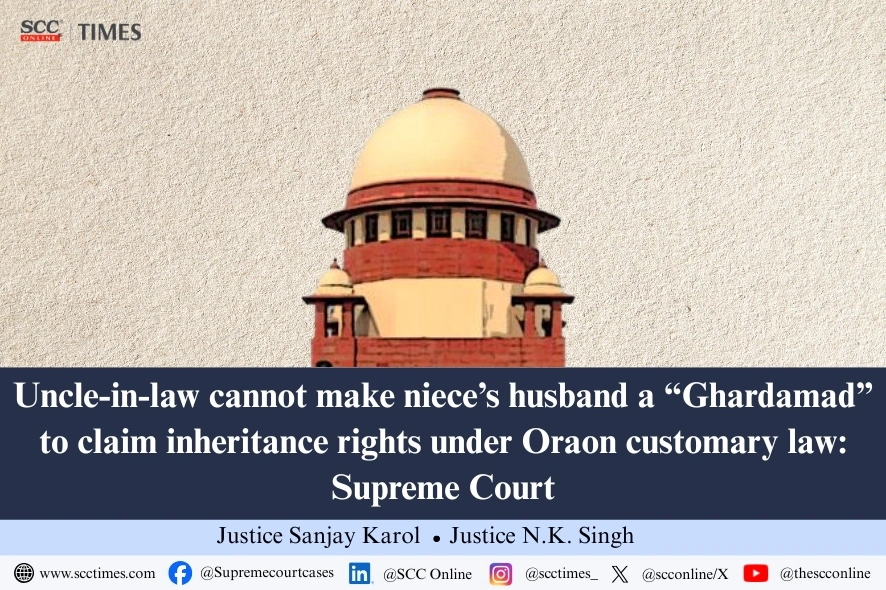
Supreme Court: In a significant ruling on the proof of customary law governing Oraon tribal succession, the Division Bench of Sanjay Karol* and N.K. Singh, JJ. held that an uncle-in-law cannot induct his niece’s husband as a ghardamad (resident son-in-law) under the recognised customary law of the Oraon tribal community to confer inheritance rights over ancestral property. The Court reiterated that the party relying upon a custom bears the burden of proving its existence, antiquity, certainty, and continuous observance, and that courts cannot recognise or enforce an unproved custom. Accordingly, finding that the respondents had failed to establish the alleged custom, the Court set aside the concurrent judgments of the trial court, the First Appellate Court, and the Jharkhand High Court, and allowed the appeal.
Background
The dispute arose over succession to ancestral property governed by the customary law of the Oraon tribe. The appellant claimed entitlement to the disputed property as the nearest male agnate after the death of the last male holder, contending that daughters had no right of inheritance under the applicable custom. The respondents, however, asserted title on the basis that the deceased landowner, who had no children, had taken his niece’s husband as his ghardamad, entitling him to inherit the property. They also relied upon a deed described as a partition/lease deed executed in their favour. The trial court dismissed the appellant’s suit, holding that the ghardamad had validly acquired rights over the property. The First Appellate Court and the Jharkhand High Court affirmed the decree, leading to the present appeal before the Supreme Court.
Analysis and Decision
The Court examined whether the respondents had successfully established the customary law on which their claim rested. Reiterating the settled principles governing proof of custom, the Court held that the party relying upon a custom bear the burden of proving its existence, antiquity, certainty, reasonableness, and continuous observance. Referring to Section 48, Evidence Act, 1872 (IEA) and earlier precedents, the Court observed that customs cannot be presumed merely because they are pleaded and must be proved through cogent evidence, recognised public records, or consistent testimony of persons acquainted with the custom.
Upon analysing the oral evidence, the Court found significant inconsistencies in the respondents’ case regarding inheritance, partition, and the rights of daughters and ghardamads. While the evidence sufficiently established the existence of a custom permitting a ghardamad to inherit the property of his father-in-law, no evidence proved the distinct custom that an uncle-in-law could adopt his niece’s husband as a ghardamad and thereby confer inheritance rights. The Court further held that the courts below had misapplied the customary law without appreciating that the recognised custom contemplated adoption of a ghardamad only by the landowner or his widow, and not by an uncle-in-law.
The Court also held that the alleged partition or lease deed did not confer title. If it was a lease deed, it could not create ownership rights; if it was a partition deed, it was ineffective because partition can take place only between persons having pre-existing shares in the property. Since the respondents failed to establish any valid title under customary law, the document was of no assistance to their case.
The Court further observed that although it ordinarily does not interfere with concurrent findings of fact under Article 136 of the Constitution, interference is justified where such findings are based on a misapplication of law, unsupported by evidence, or are otherwise perverse. In the present case, the concurrent findings suffered from these defects as they were founded upon an unproved custom.
The Court held that the respondents had failed to prove the customary law entitling an uncle-in-law to adopt his niece’s husband as a ghardamad for the purpose of succession. Relying on the established principles of Oraon customary law, the Court held that, in the absence of a validly recognised ghardamad or any other eligible male heir, the property would devolve upon the nearest male agnate. Accordingly, the Court set aside the judgments of the trial court, the First Appellate Court, and the Jharkhand High Court, decreed the appellant’s suit, and allowed the appeal.
[Bejla Oraon v. Kali Das Oraon, 2026 SCC OnLine SC 1302, decided on 9-7-2026]
*Judgment Authored by: Justice Sanjay Karol
Advocates who appeared in this case:
For Petitioner(s): Mr. Rajan Raj, Adv. Ms. Mohini Priya, AOR Ms. Sayesha Gambhir, Adv.
For Respondent(s): Mr. Vinod Chauhan, Adv. Mr. Ajit Kumar Bhagat, Adv. Mr. Pradeep Kumar, Adv. Mr. Ashutosh Parasher,Adv. Mr. Anubhav, AOR