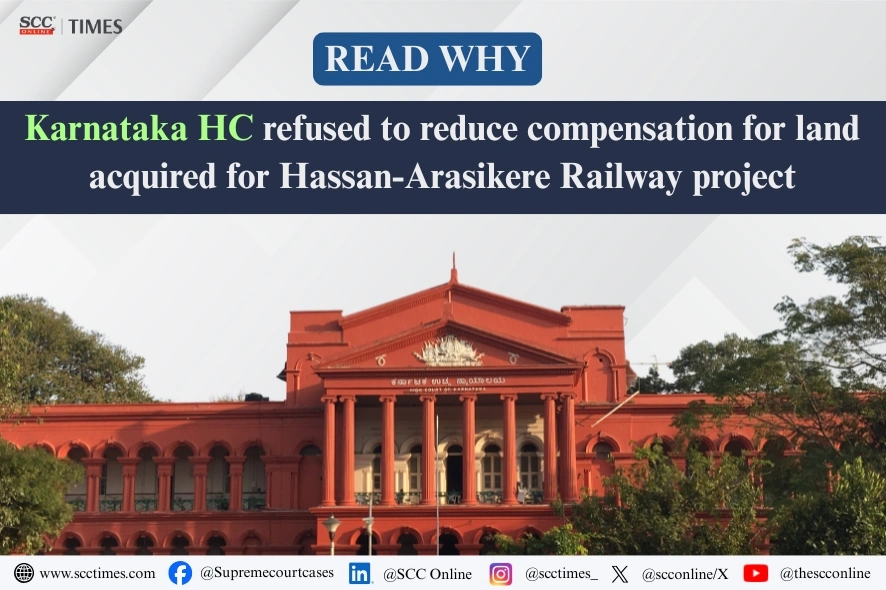
Karnataka High Court: In appeals filed under Section 54(1), Land Acquisition Act, 1894 (Land Act) challenging enhancement of compensation for land acquired for the Hassan- Arasikere Railway project, the Division Bench of Anu Sivaraman and Tara Vitasta Ganju*, JJ., held that although the Reference Court had relied on judgments that were later set aside on appeal, the claimants had independently produced contemporaneous evidence, including sale deeds and proof the land’s locational advantages, sufficient to sustain the enhancement. Accordingly, the Court declined to interfere with the compensation awarded and dismissed the appeals.
Background
In the present case, Special Land Acquisition Officer issued notifications under Section 4(1), Land Act, for acquisition of the land belonging to the respondents in December 2010 and January 2011. The final notification was issued in August 2011 under Section 6(1), Land Act. The purpose of the said acquisition was for the extension of the railway line of the Hassan-Arasikere Railway project.
Subsequently, the Special Land Acquisition Officer affixed the compensation at ₹1,04,800 per acre or ₹2620 per gunta. Being dissatisfied, enhancement was sought by filing a reference petition under Section 18(1), Land Act. The appellants along with Respondents 2 and 3 filed objections to the petition contending that the appellants adopted a scientific method of assessment of the said acquired lands. It was further stated that the land acquired was not fertile but waste land for forming railway new broad-gauge and that they had invested huge amounts in the project for the interest of public.
The Reference Court enhanced compensation to ₹1,00,000 per gunta with solatium at 30 per cent considering the evidence placed on record that crops were being grown in the said acquired lands and relying on R. Rajagopalashetty v. LAO 2015 SCC OnLine Dis Crt (Kar) 1 (Rajagopalashetty case) and Eeramma v. LAO 2015 SCC OnLine Dis Crt (Kar) 2 (Eeramma case) passed by the Additional Senior Civil Judge.
Aggrieved, the appellants approached the High Court stating that the Reference Court did not undertake an independent assessment.
Issues
-
Whether or not the Reference Court was justified in relying on the judgments for determining the market value of the acquired lands.
-
Whether or not the enhancement of compensation to ₹1,00,000 was sustainable in view of subsequent developments affecting the basis of such determination.
Analysis
The Court reiterated that “while exemplar awards/sale instances may legitimately form the basis for determination of compensation, the Court is nevertheless required to independently assess comparability and surrounding circumstances before mechanically adopting the rate determined therein”.
The Court stated that the Eeramma case could not be relied upon, since the preliminary notification was of a different date and the land was not similarly situated and that the purpose of acquisition was also entirely separate. Further, the Court stated that the said case was in view of the fact that the claimants did not produce sufficient evidence in support of their claim, however, in the present case the Reference Court did not take into account the evidence produced by Respondent 1. The Court held that the fact that the land had crops and yield as was referenced by Respondent 1 could not be refuted. The Court further specified that by way of exemplars, the respondents produced 3 sale deeds which were all of the same vicinity as the acquired land but the prices for the lands in sale deeds were at variance, reflecting the amount from ₹1,07,000 per gunta as the highest exemplar.
The Court further noted that the respondents had placed reliance on other judgments wherein the market value had been determined at ₹81,675 and ₹1,00,000 per gunta respectively, however, these exemplars were not relied upon by the Reference Court as they related to lands situated in different villages. The Court further noted that the respondents had produced other documentary evidence, including the tax demand register along with a sale deed reflecting a value of approximately ₹1,07,000 per gunta. The Court held that the respondents had adduced sufficient contemporaneous evidence to establish the value and potentiality of the acquired land, which was situated close to Hassan Airport.
Thus, even though the judgments relied upon by the Reference Court for fixing compensation were later set aside on appeal, the claimants’ own contemporaneous evidence, including crop yields, sale deeds, and proof of locational advantage, independently justified the enhancement.
Decision
Thus, the Court held that there was no justification for reducing the compensation awarded by the Reference Court and declined to interfere with the impugned judgment.
[Chief Engineer v. Chandrashekara, 2026 SCC OnLine Kar 4089, decided on 2-6-2026]
*Judgment authored by Justice Tara Vitasta Ganju
Advocates who appeared in this case:
For Appellants: B. Pramod, Advocate
For Respondents: Chethan. B. and Radha Ramaswamy, Advocates