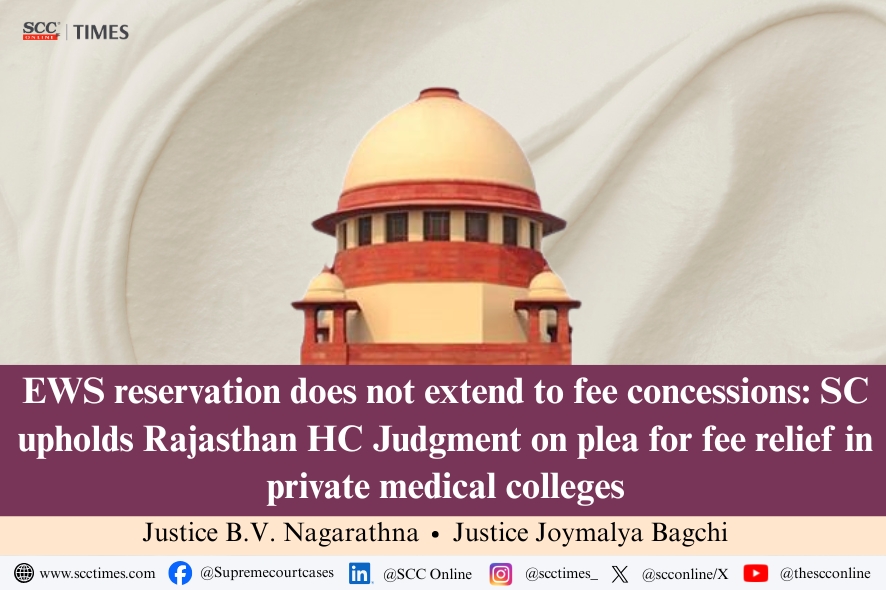
Supreme Court: In a matter concerning whether Economically Weaker Sections (EWS) candidates admitted to private medical colleges are entitled to fee concessions, in addition to reservation in admissions, to make the constitutional benefit of EWS reservation meaningful, the Division Bench of B.V. Nagarathna and Joymalya Bagchi, JJ., declined to interfere with a Rajasthan High Court judgment rejecting such a plea. Dismissing the Special Leave Petition (SLP), the Court observed that it found no reason to interfere with the impugned order. However, it clarified that the larger question of law, if any, has been left open for consideration in an appropriate case.
Background
The petitioner, an EWS candidate who appeared for NEET-UG 2025, challenged the fee structure of private medical colleges in Rajasthan, contending that the annual tuition fees charged by these institutions rendered the EWS reservation ineffective. He argued that although the income ceiling for EWS eligibility is ₹8 lakh per annum, EWS candidates are required to pay the same tuition fees as general category students, making admission financially inaccessible. According to the petitioner, this defeated the object of the 10% EWS reservation introduced by the Constitution (One Hundred and Third Amendment) Act, 2019. He therefore sought directions for an affordable fee structure for EWS students in private medical colleges.
Also Read: Supreme Court by a majority of 3:2 upholds the validity of 103rd Constitutional Amendment Act, 2019
The Rajasthan High Court rejected the plea, holding that EWS reservation operates only at the stage of admission and does not, in the absence of a statutory provision or government policy, confer a right to fee concessions in private medical colleges. The High Court observed that the fee structure had been fixed by the State Fee Regulatory Committee in accordance with the principles laid down by the Supreme Court in Islamic Academy of Education v. State of Karnataka, (2003) 6 SCC 697, and that the petitioner had not challenged the fee fixation order itself.
The High Court further held that no statutory provision or binding policy of the Rajasthan Government provides fee concessions to EWS students in private medical colleges. It also noted that the National Medical Commission’s Office Memorandum, relied upon by the petitioner, was merely recommendatory in nature and had not been adopted by the State Government.
Decision
Declining to interfere with the High Court’s judgment, the Court dismissed the SLP. However, it expressly left the larger question of law open, clarifying that the issue of whether EWS reservation in private medical colleges should carry a corresponding entitlement to fee concessions may be considered in an appropriate case in the future.
Also Read: Conundrum on Economically Weaker Section —Having Reservations about Reservation
[Harshvardhan Singh v. State of Rajasthan, 2026 SCC OnLine SC 1219, decided on 24-6-2026]
Advocates who appeared in this case:
For Petitioner(s): Mr. Rishabh Sancheti, Adv. Mr. Armaan Arora, Adv. Mr. Varun Varma, Adv. Mrs. S. Gomathi Lakshmi, Adv. Mr. T. Hari Hara Sudhan, AOR
For Respondent(s): Mr. Shiv Mangal Sharma, Adv. Mr. Shivansh B. Pandya, Adv. Mr. Saurabh Raj Pal, AOR Mr. Vishal Kumar Yadav, Adv