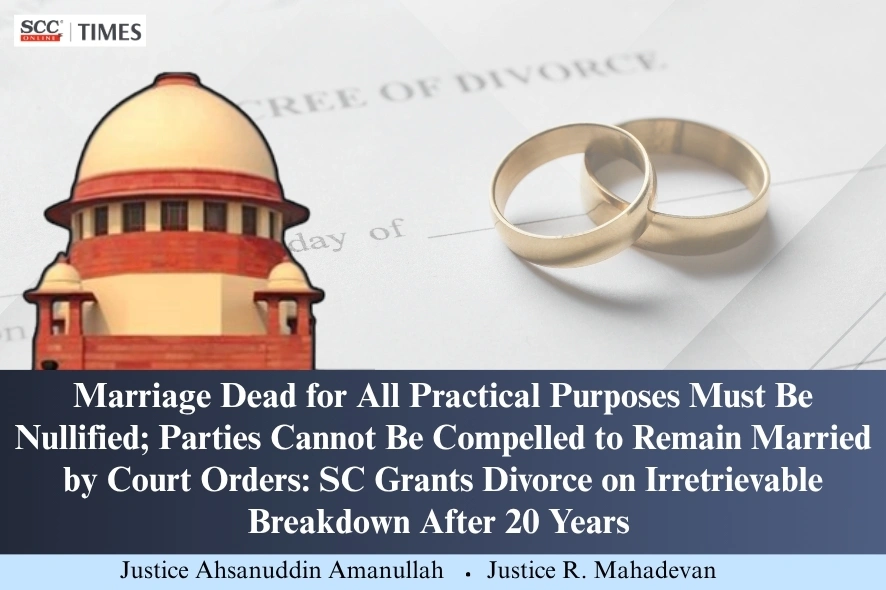
Supreme Court: In an appeal assailing orders dismissing petition for divorce, the Division Bench of Ahsanuddin Amanullah and R. Mahadevan, JJ., held that “the marriage between the parties being dead for all practical purposes has to be nullified”; granted a decree of divorce to the parties on the ground of irretrievable breakdown of marriage.
Background
The present appeals arose from the dismissal of the appellant-husband’s petition for divorce by the Family Court, which was subsequently upheld by the High Court.
The appellant contended before the Court that the parties had been living separately since 2003 and that efforts at reconciliation had failed. It was submitted that the respondent-wife’s conduct had resulted in persistent disputes between the parties and that the appellant no longer saw any future in the marital relationship. The appellant further stated that he had paid more than ₹40 lakhs towards the upkeep of the respondent-wife and their daughter and that, pursuant to an earlier order of the Court, ₹68 lakhs had been deposited with the Registry, having grown to approximately ₹75 lakhs with interest. During the hearing, the appellant also agreed to pay ₹60 lakhs to the respondent-wife by way of one-time permanent settlement in the event a decree of divorce was granted.
The respondent-wife opposed the grant of divorce and disputed the allegations made by the appellant. She submitted that she was not willing to consent to dissolution of the marriage.
Analysis, Findings and Decision
The Court noted that the parties had been living separately since 2003 and that their positions before the Court were completely opposed and inflexible. The Court observed that the relationship between the parties could not be restored merely by passing judicial orders and that the respondent-wife was unable to furnish a satisfactory explanation when queried regarding the real differences between the parties, particularly when the Court was of the tentative opinion that the marriage had irretrievably broken down.
The Court observed that, in such matters, it is required to take an objective view of the situation and that a relationship between husband and wife cannot be forced through judicial proceedings. Hence, the Court held that “the marriage between the parties being dead for all practical purposes has to be nullified”.
Accordingly, exercising its jurisdiction under Article 142 of the Constitution of India, the Court granted a decree of divorce to the parties on the ground of irretrievable breakdown of marriage.
The Court directed that the grant of divorce would be subject to the appellant paying ₹60 lakhs to the respondent-wife within 2 months. The Court further directed that the amount of ₹68 lakhs lying with the Registry, along with accrued interest, be released to the respondent-wife upon completion of the requisite formalities.
The Court recorded that the daughter of the parties would not be denuded of any rights accruing to her as the biological daughter of the appellant and further recorded the appellant’s statement that he would contribute towards her marriage.
Accordingly, the appeals were allowed, and the matter pending before the Family Court was quashed.
Also Read: SC on validity of US divorce decree in India under HMA |SCC Times
[Gopalakrishna Surapaneni v. Anuradha Surpaneni Maiden, 2026 SCC OnLine SC 1056, decided on 27-5-2026]
Advocates who appeared in this case:
For the appellant: AoR Balaji Srinivasan with Kanishka Singh, Advocate
For the respondent: Respondent-in-person
Buy Constitution of India HERE