
Delhi HC: Mere Non-Return of Stridhan Insufficient for Section 406 IPC Without Specific Entrustment
In Harcharanjeet Bains v. State (NCT of Delhi), the Delhi High Court partly quashed criminal proceedings arising from a matrimonial dispute. The

Bringing you the Best Analytical Legal News


In Harcharanjeet Bains v. State (NCT of Delhi), the Delhi High Court partly quashed criminal proceedings arising from a matrimonial dispute. The
Rejecting a husband’s revision, the Allahabad HC holds that money is the only soothing legal balm for wife, she can’t be allowed to resign to destiny.
The Gauhati High Court has held that Talaq-E-Hassan is a valid and recognised form of Talaq and is not prohibited under law.
Family Court had dismissed respondent-mother’s application for restoration of custody, by recording findings contrary to the material placed before it and inconsistent with the Karnataka High Court’s express order modifying the visitation arrangement.
From a fake AI-generated precedent that voided an insolvency order to a stray bull attack that reshaped animal-welfare law, July 2026 was one of the Supreme Court’s most consequential months. Explore 30+ rulings spanning constitutional law, criminal justice, technology, and human rights, plus the appointments, transfers, and numbers behind the month’s docket.
The Court held that with adequate material like a DNA test and joint acknowledgment of parentage, Section 15, Registration of Births and Deaths Act, 1969 permits correction of the birth certificate to replace the former husband’s name with that of the biological father.
Neither a divorce nor a marriage can be conducted through a notarised agreement, the Madhya Pradesh High Court holds, dismissing a family pension claim by a man who could not prove he was ever legally married to a deceased Tribal Affairs Department employee.
“An incapacity for a second marriage for a certain period does not have the effect of treating the former marriage as subsisting. This settled position in law would suffice to reject the argument of the husband that the second marriage was void since it was bigamous in nature.”
A quick roundup to cover all the important legal developments and cases this week.
Delhi High Court held that overnight custody was not warranted where the child had never stayed overnight with the father and required further time to acclimatise, the Court thus modified the Family Court’s order and granted the father extended daytime custody instead.
Disclaimer: This has been reported after the availability of the order of the Court and not on media reports so as to
The Court held that the marriage was dead for all practical purposes, warranting to be nullified under Article 142 to grant a decree of divorce.
The Court stated that if the husband was bearing substantial expenses for the technical education of the major son, the same could not be a ground to restrict reasonable maintenance and educational support to the minor daughter.
The April Roundup of Family and Personal Law contains important rulings and judgements from the Courts all over, on marriage, divorce, maintenance, child custody, guardianship and waqf.
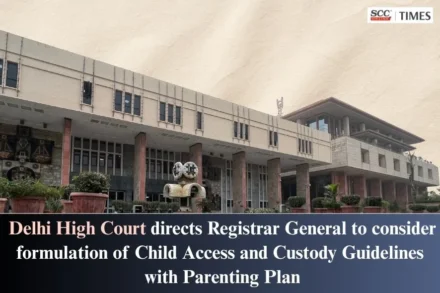
With similar frameworks already emerging in other states, the Delhi High Court begins evaluating whether formal child access and parenting plan guidelines are needed.
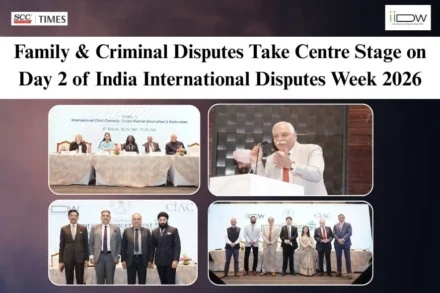
Day 2 underscored IIDW’s theme that resolving family and criminal disputes demands dissolving borders through collaboration, reform and mutual trust, positioning India as a dispute resolution hub.
“Now the convenience of the wife/lady is not the paramount consideration for deciding the transfer applications and alternatives to transfer proceedings have been provided.”
“In case where necessary pleadings are there and no declaration is sought regarding illegitimacy of the child and the issue only relates to adultery of the wife, then in appropriate cases, a DNA test can be ordered, if there are sufficient pleadings of non-access”.
“Parental rights of a biological father cannot be undermined at the altar of dispute between the couple. A child should not suffer the dispute, either emotionally or educationally/ socially.”
Allahabad High Court emphasied that the proceedings under Section 27 Hindu Marriage Act, 1955 cannot be treated as independent or standalone proceedings to result in a decree.