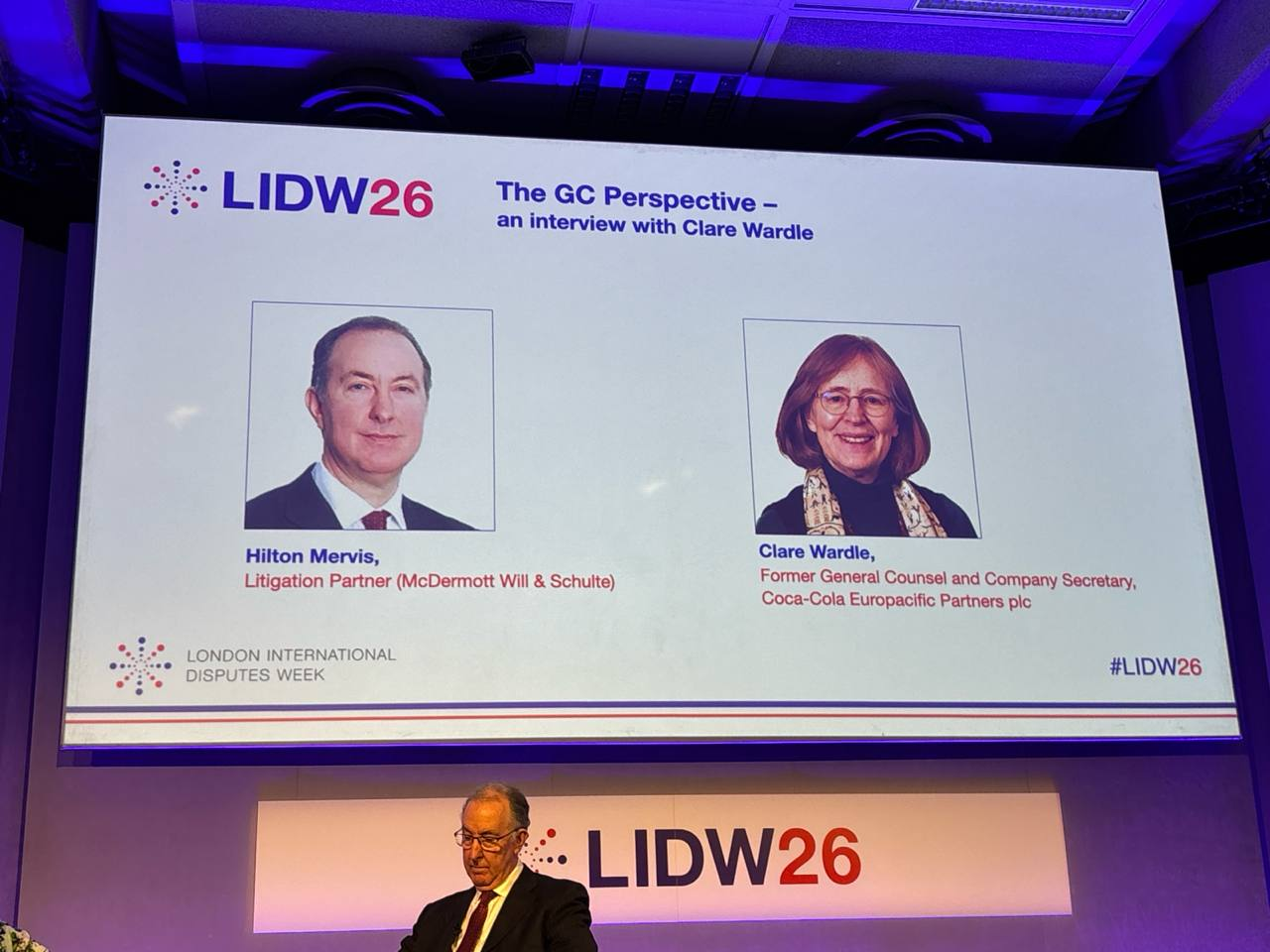
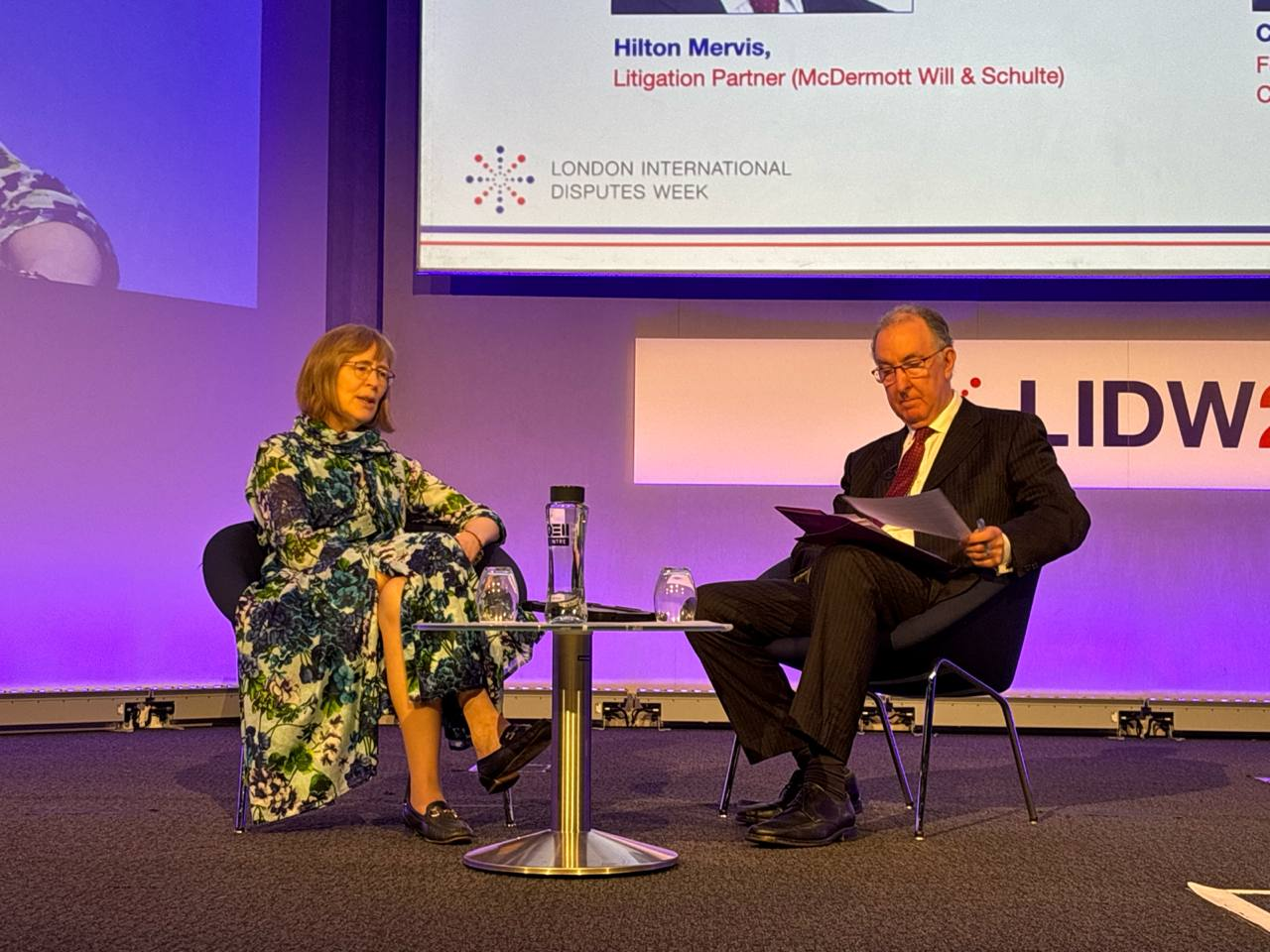
After a brief introduction of Ms. Wardle, Mr. Mervis began the interview:
Q. Whether she knew that she always wanted to be a lawyer, or was it a series of twists and turns?
Opening the discussion, she reminisced about her different career ambitions as a child and explained how her route into the profession was shaped by a series of opportunities and unexpected turns. After initially pursuing a career as a barrister, she delved into commercial litigation, where she gained exposure across multiple disciplines, including property, technology, and particularly patent litigation.
From there, her career evolved through increasingly diverse leadership opportunities, including roles that combined legal, commercial, and governance responsibilities. Eventually, she joined Coca-Cola Europacific Partners, where she oversaw legal affairs, disputes, compliance, risk management, security, and corporate governance across a complex international business.
Reflecting on her path, Ms. Wardle described it as “a journey rather than a plan,” driven by a willingness to embrace new opportunities and continue learning.
Q. How have you used Law and Justice in making decisions?
She emphasized that the law is fundamentally built upon societal norms and values, and it is supposed to encapsulate justice. Lawyers, she argued, achieve better outcomes when they know that they are doing the right thing.
Drawing on her experience managing litigation, Ms. Wardle recalled changing corporate policies around customer injury claims. Rather than automatically denying liability, her team introduced practical measures to improve safety and ensured that injured customers received immediate assistance. The result was a significant reduction in litigation.
Q. What qualities do General Counsels look for in External Lawyers?
At the outset, Ms. Wardle highlighted competence as a given but stressed that personal qualities and values often make the difference. She stated that she assesses whether an external counsel would be a great team member, contact the right people, etc. She noted that clients want advisers who operate as trusted members of the team rather than external experts who simply deliver technical legal advice. For pro-bono cases, she underscored the importance of having the right type of lawyer who works collaboratively and listens to the client.
Q. What different norms have you found while working with other jurisdictions?
Having overseen disputes across numerous jurisdictions, Ms. Wardle emphasised that successful international dispute management depended largely on communication and collaboration with external lawyers and teams. Different legal systems, cultures, and business practices require lawyers to listen carefully and ensure that all stakeholders are aligned.
She observed that even global law firms can sometimes operate as separate entities across jurisdictions, making coordination especially important. The key, she argued, was bringing the right people together and creating an environment where expertise can be shared effectively.
Q. Are there any barriers to growth as an in-house lawyer?
Regarding the evolution of the role of in-house counsel, Ms. Wardle opined that indeed there were barriers, but they depended on the trajectory of a lawyer. Typically, in a law firm, people are hired based on whether they can provide technically correct legal answers. Once a lawyer learns to provide correct answers, they move on to helping people frame the right question, then they begin understanding the business and identifying solutions to circumvent legal issues, and lastly, they start influencing the business strategy itself.
Q. How can in-house counsels acting against the interests of the company be tackled, both from the outside lawyer’s perspective and the whistleblowing perspective?
At the outset, she stated that almost all big companies had whistleblowing hotlines that could be used by internal and external professionals to raise an ethical or criminal issue. She emphasised that communication should always be the first response. Rather than assuming misconduct, there should be an attempt to understand the broader context behind a counsel’s decision, which seems to be against the company’s interests. She added that often different stakeholders, like the CEO, finance director, etc., might hold different views than the general counsel, and there might be internal politics between them, which could make the general counsel take such decisions.
Q. What was your most challenging moment?
Among the most memorable challenges of her career were situations involving geopolitical and operational risks. She recalled one particularly striking incident wherein a commercial dispute in the Russian Far East, where a business partner allegedly sought to pressure a company representative into signing away key contractual rights under life-threatening circumstances. She mentioned how she had to provide immediate legal guidance remotely while balancing commercial, political, and personal safety considerations.
Q. What are your achievements in your role as a general counsel?
Answering this question, she mentioned a multi-billion-dollar Australian deal that they completed during the Covid-19 pandemic without meeting anyone in real life and navigating every aspect of the process online. Ms. Wardle claimed that her proudest achievements were often related to people. Several members of her legal teams have since become successful, a legacy she regards as more meaningful than any individual transaction.
She also highlighted her attempts at improving female representation in senior leadership positions through targeted development initiatives and mentoring programmes.
Q. How will AI change the role of an In-House Lawyer and Law Firms?
Ms. Wardle agreed that artificial intelligence will fundamentally reshape legal practice. Contrary to suggestions that AI will reduce demand for lawyers, she argued that it has generated additional complexity and workload. She illustrated that in employment disputes, where once a dissatisfied employee might send a brief complaint, AI tools now enable claimants to produce more sophisticated legal responses.
At the same time, she said that there was an opportunity for AI to improve access to justice, streamline document analysis, and deliver legal services more efficiently. The challenge, she said, is ensuring that AI is used in ways that genuinely improve outcomes rather than simply creating additional bureaucracy.
She added that it was important to demonstrate that AI can be used for pro bono work and for the development of junior lawyers. Young lawyers involved in pro bono work gain opportunities to run cases, interact directly with clients, develop advocacy skills, and understand the human impact of legal advice. Thus, she encouraged law firms to demonstrate meaningful commitment to these areas, both because they benefit society and because they help develop stronger lawyers and create more rounded and effective professionals.
Q. Do businesses actually have access to justice for million-dollar claims? Does automatic no-fault cost recovery stifle access to justice? How can we make justice to businesses actually more accessible?
Ms. Wardle stated that businesses often settle claims when they are faced with a difficult point of law. However, the costs are arbitrary when companies win all the way till the appellate court but lose in the Supreme Court. In these situations, the companies are expected to have known that they would lose the entire time and end up with multi-million-dollar costs.
She argued that businesses increasingly face barriers to justice because litigation costs often outweigh the value of legitimate claims.
Q. Would you choose the same career path again?
Having worked across dozens of countries, led major international legal teams, and helped shape businesses through periods of significant change, she answered positively. She described her career as both rewarding and intellectually stimulating; thus, she would choose it again.
In her concluding remarks, Ms. Wardle encouraged people to abolish AI recruitment processes, which were extensive and lengthy, often resulting in the wastage of time for unsuccessful candidates. She questioned whether such systems genuinely improve hiring outcomes and warned against allowing AI-driven filtering processes to determine career opportunities for young people.
Additionally, despite severe competition and such recruitment processes, the quality of candidates did not see much improvement. Thus, she concluded that AI and other new technologies might be useful, but one should maintain a cautious approach.
This report forms part of SCC Times’ special coverage of London International Disputes Week (LIDW) 2026. As a Media Partner for the event, SCC Times is reporting key conversations across the conference, highlighting emerging trends and perspectives from the international dispute resolution community.
Read more LIDW 2026 Coverage:
-
Why Lawyers Keep Getting AI Wrong and Why Human Judgment Still Matters: Insights from LIDW 2026
-
Who Owns the Risk When AI Gets It Wrong? Confidentiality, Governance and Human Judgment at LIDW 2026
SCC Times extends its appreciation to Zehra Naqvi, EBC—SCC Online Foreign Student Ambassador and Lawyer, for her on ground presence, valuable assistance and contribution to the reporting of this event.