


Disclaimer: This has been reported after the availability of the order of the Court and not on media reports so as to give an accurate report to our readers.
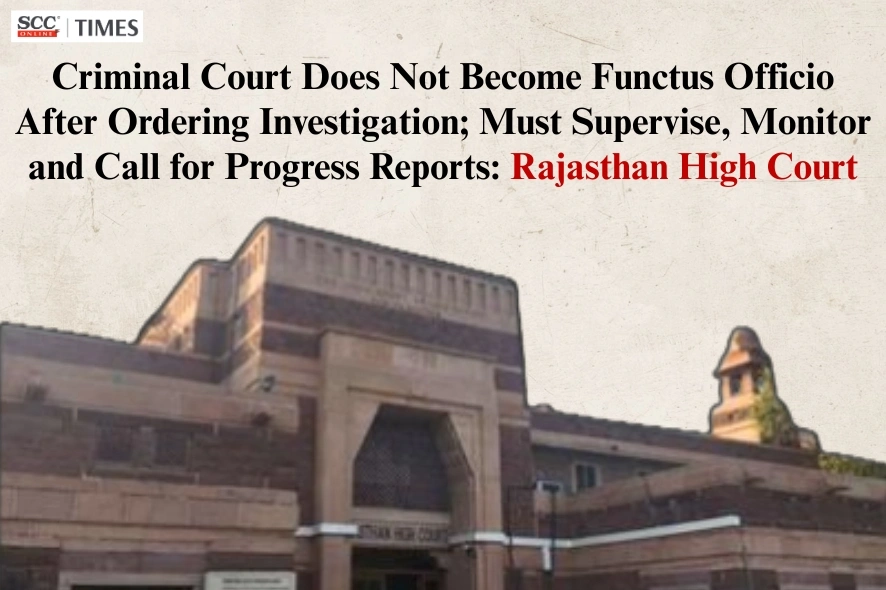
Rajasthan High Court: While considering a writ petition filed seeking directions for the police authorities to complete the investigation in a criminal case within a reasonable period and submit a report, a Single Judge Bench of Rekha Borana, J., held that after issuing a direction for investigation in terms of Section 156(3), Cr. P.C. [Section 175(3), Nagarik Suraksha Sanhita, 2023 (BNSS)], a criminal court does not become functus officio.
Further, the Court directed the trial court to ensure the filing of the conclusive investigation report within 6 weeks.
Background
In the present case, on the complaint been filed by the complainant, the trial court directed the Circle Officer to undertake thorough investigation and file the investigation report by 22 May 2025. On 16 October 2025, a specific direction was issued to the Station House Officer concerned by the Court, only then a factual report was filed on 27 November 2025.
Since then, the matter remained pending awaiting the progress report/conclusive report, till date. Thus, the petitioner approached the High Court.
Analysis
The Court stated that it has come across several writ petitions been filed only on account of non-compliance of directions issued by the Magistrate for conducting investigation in pursuance to order passed under Section 156(3), Cr. P.C. [Section 175(3), BNSS]. The Court further stated that it has been witnessed that in all such matters, despite specific direction of the Magistrate to carry out the investigation and file a conclusive report, neither is the investigation concluded within a reasonable period nor are the progress reports been filed for a long period.
Further, the Court stated that “in many such cases, the proceedings remain pending before the trial court for years while mechanically fixing repeated dates, calling upon the effective status/progress report from the investigating agency and as a consequence, litigants approach the High Court in extra-ordinary jurisdiction calling for implementation of orders which otherwise fall within the supervisory domain of the criminal court concerned”.
Thus, the Court observed that after a direction for investigation been issued by the criminal court in terms of Section 156(3), Cr. P.C. [Section 175(3), BNSS], it does not become functus officio, that is, it does not cease to have authority over the matter, and therefore need not keep repeating in the order sheets that the progress report or conclusive report is awaited.
Relying on Robert Lalchungnunga Chongthu v. State of Bihar, 2025 SCC Online SC 2511 and Sovaran Singh Prajapati v. State of U.P., 2025 SCC OnLine SC 351, the Court held that “the Magistrate/criminal court does not absolve of its duties after sending the matter under Section 156(3), Cr. P.C. [Section 175(3), BNSS]to the investigating agency for investigation”.
The Court further stated that it is under a bounden duty to supervise and monitor the said investigation, thus, to call for the progress reports, if it finds that the investigation is not completed within a reasonable time or is unnecessarily delayed. The Court observed that the investigation cannot be lingered on by the investigating agency for years without any logical conclusion thereof as it not only hampers the rights of the victim or complainant, but also that of the accused.
The Court reiterated that “an unduly prolonged investigation even gives a right to the accused to pray for quashing of FIR and his discharge from all the offences as alleged”.
Decision
Thus, the Court disposed of the petition at hand and directed the trial court to ensure the filing of the conclusive investigation report by the investigation officer within 6 weeks.
Further, the Court granted liberty to the trial court to pass appropriate orders for the erring officer if the investigation officer fails to file the same within the stipulated period.
[Sumann Mundhara v. State of Rajasthan, 2026 SCC OnLine Raj 3545, decided on 18-5-2026]
Advocates who appeared in this case:
For the Petitioner: Navneet Singh, Advocate
For the Respondent: Ramesh Devasi, Public Prosecutor