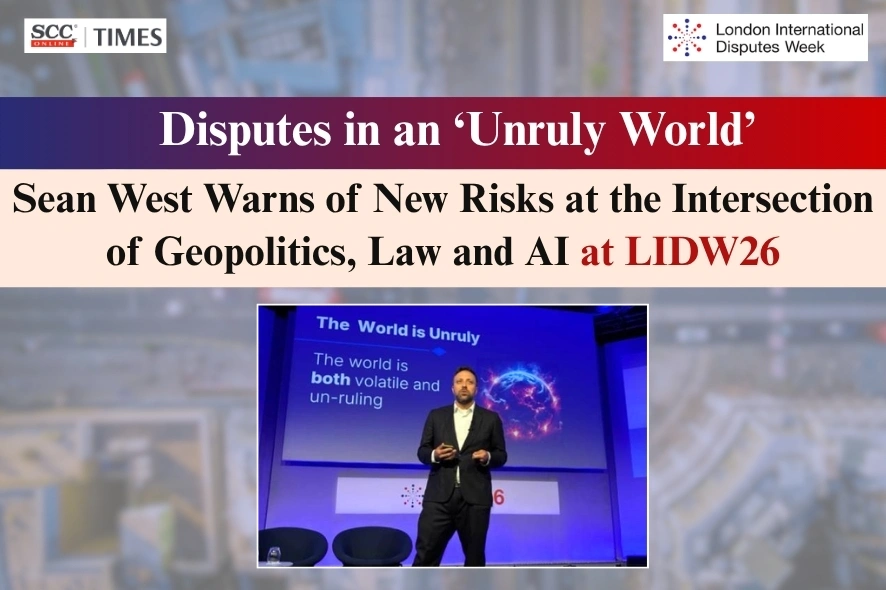
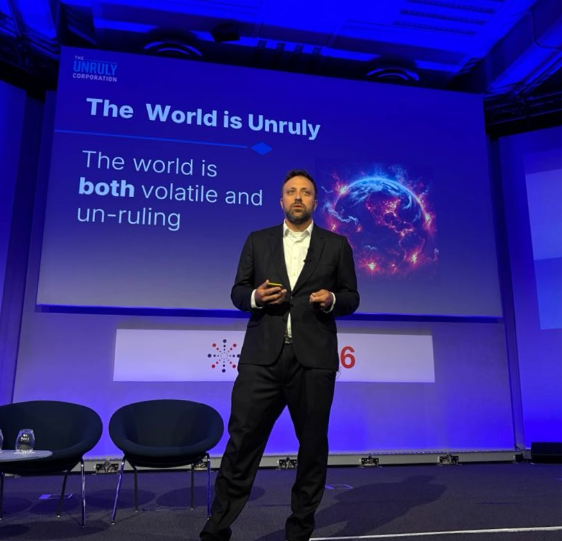
Day 2 of London International Disputes Week (LIDW) 2026 commenced with a keynote address by Mr. Sean West, Co-Founder of The Unruly Corporation, a geopolitical AI company, and Hence Technologies, a legal technology company, and author of Unruly: Fighting Back When Politics, AI, and Law Upend the Rules of Business. Mr. West explored how the simultaneous transformation of geopolitics, law and technology is reshaping the global disputes landscape and creating new challenges for businesses, lawyers and dispute resolution institutions.
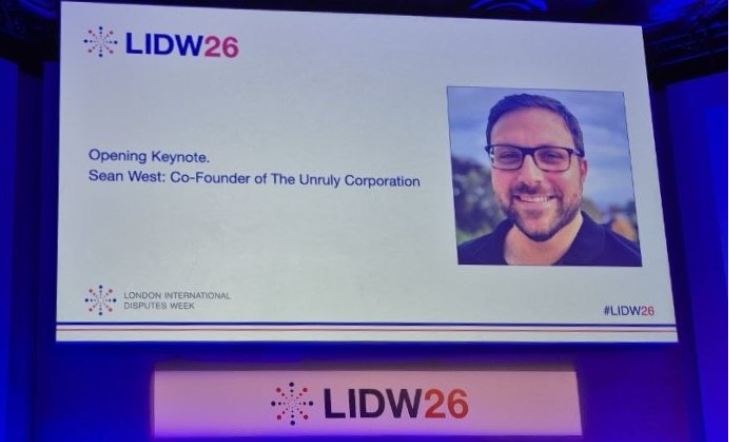
The ‘Unruly Triangle’: Geopolitics, Law and Technology
Mr. West began by observing that the world is experiencing a period of profound transition. The assumptions that characterised the era of globalisation – regulatory convergence, expanding international commerce and increasing economic integration, are steadily giving way to a more fragmented and uncertain international order.
According to Mr. West, businesses and legal professionals are no longer operating in a world where countries compete primarily to attract foreign investment and remove barriers to trade. Instead, they face a geopolitical environment increasingly characterised by strategic competition, conflicting regulation and diverging national interests.
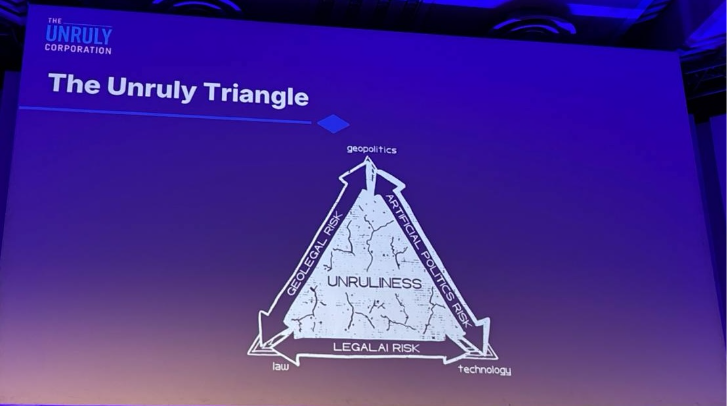
To explain these developments, Mr. West introduced what he described as the “Unruly Triangle”, a framework built around the interaction of geopolitics, law and technology. While each of these forces independently creates uncertainty, their simultaneous transformation generates entirely new categories of risk.
He explained that the convergence of geopolitics and law creates what he termed “geo-legal risks”, where sanctions, export controls and legal mechanisms increasingly become tools of geopolitical competition. The intersection of politics and technology produces “artificial politics risks”, including deepfakes, disinformation and technological interference in democratic processes. Meanwhile, the interaction between law and technology gives rise to “legal AI risks”, which have the potential to transform access to justice, litigation strategy and legal services.
Geo-Legal Risks and the ‘Rule of Law Recession’
A significant portion of the keynote focused on what Mr. West described as an “international rule of law recession”. Drawing on rule of law data collected over the past decade, he argued that many countries have witnessed declining adherence to rule of law principles while international institutions established after the Second World War have become less effective in resolving global disputes.
Referring to the increasing use of sanctions, secondary sanctions and other forms of legal pressure, Mr. West argued that legal tools are increasingly functioning as instruments of geopolitical strategy rather than purely legal mechanisms.
He observed:
“We live in a world of lawfare where legal weapons can actually shut down commerce, can change the way that people do business without ever having to produce a real weapon.”
According to Mr. West, the growing use of lawfare, combined with the expanding role of domestic courts and executive power, has altered the traditional relationship between law, politics and international commerce. Businesses increasingly find themselves operating in environments where legal and political risks are difficult to separate.
Artificial Politics: Deepfakes, Disinformation and Surveillance
Turning to the relationship between technology and politics, Mr. West discussed the disruptive impact of artificial intelligence on political systems, labour markets and public discourse. He suggested that AI is likely to reshape the political economy in much the same way that previous industrial revolutions transformed economic structures.
Discussing the rise of deepfakes and AI-generated content, he warned that societies are entering an era in which distinguishing genuine information from fabricated information will become increasingly difficult. Referring to the phenomenon known as the “liar’s dividend”, he explained how the existence of deepfake technology creates opportunities to dismiss authentic evidence as fabricated, raising significant implications for both politics and legal proceedings.
Mr. West also discussed the growing surveillance capabilities made possible by artificial intelligence and warned that governments increasingly possess the technological ability to monitor individuals, businesses and financial activity at unprecedented levels. At the same time, regulators are struggling to keep pace with rapidly evolving technologies, creating diverging approaches to AI governance across jurisdictions.
Legal AI and the Future of Access to Justice
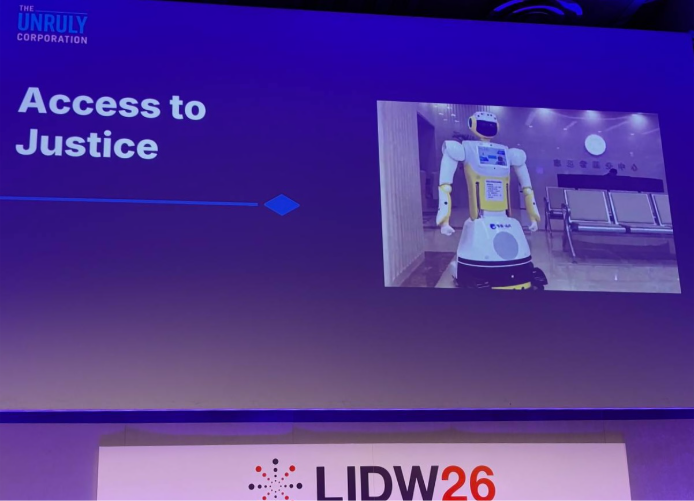
The keynote then turned to what Mr. West described as the transformative impact of AI on legal services and dispute resolution. As a legal technology entrepreneur, he acknowledged the significant opportunities AI presents for expanding access to justice and reducing the cost of pursuing legal claims.
Drawing on examples ranging from AI-powered legal systems in China to his own experience using an AI-generated legal claim against an insurance company, he argued that legal technology is empowering individuals to pursue claims that would previously have been economically impractical.
He stated:
“Generative AI makes legal action effectively free.”
According to Mr. West, this development could dramatically alter the economics of dispute resolution. Individuals and businesses may increasingly use AI tools to generate claims, challenge corporate decisions and pursue legal remedies without incurring substantial legal costs.
At the same time, he cautioned that the same technologies could produce new challenges, including mass claims, automated litigation campaigns and large-scale legal actions generated at minimal cost. Referring to examples involving thousands of arbitration claims filed simultaneously against major corporations, he suggested that dispute resolution systems may soon face entirely new forms of pressure created by technological scalability.
Rethinking Foreseeability in an Age of Geopolitical Disruption
Moving from technology to practical implications for dispute resolution, Mr. West argued that lawyers must reconsider traditional contractual concepts, particularly the concept of foreseeability.
Drawing on a scene from the British political satire In the Loop, he questioned whether geopolitical events such as tariffs, sanctions and armed conflicts can still be regarded as unforeseeable in an era where geopolitical disruption has become a recurring feature of international commerce.
Referring to disputes surrounding tariffs and conflicts in the Middle East, he suggested that parties can no longer rely solely on broad force majeure clauses to manage geopolitical uncertainty. Instead, lawyers must increasingly identify and allocate specific geopolitical risks during contract drafting and transaction planning.
Mr. West further suggested that dispute resolution practitioners must increasingly adopt multi-forum strategies, recognising that a single governmental measure can generate consequences across commercial arbitration, investment arbitration, insurance disputes, regulatory proceedings and court litigation simultaneously.
He also encouraged lawyers to become more proactive in identifying geopolitical developments before disputes arise. Rather than reacting to events after they occur, practitioners should develop the ability to monitor geopolitical trends and anticipate the legal consequences they may generate for clients.
Preserving Institutions in an Unruly World
While acknowledging the pressures facing international institutions, he urged legal professionals to actively support and strengthen the frameworks that underpin international commerce and dispute resolution.
He concluded with a challenge to the audience:
“In an unruly world, what are you doing to sustain the infrastructure that you rely on?”
The keynote offered a wide-ranging examination of how geopolitics, law and technology are converging to reshape the global disputes landscape. While Mr. West painted a picture of growing volatility and uncertainty, he also emphasised that lawyers, arbitrators and dispute resolution professionals have a critical role to play in helping businesses navigate this changing environment while preserving the institutions on which the international legal order depends.
This report is part of SCC Times’ special coverage of London International Disputes Week (LIDW) 2026. As an official Media Partner of LIDW26, SCC Times is covering key discussions, insights and developments from across the conference, bringing readers perspectives on emerging trends shaping the future of international dispute resolution.
SCC Times extends its appreciation to Zehra Naqvi, EBC–SCC Online Foreign Student Ambassador and Lawyer, for her on ground presence, valuable assistance and contribution to the reporting of this event.