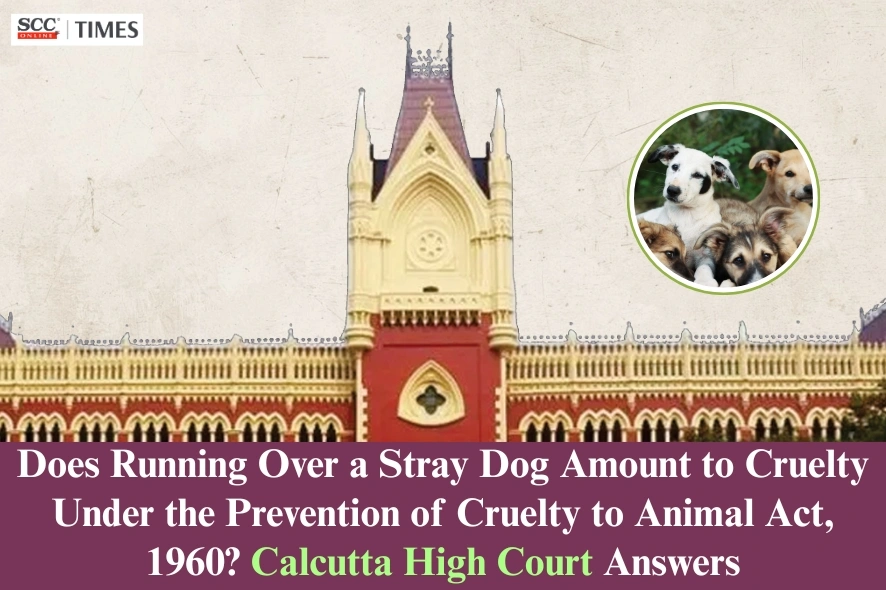
Calcutta High Court: An application was filed by the complainant on the appellate side seeking quashment of case registered under Sections 428 and 429 of Penal Code, 1860 read with section 11(1) (a) of the Prevention of Cruelty to Animal Act, 1960, as per which, a stray dog was run over on 04-12-2002 by a slow moving car, near Howrah. Ajoy Kumar Mukherjee, J., allowed the appeal and held that it would be an abuse of process of court where criminal proceeding has been initiated to give a colour of criminality to an accident and which lacks essential ingredients of the alleged offence.
Counsel for the petitioner argued that the offences under Sections 428 and 429 IPC are founded upon the concept of “mischief” as defined under Section 425 IPC, which necessarily requires wrongful loss, destruction, or diminution of property. It was contended that a stray dog cannot be treated as “public property” in the statutory sense, since it is neither owned nor controlled by any governmental authority or institution. Consequently, the foundational ingredients of the offences alleged are absent.
It was further submitted that the FIR itself records that the petitioner’s vehicle was moving at a slow speed while negotiating an L-shaped blind corner at Olaibibitala Lane. Such slow movement, according to the petitioner, is wholly inconsistent with any intention to harm or kill the animal, as a deliberate act of cruelty would ordinarily involve aggressive conduct, acceleration, or overt targeting. The surrounding circumstances, including the blind turn and slow maneuvering of the vehicle, indicate at best an unfortunate accident rather than any criminal intent.
Counsel argued that the allegation of intentional killing loses all credibility in the absence of conclusive evidence establishing either the death or injury of the dog. No forensic or physical evidence has been produced, linking the petitioner to the alleged demise of the animal. In the absence of proof of fatal injury, the invocation of Section 429 IPC is rendered doubtful and speculative.
It was additionally contended that Section 11(1)(a) of the Prevention of Cruelty to Animals Act, 1960 requires proof that the accused caused unnecessary pain or suffering with intention or knowledge. The allegations in the FIR, however, do not disclose any deliberate act of cruelty. Rather, the complaint itself suggests that the vehicle was moving slowly at a blind bend and that the incident may have occurred because the dog, possibly due to old age or infirmity, failed to move away in time. Such circumstances, it was argued, cannot be equated with intentional cruelty or ill will.
The petitioner also emphasized that he resides merely 20 meters away from the alleged place of occurrence. Therefore, the allegation that he had arrived at the spot solely to kill the dog is wholly untenable and inherently improbable. On the contrary, the facts indicate that the petitioner was simply passing through the area in the course of his normal commute.
Lastly, it was submitted that a mere accident devoid of mens rea cannot be stretched into offences punishable under Sections 428 or 429 IPC, nor can it constitute cruelty under the 1960 Act without any material demonstrating intentional infliction of unnecessary pain or suffering. Since the prosecution case rests entirely on conjecture and speculative assumptions, continuation of the criminal proceeding would amount to an abuse of the process of court and therefore deserves to be quashed.
The Court noted that in order to come within the definition of “mischief” under section 425 IPC, it requires a wrongful or intentional destruction or diminution of property in the context of the Prevention of Damage to Public Property Act, 1984 or to any person. If such mischief is directed against ‘public property’ it is enumerated in section 2 (b) of the said Act namely “property” owned or controlled by the Central Government, State government, local authorities or corporations or institutions substantially funded by governmental bodies. Public property in the statutory sense may not extend to a stray animal as it is neither owned nor controlled by any government authority or institution. A stray dog by its very nature falls outside the boundary of “public property”. Furthermore, a stray dog is also not owned by an individual. Therefore, if the allegation is mischief under section 428/429 IPC and if it read with PDPP Act it cannot be sustained against an individual who is alleged to have harm a stray animal, because the object of the alleged mischief i.e. the stray dog does not qualify the term “public property” nor owner of such property can be any particular person.
The Court further noted that the prosecution has not furnished material proof to confirm the alleged death or the dog’s fate. Also, the omission to incorporate such material evidence also undermines the authority of the claim that the dog was killed by the petitioner and died instantly. Without having any forensic or physical evidence, the entire case stands on speculative ground based on alleged CCTV footage. This is also because an investigating agency has not demonstrated any pressing reason or motive that induced the petitioner to harm a stray animal. No pre-existing grudge or dispute is on record which renders the allegation of cruelty under the Prevention of Cruelty to Animal Act, 1960, purely conjectural. It is well settled that a mere accident without mens rea cannot be stretched into an offence under section 429/428 IPC. Similarly, the claim of cruelty under the Act of 1960 demands at least some demonstration of unnecessary pain inflicted with purpose. There is no evidence showing dogs alleged injury or even its death has not been conclusively proved.
The Court stated that the written complaint was lodged only on 30-12-2022, i.e., after a delay of nearly 26 days without any explanation whatsoever. Such an inordinate and unexplained delay also creates a serious doubt on the veracity, genuineness and bonafides of the complaint. Such an unexplained delay in lodging FIR /complaint is a material factor which strikes at the root of the prosecution case and renders the allegation unreliable.
Thus, the Court allowed the appeal and concluded that no offence under section 428 or Section 429 of IPC or Section 11(1)(a) of the Act of 1960 can be set to be made specially when a mens rea, animus or intention has not been established during investigation.
[Emon Roy v State of WB, 2026 SCC OnLine Cal 6079, decided on 22-05-2026]
Judgment Authored by: Justice Ajoy Kumar Mukherjee
Advocates who appeared in this case:
For the petitioner: Mr. Moyukh Mukherjee Ms. Sagnika Banerjee
For the State: Mr. Bidyut Kumar Ray Mr. Ashok D
Buy Penal Code, 1860 HERE