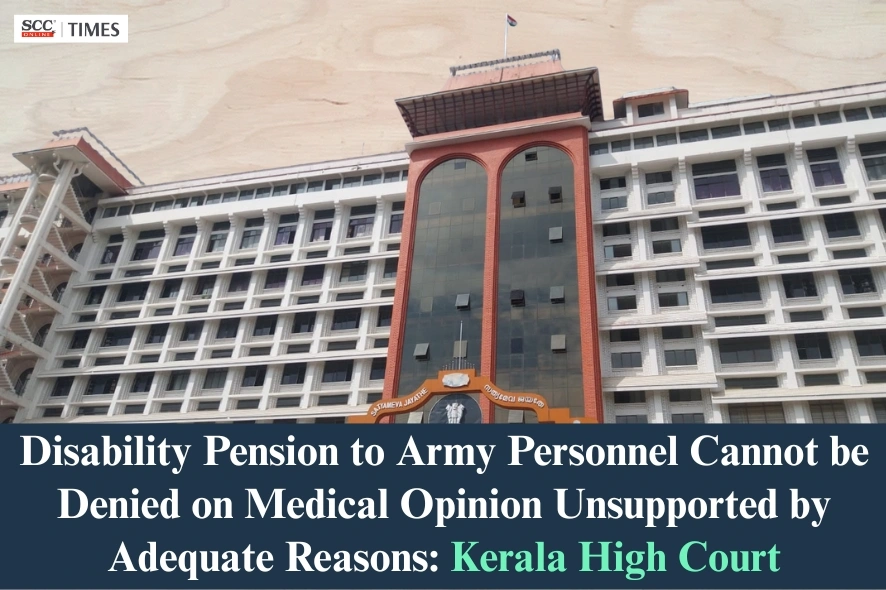
Kerala High Court: In a writ petition filed by a former Army personnel challenging the order dated 06-03-2024 passed by the Armed Forces Tribunal, Regional Bench, Kochi, rejecting his claim for disability pension, the Division Bench of K. Natarajan and Johnson John*, JJ., said that for disability pension claims raised within 15 years of discharge, the primary burden of proof rests on the Department, and disability pension cannot be denied solely based on inadequately reasoned medical opinions or merely because the disease manifested during peace postings.
Background
The petitioner enrolled on 18-11-2004, was discharged on 30-11-2021 after completing 17 years and 12 days of service. Upon discharge, the Release Medical Board assessed him with disabilities of primary hypertension (30% for life) and obesity (5% for life), with a composite disability of 33.5% for life. However, the Board concluded that the disabilities were neither attributable to nor aggravated by military service, leading to rejection of his claim for disability pension.
Aggrieved by the rejection, the petitioner approached the Armed Forces Tribunal, Kochi, which dismissed his claim. The Tribunal held that the petitioner could not claim the benefit of presumptions under the Entitlement Rules for Casualty Pensionary Awards, 1982, and accepted the Medical Board’s opinion that the disabilities were not connected to military service.
Analysis
The Court examined Rule 7 of the Entitlement Rules for Casualty Pensionary Awards, 2008, and reiterated that where claims are raised within 15 years from discharge, the primary burden of proof remains on the Department. Since the petitioner had pursued remedies immediately after rejection of his claim and approached the Tribunal without delay, the Court held that the Tribunal wrongly shifted the burden entirely onto him.
The Court observed that,
“We find force in the argument of the petitioner that since the claim is raised within 15 years from the date of discharge; the onus of proof will be primarily on the Department and the findings of the Tribunal in this regard is not legally sustainable.”
The Court further scrutinised the reasoning of the Medical Board and observed that merely stating that the disease arose during peace tenure or describing obesity as a lifestyle disorder was insufficient to deny attributability. The Court noted that the Medical Board’s opinion lacked adequate reasons and relied on precedents emphasising that disability pension claims, being beneficial in nature, require liberal interpretation.
Decision
Allowing the writ petition, the Court set aside the order of the Armed Forces Tribunal and held that the petitioner was entitled to disability pension. The respondents were directed to issue a corrigendum PPO granting disability pension within three months from receipt of the judgment. The Court further ordered that failure to comply within the stipulated period would result in unpaid arrears carrying interest at 7% per annum.
[Balamurali Krishna v Union of India, 2026 SCC OnLine Ker 5229, decided on 29-05-2026]
Also Read:
*Judgment Authored by: Justice Johnson John
Advocates who appeared in this case:
For Petitioners: T.R. Jagadeesh, Adi Narayanan, Gokulkrishna V.K., Jose Job, Manasi Jagadeesh
For Respondents: M.Shajna, CGC