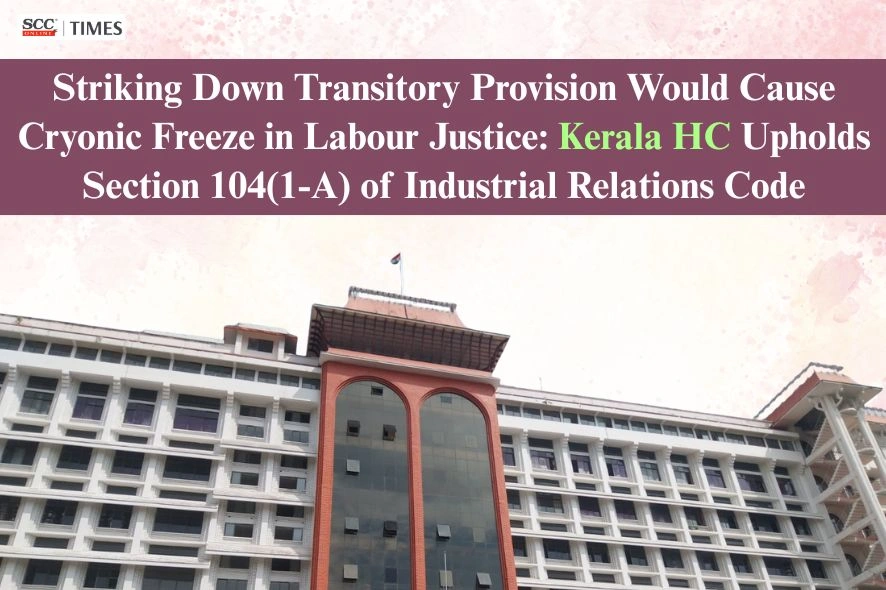
Kerala High Court: In a writ appeal challenging the constitutionality of the Industrial Relations Code (Amendment) Act, 2026 (Amending Act), that provided for the continuation of the existing Labour Tribunals till the Tribunals and authorities under the Industrial Relations Code, 2020 (IR Code) become functional, the Division Bench of Devan Ramachandran* and Basant Balaji, JJ., while dismissing the appeal, affirmed the judgment of the learned Single Judge and upheld the validity of Section 104(1-A) IR Code, 2020 allowing existing Labour Tribunals to continue, observing that it constitutes a necessary mechanism to ensure continuity of adjudication until new tribunals are constituted. The Court observed that,
“Section 104(1-A) IR Code operates as a non-obstante provision which provides that the statutory authorities under the repealed Acts would continue to function till the tribunals and other authorities become functional under it. If declared unconstitutional, it would lead to a situation leading to complete cessation of the judicial functions.”
Also Read: Industrial Relations Code Amendment 2026 Explained
Background
The appellants instituted proceedings seeking a declaration that the Amending Act, particularly the insertion of Section 104(1-A), is unconstitutional, arbitrary, and ultra vires the provisions of the IR Code. They also alleged violations of Articles 14 and 21 of the Constitution. The appellants further sought that a writ of prohibition be issued, to restrain Labour Courts, Industrial Tribunals and National Tribunals constituted under the Industrial Disputes Act, 1947 (ID Act) from adjudicating any existing or new cases under the IR Code. The Single Judge had rejected the challenge and upheld the provision, finding no constitutional infirmity. Aggrieved thereby, the appellants preferred the present writ appeal.
The appellants contended that Section 104(1-A) IR Code was manifestly illegal since it permitted earlier tribunals and judicial forums constituted under repealed enactments to continue functioning. It was argued that this defeated the mandate of Sections 44(7) and 51(1) IR Code which provided for mandatory transfer of all cases to forums which had multiple members, and not single, as were permitted by the repealed Statutes. The appellants asserted that such continuation results in inconsistency within the statutory framework and undermines legislative intent. It was further contended that IR Code also curtailed the powers of the States thereby creating legal issues.
In response, the respondents submitted that Section 104(1-A) IR Code was only a transitional provision providing for adjudication of matters pending the establishment of the Tribunals under it. It was argued that striking down the provision would lead to a situation where there would be no tribunals or forums to adjudicate any of the existing disputes, and it would culminate in a virtual “cryonic freeze”, thus bringing disservice to litigants, rather than any benefit to them.
Also Read: Continuation of existing Labour Tribunals not arbitrary: Ker HC
Analysis
The Court relied on Shayara Bano v. Union of India, (2017) 9 SCC 1, wherein it was observed that it is only in the case of manifestly and shockingly arbitrary provisions, that the jurisdiction of Courts is normally attracted.
The Court opined that Section 104(1-A) IR Code operates as a non-obstante provision which provides that the functionaries and statutory authorities under the repealed Acts would continue to function till the Tribunals and other authorities become functional under it. The Court noted that the issues relating to the constitution of the Tribunals and statutory authorities under the IR Code are pending before the Supreme Court and that interim orders have also been issued by it, and their constitution is underway.
The Court observed that the impugned provision merely enables the existing tribunals and statutory authorities to continue, thereby creating a transitory mechanism, for the period until new tribunals and statutory authorities are brought into existence. If declared unconstitutional, it would lead to a situation leading to complete cessation of the judicial functions as required either under the repealed Acts or under the IR Code, which would certainly not help any interest, be that of the litigant, or that of the State.
Regarding the alleged inconsistency with Sections 44(7) and 51(1) IR Code mandating transfer of cases and constitution of new tribunals, the Court observed that it is precisely during the time it takes for the Tribunals to be so constituted, that the transitory provision applies.
Also Read: Ker HC upholds continuation of existing labour courts and tribunals
Decision
Accordingly, the Court did not find anything wrong, particularly when there was no case for the appellants that the legislature did not have the competence to legislate in the manner it has done. Consequently, the Court affirmed the views of the Single Judge and dismissed the appeal.
[M.K. Suresh Kumar v. Union of India, 2026 SCC OnLine Ker 5137, decided on 22-5-2026]
*Judgment authored by: Justice Devan Ramachandran
Advocates who appeared in this case:
For the Appellants: A. Abdul Nabeel, Advocate.
For the Respondents: Amal Parthasaradhy, CGC, P. Sreekumar, ASGI