


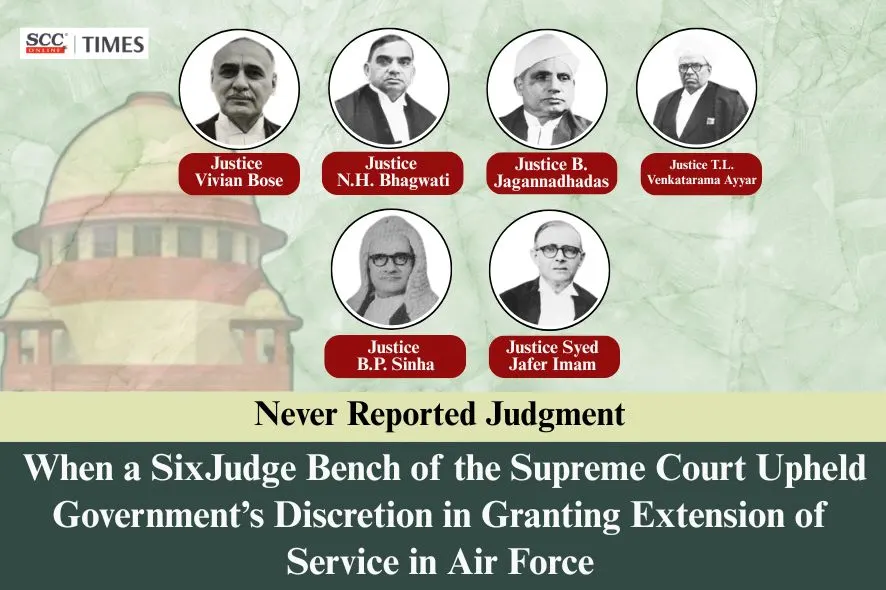
Supreme Court: In a case concerning entitlement of the appellant, an armed forces employee, to continue on active list after 4 years and to make himself eligible for regular pension after 15 years pensionable service, the six-Judge Bench of Vivian Bose*, N.H. Bhagwati, B. Jagannadhadas, T.L. Venkatarama Ayyar, B.P. Sinha and Syed Jafer Imam, JJ., noted that the appellant referred to several other provisions of the Air Force Instructions (India), 1946 (Instructions) and letters to argue that he was not continued in service due to age, not lack of suitability. However, the Court held that the reasons behind the Government’s decision were irrelevant. The Government has the discretion in granting extension of service in Air Force and it has the authority to decide whether to offer a further extension. Thus, since, in the present case, no further extension was made to the appellant by the Government, he was not entitled to pensionable service.
Background
The appellant received an Emergency Commission on 31 July 1942 for the duration of the war or for any additional period the Government considered appropriate. This continued until 3 July 1948. On that date, his service was extended under a scheme introduced in 1946, which, according to the Union Government, lasted until 3 July 1952. He was then removed from the active list and placed on the reserve list. He claims that he should have been allowed to remain on the active list so he could complete 15 years of pensionable service and qualify for a regular pension.
The appellant contends that the Government’s decision to take him off the active list and place him on the reserve list is illegal. The conditions of employment on which the appellant was given the extension on 3 July 1948 are embodied in the Instructions.
Analysis, Law, and Decision — Government’s discretion in granting extension of service in Air Force
The Court rejected the appellant’s argument that Para 8(g) of the Instructions gave him the right to choose whether to move to the reserve list or remain on the active list after completing 4 years of service.
The Court explained that Para 8(g) of Instructions only guarantees four years of service on the active list. After that, it is up to the Government to decide whether to continue the officer. If the Government chooses to extend the service, it will also decide the duration of that extension. The Court further clarified that an officer under this provision is initially entitled to a gratuity at the prescribed annual rate. However, if he is offered an extension and chooses to continue in order to complete 15 years of pensionable service, he gives up the gratuity and becomes eligible only for a pension or retiring gratuity. Importantly, the option to choose arises only if the Government offers an extension. If no such offer is made, Para 8(g) of Instructions does not apply at all.
The Court noted that the appellant referred to several other provisions of the Instructions and letters to argue that he was not continued in service due to age, not lack of suitability. However, the Court held that the reasons behind the Government’s decision were irrelevant. The Government has the authority to decide whether to offer a further extension, and since this power lies with it, no further issues arise. Thus, since, in the present case, no further extension was made to the appellant, he was not entitled to pensionable service.
[H.L. Maitra v. Union of India, (1955) 1 SCC 80, decided on 31-1-1955]
Read More on NRJ Series:
*Judgment authored by- Justice Vivian Bose
**Note: Government’s Discretion in Granting Extension of Service in Air Force
Air Force Instructions (India), 1946 was an administrative guideline applicable to Emergency Commission officers. These instructions granted only a limited right to an initial period of service and placed the question of further continuation within the discretion of the Government.
However, in the present legal framework, service conditions in Indian Air Force are now governed by statutory regime under Air Force Act, 1950 along with Air Force Rules, 1969 and corresponding service regulations. Sections 10, 11 and 12 of Air Force Act, 1950 deals with commission, appointment and enrolment, as per which appointment and continuation in service depend on terms prescribed by the Government. Further, Section 18 of the Air Force Act, 1950 establishes that the service is held during the pleasure of the President and Section 19 of the Air Force Act, 1950 empowers the Central Government to terminate service of officers, reinforcing that continuation is not absolute.
Thus, the principle that an officer does not have a vested right to continue in service beyond the prescribed tenure, and continuation or extension remains subject to the discretion of the competent authority, continues to hold relevance under the current legal framework.
Advocates who appeared in this case :
For the Respondents: M.C. Setalvad, Attorney General for India (P.A. Mehta and P.G. Gokhale, Advocates, with him)




Decision of the six-judge Bench of the Supreme Court of India in H.L. Maitra v. Union of India, (1955) 1 SCC 80, decided on 31-1-1955 is a significant milestone not only in service jurisprudence but also in many other branches of law. It emphatically reiterates and asserts the principle of sovereignty of state in all matters. The appellant employee obviously wanted to get a favourable interpretation of the terms and conditions of the service. In the era of a liberal, democratic and welfare state, such an expectation might be considered by some to be a moral and/or humane approach. That expectation and prayer, however, conveniently overlooked those very (‘unfavourable’) employment conditions that were consented to by the same employee while accepting the job offer and joining the service.
This particular instance reminds one of the definition of law propounded by John Austin (1790-1859). He wrote a famous book entitled “Province of Jurisprudence Determined” and is famous for enunciating the theory of sovereignty and legal positivism. In the words of Austin, “Law is the command of a sovereign backed by the sanction”. This definition has formed the basis of the theory of sovereignty. It mentions three essential components of this theory i.e. command, sovereign and sanction. It is noteworthy that Austin had also served in the army for first five years. Austin’s analytical theory of law challenged the natural law theory and stated that laws originated from a sovereign authority and are not based upon moral principles. This school emerged in the 19th century after the natural law theory lost its significance. It tried to differentiate between how the law currently exists and how it should be in a true sense.
The said unreported judgment of the apex court in this matter is a stark reminder that one must strictly interpret law. In other words, an employee does not have a vested right to continue in service beyond the prescribed tenure, and continuation or extension remains subject to the sole discretion of the competent authority.