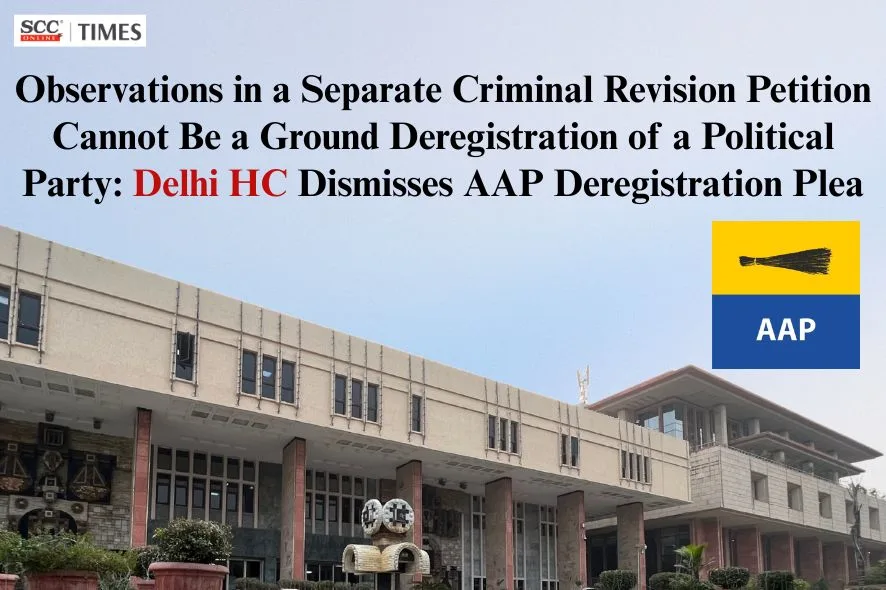
Delhi High Court: While considering a writ petition seeking directions to the Election Commission of India (ECI) to deregister the Aam Aadmi Party under Section 29-A(5), Representation of the People Act, 1951 (RPA), and to disqualify certain party members from contesting elections, the Division Bench of Devendra Kumar Upadhyaya*, CJ., and Tejas Karia, J., dismissed the petition as misconceived and held that the ECI had no power to deregister a political party for alleged violation of Section 29-A(5) except in limited circumstances.
Facts and Background
The petitioner sought 2 principal reliefs. First, a direction was sought against the ECI to deregister the Aam Aadmi Party on the ground that the conduct of some of its office-bearers amounted to a violation of Section 29-A(5) RPA. Secondly, the petitioner sought directions declaring certain individual respondents disqualified from contesting elections to Parliament or the State Legislature.
The petitioner relied on certain observations made by the Court in an earlier criminal revision petition concerning the conduct of the office-bearers concerned. According to the petitioner, those observations demonstrated conduct contrary to constitutional principles and therefore justified deregistration of the political party and disqualification of its members.
The respondents opposed the petition and argued that the reliefs sought were not maintainable in law. It was submitted that the ECI had no statutory power to deregister a political party merely on allegations of violation of Section 29-A(5) RPA, except under certain conditions.
Analysis and Decision
The Court examined the scheme of Part IV-A RPA dealing with registration of political parties. The Court observed that Section 29-A prescribed the procedure and conditions for registration of political parties, including the requirement that the party’s memorandum or rules affirm allegiance to constitutional values. However, the statute did not contain any express provision conferring a general power of deregistration upon the ECI.
The Court relied extensively upon the decision of the Supreme Court in Indian National Congress (I) v. Institute of Social Welfare, (2002) 5 SCC 685, wherein it had been held that the ECI could not deregister a political party for alleged violation of constitutional principles in the absence of an express statutory power of review. The Supreme Court had recognised only limited exceptions where deregistration could be undertaken, namely, where registration had been obtained by fraud or forgery, where the party amended its constitution contrary to Section 29-A(5), or where circumstances existed that required no factual enquiry, such as the party being declared unlawful under a statute.
Applying the above principles, the Court held that none of the recognised exceptions were attracted in the present case. There was no allegation that the political party had obtained registration by fraud, altered its constitution contrary to statutory requirements, or had been declared unlawful under any legislation. The Court found that the petitioner’s entire case rested upon observations made in an earlier criminal revision proceeding, which could not be extended beyond the context of that case.
The Court further observed that if any conduct of the individual respondents amounted to undermining the authority or dignity of the Court, the appropriate remedy lay under the Contempt of Courts Act, 1971, and not through proceedings seeking deregistration of a political party.
With regard to the prayer for disqualification of the individual respondents, the Court held that disqualification from contesting elections could arise only under the specific grounds enumerated in the RPA, such as those contained in Sections 8, 9, 9-A, 10 and 10-A. Since the petitioner had neither pleaded nor established any such statutory disqualification, no direction could be issued to the ECI. The Court also noted that the issue of disqualification would arise only if and when the individuals concerned contested elections.
Accordingly, the Court held that the writ petition was wholly misconceived, far-fetched, and devoid of merit. The petition was dismissed without any order as to costs.
[Satish Kumar Aggarwal v. Union of India, 2026 SCC OnLine Del 4024, decided on 20-5-2026]
*Judgment authored by: Chief Justice Devendra Kumar Upadhyaya
Advocates who appeared in this case:
For Petitioner: Barun Kumar Sinha, Pratibha Sinha, Sneh Vardhan, Vaibhav Singh, Advocates
For Respondent: Ankur Mittal, CGSC, Sanjay Vashishtha, SC, Aviraj Pandey, Sobhya Jain, Hrithik Saxena, R. Jaiswal, Siddhartha Goswami, Ashish Shukla, Aditya Sachdeva, Krish Bhatia, Advocates