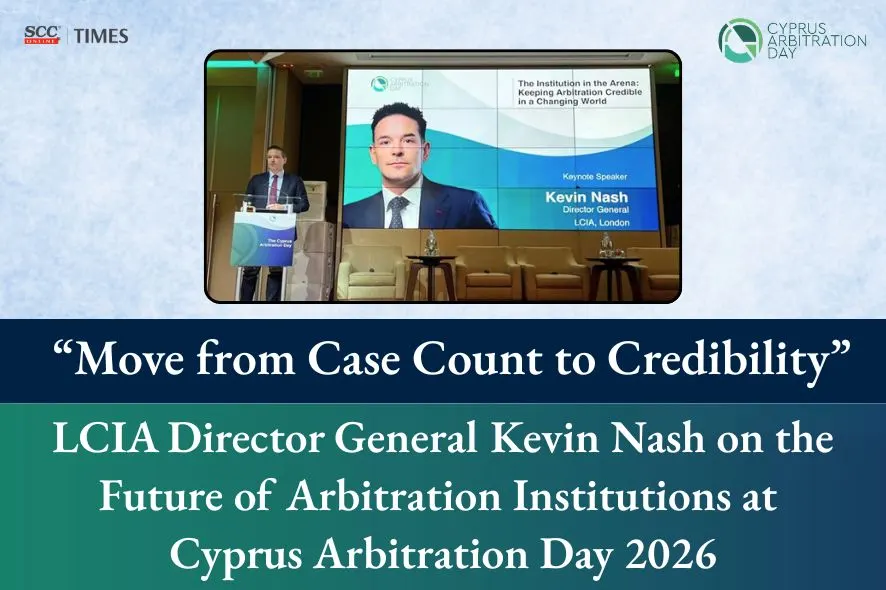
Delivering the keynote address titled “The Institution in the Arena: Keeping Arbitration Credible in a Changing World” at Cyprus Arbitration Day 2026, Mr. Kevin Nash, Director General, London Court of International Arbitration (LCIA), reflected on the evolving role of arbitral institutions in an increasingly complex global environment shaped by sanctions, AI, procedural challenges, and changing user expectations. He argued that arbitral institutions can no longer function merely as administrative bodies, but must actively shape the credibility, efficiency, and legitimacy of arbitration itself.

At the outset, Mr. Nash questioned how institutional success should truly be measured. While acknowledging that case numbers remain important, he stressed that institutional legitimacy extends far beyond filings and statistics. He observed:
“Case count is the scoreboard. It is not the game.”
According to him, modern arbitral institutions must instead be evaluated through broader considerations such as trust, due process, enforceability, meaningful innovation, and procedural proportionality. He emphasised that institutions today are no longer operating outside the dispute resolution process but are deeply embedded within it, often handling urgent and highly complex procedural situations even before tribunals are constituted.
Drawing from his institutional experience, Mr. Nash discussed practical examples involving emergency arbitration, consolidation requests, joinder of non-signatories, procedural timelines, and enforceability concerns under the New York Convention. He highlighted how institutions increasingly function as procedural architects responsible for balancing efficiency with fairness in highly compressed timelines. Referring to the expanding responsibilities of arbitral institutions, he remarked:
“The modern arbitral institution is not outside the arena. It is in the arena. And it may even be the arena.”
A significant portion of the keynote focused on how institutional innovation has shaped modern arbitration practice. Tracing the evolution of emergency arbitration, early dismissal procedures, and streamlined mechanisms, Mr. Nash explained how institutions have gradually developed tools responding to commercial realities, sanctions, force majeure disputes, and geopolitical disruptions. He noted that arbitration’s real competition is no longer limited to courts, but includes every credible form of dispute resolution, including mediation, negotiated settlements, and commercial pressure.
Addressing the growing role of artificial intelligence in arbitration, he observed that the debate is no longer about whether AI will enter arbitration, but about how legal systems and institutions will regulate its use responsibly. He cautioned that while AI may improve efficiency, institutions must ensure that technology does not undermine procedural integrity, fairness, or human judgment. He further reflected on broader institutional challenges concerning sanctions, movement of arbitration funds, confidentiality, transparency, and publication of arbitral data.
On the future of arbitration centres, Mr. Nash discussed Cyprus’ emerging position as a regional arbitration hub, noting its strategic location, common law background, English-language familiarity, and sophisticated professional community. However, he cautioned against imitation of established jurisdictions such as London or Singapore, stressing instead the importance of developing a model aligned with Cyprus’ own comparative strengths. He observed:
“The right question is how Cyprus aligns its own strengths into an arbitration ecosystem that users can continue to trust.”
Concluding the keynote, Mr. Nash issued a broader institutional call for reform and accountability across the arbitration ecosystem. He urged institutions to publish better procedural data, tribunals to utilise existing procedural tools effectively, courts to avoid unnecessary interference, and counsel to avoid weaponising procedure. He concluded with a statement encapsulating the broader theme of his address:
“That is how arbitration stays credible, not by nostalgia, but by design.”
The keynote ultimately underscored that the future credibility of international arbitration will depend not only on procedural innovation and technological adaptation, but equally on institutional trust, transparency, efficiency, and the preservation of principled decision-making in a rapidly changing world.