Disclaimer: This has been reported after the availability of the order of the Court and not on media reports so as to give an accurate report to our readers.
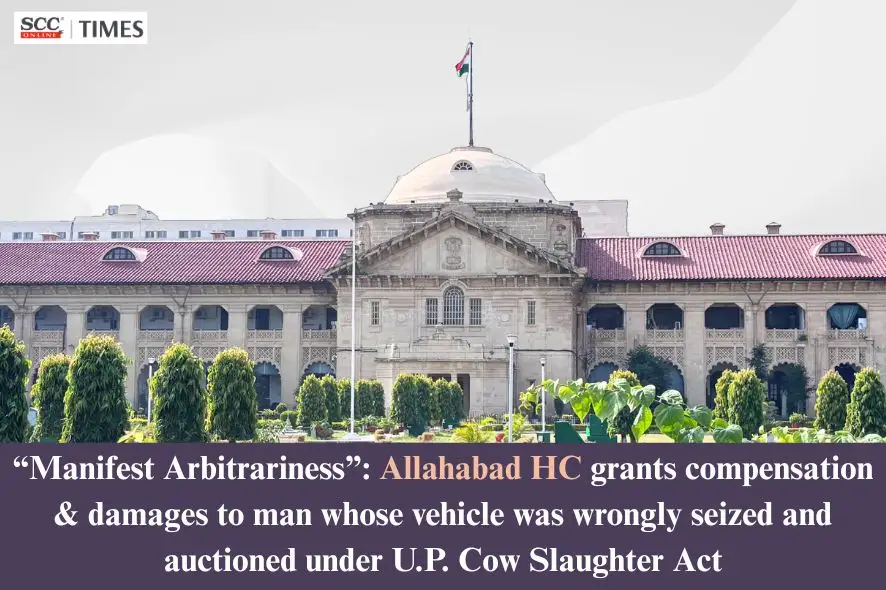
Allahabad High Court: In a writ petition filed by a man against the seizure of his vehicle for allegedly transporting bovines to Bihar for cow slaughter, the Single Judge Bench of Sandeep Jain, J., allowed the petition, holding that the State action of confiscating the petitioner’s vehicle was arbitrary, illegal, and unsupported by the statutory provisions of the Uttar Pradesh Prevention of Cow Slaughter Act, 1955 (U.P. Cow Slaughter Act). The Court also held that the sole basis of confiscation appeared to be that the animals were allegedly being transported without a permit, and there was no cogent material on record to establish that the animals were being transported to Bihar for slaughter.
Background
In 2024, the police were informed about the interception of a vehicle that was transporting cows and their progeny for slaughter to Bihar. Upon search, ten bovine animals, namely, 6 heifers, 2 cows, 1 bull, and 1 bullock, were allegedly recovered therefrom. Consequently, the vehicle was seized, and an FIR was registered against the present accused and 3 others under Sections 3, 5, 5-A and 8, U.P. Cow Slaughter Act, as well as Section 11, Prevention of Cruelty to Animals Act, 1960 (PCA Act).
The District Magistrate (DM) held that, under the provisions of the U.P. Cow Slaughter Act and the rules framed thereunder, a permit was required for transporting the animals to Bihar, and that the animals were being transported for slaughter. Since the vehicle had been intercepted near the Bihar border, a presumption was drawn that the vehicle was proceeding towards Bihar and the animals were intended for slaughter. Consequently, in exercise of powers under Section 5-A(7), U.P. Cow Slaughter Act, the accused’s vehicle was confiscated.
Aggrieved, the accused filed a criminal revision petition against the DM’s order, but it was dismissed by the trial court on the ground of lack of jurisdiction, holding that the competent authority was the Commissioner. Thereafter, his appeal before the Commissioner was dismissed via the impugned order.
The accused then approached this Court under Article 227 of the Constitution, but the coordinate Bench disposed of the petition. However, the coordinate Bench granted him liberty to file a criminal revision before the Divisional Commissioner within 4 weeks. Pursuant thereto, the accused filed the same under Section 5-A(8), U.P. Cow Slaughter Act, which was dismissed by the impugned order. Hence, the present petition.
Analysis
At the outset, the Court perused Sections 5-A and 5-B, U.P. Cow Slaughter Act, which regulate the transport of cows, bulls, and bullocks. The Court referred to Kaliya v. State of U.P., 2023 SCC OnLine All 1974, and Munib v. State of U.P., 2024 SCC OnLine All 9631, wherein it was held that no permit is required to transport a cow and its progeny within the State of U.P. and therefore, it cannot be said that the seized vehicle in question was used in violation of Section 5-A(1) to (11) or any provisions of the U.P. Cow Slaughter Act.
The Court noted that 10 bovine animals were allegedly discovered in the accused’s vehicle, but no beef or slaughtered animal flesh was recovered. The sole basis of confiscation appeared to be that the animals were allegedly being transported without a permit. However, there was no cogent material on record to establish that the animals were, in fact, being transported to Bihar for slaughter. Noting this, the Court held that, “Mere interception of the vehicle near the Bihar border cannot, ipso facto, justify such presumption. Suspicion, however strong, cannot substitute legal proof.”
Furthermore, the Court noted that cruelty to animals under Section 5-B, U.P. Cow Slaughter Act may attract separate proceedings; however, the authorities did not record any categorical finding that the vehicle was liable to confiscation on account of cruelty inflicted upon the animals.
Even otherwise, for invoking such provisions, the Court stated that there must be evidence of such physical injury or conditions of transport as would endanger the life of the animals. There must be such an injury on the body of the animals that either endangers their life or mutilates their body. A simple injury, which neither endangers their life nor mutilates their body, is not sufficient to attract the provision of Section 5-B, U.P. Cow Slaughter Act. Additionally, the prosecution was bound to prove such injuries in accordance with the law.
Considering the aforesaid, the Court noted that in the instant case, neither had such evidence been brought on record by the prosecution nor was there any discussion on this aspect by the authorities. The only ground assigned in the impugned orders was the absence of a permit. However, for the transportation of cows or their progeny within Uttar Pradesh, no permit was required. Thus, the Court held that in the absence of reliable evidence that the animals were being transported outside the State for slaughter, the very substratum of the confiscation proceedings collapses. Accordingly, the State action of confiscating the petitioner’s vehicle was arbitrary, illegal, and unsupported by the statutory provisions of the U.P. Cow Slaughter Act.
The Court further stated that it was equally disturbing that during the pendency of proceedings before the Commissioner, the State proceeded to auction the vehicle without awaiting adjudication of the accused’s challenge. Such an arbitrary action caused grave prejudice to the accused. As per the accused, the vehicle was sold for Rs 85,000 despite its worth being around Rs 4 lakhs at the time of the auction. “The sale for such grossly inadequate consideration demonstrates manifest arbitrariness.”
The Court further noted that the vehicle was a commercial transport vehicle and the principal source of livelihood of the accused. The vehicle had been financed through Shriram Finance Ltd., and the accused was paying monthly loan instalments until August 2024 but defaulted thereafter owing to the seizure of the vehicle.
Accordingly, the Court directed the State to pay compensation of Rs 15,000 per month to the accused from date of seizure till the restoration of the vehicle and an additional sum of Rs 20,000 towards mental agony and harassment.
Regarding the contention that the State could restore the vehicle, the Court held that even if the vehicle was restored, the State shall nevertheless be entitled to compensation towards loss of earnings from September 2024 till the date of actual restoration, calculated at Rs 15,000 per month. But if the vehicle was not restored, then the accused was entitled to the depreciated cost of the vehicle of Rs 4 lakhs at the time of the auction, along with the monthly damages. The Court further directed that these amounts shall be paid within 15 days.
Thus, the writ petition was allowed with liberty to the State to realise the damages awarded to the accused from the employees and officials concerned.
[Chandrabhan Kumar v. State of U.P., 2026 SCC OnLine All 4456, decided on 30-4-2026]
Advocates who appeared in this case :
For the petitioner: Hira Lal
For the respondents: Additional Advocate General Sanjeev Singh, Pankaj Saxena and Seema Shukla