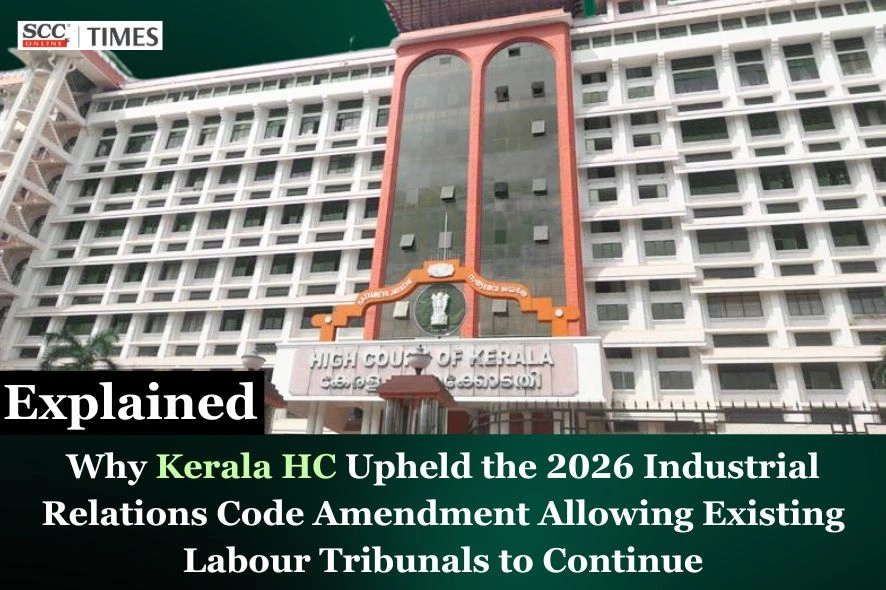
Kerala High Court: In a writ petition challenging the constitutionality of the Industrial Relations Code (Amendment) Act, 2026 (Amending Act), that provided for the continuation of the existing Labour Tribunals till the Tribunals and authorities under the Industrial Relations Code, 2020 (IR Code) become functional, a Single Judge Bench of Gopinath P., J., while dismissing the petition, upheld the Amending Act observing that the amended Section 104(1-A), IR Code does not violate Article 14 or Article 21 of the Constitution and is neither arbitrary nor unconstitutional.
Also Read: Industrial Relations Code Amendment 2026 Explained
Background
The petitioners filed a writ petition challenging the provisions of the Amending Act, whereby Section 104(1), IR Code, was amended by introducing sub-section (1-A). They contended that the provisions of the Amending Act were violative of Articles 14 and 21 of the Constitution. The amendment provided that notwithstanding the repeal of the Industrial Disputes Act, 1947, the Trade Unions Act, 1926 and the Industrial Employment (Standing Orders) Act, 1946, the Tribunals and statutory authorities constituted under the repealed enactments would continue to function till the Tribunals and authorities under the IR Code become functional.
The petitioners submitted that they had earlier challenged a Notification dated 8 December 2025 issued by the Central Government allowing the continued functioning of such authorities till the constitution of Industrial Tribunals and National Industrial Tribunals under the IR Code, and that this Court had already repelled the challenge in M.K. Suresh Kumar v. Union of India, 2026 SCC OnLine Ker 2389. However, it was urged that a writ appeal against the said decision was pending and that the present writ petition should be tagged along with the said appeal. On the other hand, the respondents submitted that considering the judgment in M.K. Suresh Kumar (supra), the writ petition was liable to be dismissed.
Also Read: Ker HC upholds continuation of existing labour courts and tribunals
Analysis and Decision
The Court opined that the primary contention raised was that the amended provision was contrary to other provisions of the same enactment. The Court noted that such a contention cannot be a ground to challenge Section 104(1-A), IR Code as the said provision starts with a non obstante clause, thereby enabling it to operate even if there is any contrary or inconsistent provision contained in the same statute.
The Court observed that no fundamental right of the petitioners was affected by the impugned amendment. The Court highlighted that the petitioners have no fundamental right to contend that the adjudication of disputes must only be before adjudicatory bodies constituted under the IR Code. The Court also noted that there was no pleading that Parliament lacked legislative competence or that the amendment violated the basic structure of the Constitution.
While dealing with the plea of that the provisions are “manifestly arbitrary”, the Court relied on Shayara Bano v. Union of India, (2017) 9 SCC 1, wherein the Court explained the expression “manifestly arbitrary” and observed that:
“What is manifestly arbitrary is obviously unreasonable and being contrary to the rule of law, would violate Article 14. … The arbitrariness doctrine when applied to legislation obviously would not involve the latter challenge but would only involve a law being disproportionate, excessive or otherwise being manifestly unreasonable.”
The Court observed that there was no reason to even hold that the provisions that have been challenged are arbitrary, much less manifestly arbitrary and no ground was made out to grant the reliefs sought. The Court further observed that the issues raised in the pending writ appeal arising from the earlier judgment were entirely different and found no reason to adjourn the matter to be heard along with the said appeal. Accordingly, the Court dismissed the writ petition in limine.
[M.K. Suresh Kumar v. Union of India, 2026 SCC OnLine Ker 4432, decided on 8-4-2026]
Advocates who appeared in this case:
For the Petitioners: A. Abdul Nabeel, Anand B. Menon, Advocates.
For the Respondents: P. Sreekumar (ASGI).
Buy Constitution of India HERE