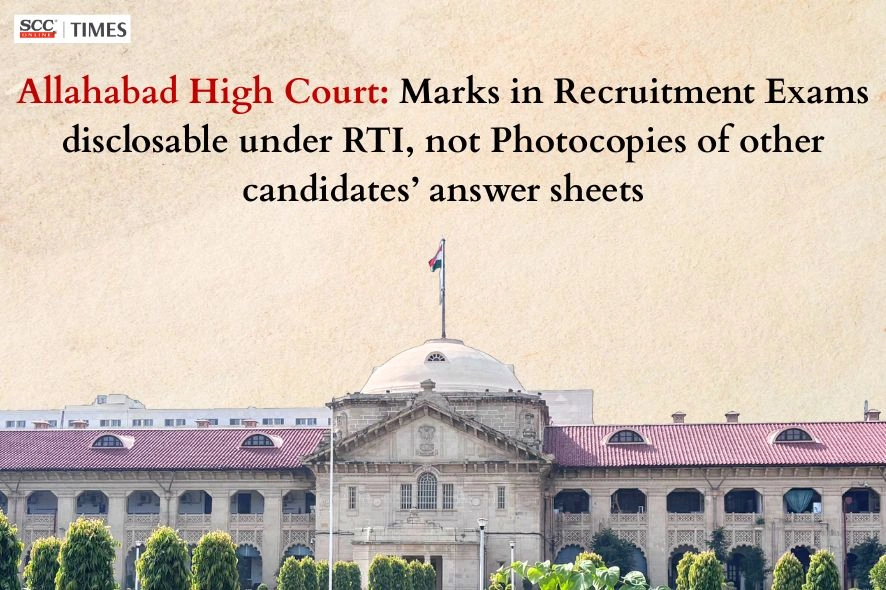
Allahabad High Court: Considering the scope of disclosure under the Right to Information Act, 2005 (RTI Act), particularly the interplay between “personal information” and “public activity” under Section 8(1)(j), a Division Bench of Swarupama Chaturvedi and Ajit Kumar, JJ., held that while marks obtained in a public examination are subject to disclosure in the interest of transparency, answer sheets of other candidates involve confidentiality concerns and are not liable to be disclosed.
The Court was dealing with a writ petition filed by the Union of India challenging an order of the Central Information Commission (CIC), which had directed disclosure of marks and photocopies of answer sheets of the respondent and two other candidates from a recruitment examination. The Bench, while examining the statutory framework including Section 8(1)(j) and the procedural safeguards under Section 11, held that although candidates are entitled to their own answer sheets and to information regarding marks of other candidates, they do not have a right to obtain photocopies of other candidates’ answer sheets. Accordingly, the writ petition was partly allowed.
Background
In the case at hand, the respondent, who was working as Office Superintendent-II, had appeared in a written examination conducted by the Indian Railways for selection to the post of Legal Assistant. On 10 October 2008, he had filed an RTI application before the Public Information Officer, Diesel Locomotive Works, Varanasi, seeking (i) his marks and those of two other candidates and (ii) photocopies of their answer sheets.
The Senior Personnel Officer, acting as the nodal PIO, had supplied the question paper but had denied photocopies of the answer sheets, while permitting inspection. The marks were also not disclosed at that stage. Aggrieved, the respondent had filed an appeal before the Central Information Commission (CIC), which, by order dated 13 May 2009, had directed the petitioners to provide photocopies of the answer sheets of the examination held on 30 July 2004.
The petitioners had subsequently disclosed the marks on 28 May 2009 but, instead of furnishing the answer sheets, had filed a review petition before the CIC, contending that such information was exempt under Section 8(1)(j) of the RTI Act as personal information.
By order dated 4 June 2009, the CIC had dismissed the review petition, holding that the Indian Railways was a “public authority” and that conducting recruitment examinations was incidental to its functions. It had further observed that disclosure of answer sheets could not be denied as a general rule and had to be decided case-wise. Aggrieved by these orders, the petitioners had filed the present writ petition before the High Court.
Analysis, Law, and Decision
The Court examined the scope of disclosure under the RTI Act in the context of third-party information and privacy, observing that when a candidate seeks information regarding another candidate’s marks, such information qualifies as third-party information, thereby attracting Section 11 of the RTI Act. However, disclosure is restricted only where it results in an unwarranted invasion of privacy.
Interpreting the statutory framework, the Court emphasized that “personal information” must be understood in light of its relationship with public activity and public interest and held that information relating to public examinations involves elements of public activity, as such processes affect a class of candidates and ensure transparency in recruitment.
Elaborating further, the Court stated that “public activity” refers to activities involving the public at large or a section thereof, particularly where public authorities are involved, and in this backdrop, disclosure of marks obtained in a public examination was not considered private in nature. At the same time, the Court distinguished between disclosure of marks and answer sheets, noting that while marks promote transparency, answer sheets may involve confidentiality concerns such as examiner identity and evaluation processes.
The Court relied upon Section 8(1)(j) of the RTI Act, which exempts disclosure of personal information having no relation to public activity or public interest, or causing unwarranted invasion of privacy, unless larger public interest justifies disclosure, and also referred to Section 11 which mandates procedural safeguards, including notice to third parties before disclosure. It placed reliance on Girish Ramchandra Deshpande v. Central Information Commissioner, (2013) 1 SCC 212, wherein the Supreme Court held that personal information of a third party cannot be disclosed unless connected with public activity or justified by overriding public interest, and on Central Board of Secondary Education v. Aditya Bandopadhyay, (2011) 8 SCC 497, which recognized the right of examinees to access their own answer sheets subject to limitations.
Accordingly, the Court held that disclosure of marks obtained in a public examination does not amount to an invasion of privacy and serves larger public interest, and such information, when sought by a participating candidate, is not exempt under Section 8(1)(j). However, photocopies of answer sheets of other candidates need not be provided as there is no vested right to obtain them and confidentiality concerns may arise, though inspection or perusal may be allowed as a sufficient alternative. It was further held that a candidate is entitled to obtain a copy of his or her own answer sheet, but not that of others as a matter of right.
Thus, furnishing marks of other candidates was justified, and no error was found in the orders of the Central Information Commission, including dismissal of the review petition. Since the marks had already been disclosed vide letter dated 28 May 2009, no further information was required to be furnished. The Court further observed that once relevant information is supplied under the RTI Act, the application stands satisfied, and it is not always necessary to provide copies of official records where inspection sufficiently meets the statutory mandate.
The writ petition was thus partly allowed.
[Union of India v. Central Information Commission, New Delhi, 2026 SCC OnLine All 549 decided on 26-2-2026]
Advocates who appeared in this case:
For the Petitioner: Krishna Ji Shukla, Shekhar Kumar Yadav, Advocate
For the Respondent: Ashish Kumar Srivastava, Advocate