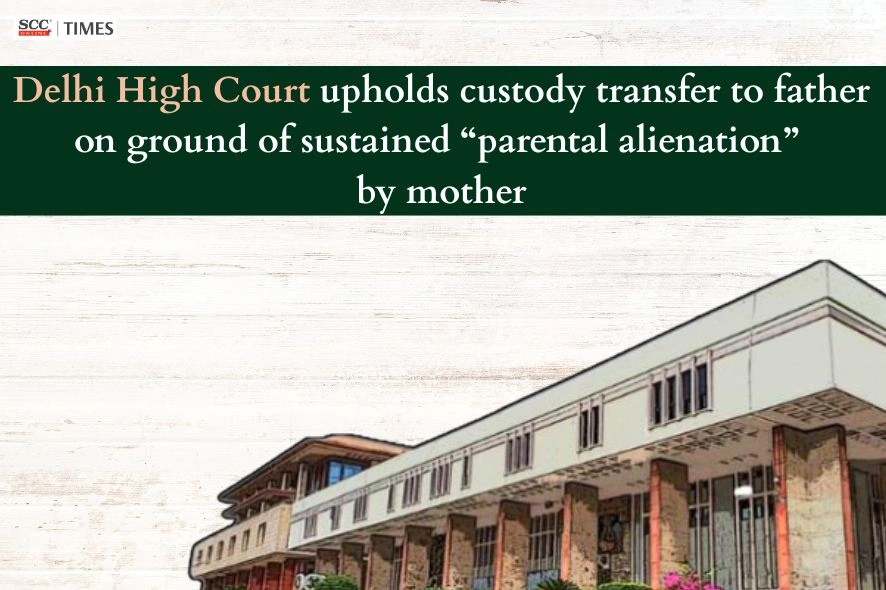
Delhi High Court: In an appeal arises out of a protracted custody dispute between estranged spouses concerning their two minor children, further involving allegations and counter-allegations of matrimonial cruelty, parental alienation and abuse of legal process, a Division Bench of Anil Kshetarpal and Harish Vaidyanathan Shankar,* JJ., dismissed the matrimonial appeal and upheld the judgment of the Family Court directing that the custody of both minor children be handed over to the father, along with structured visitation and communication rights for the mother.
Factual Matrix
The Appellant-wife and the Respondent-husband were married on 26-09-2011 and have two children, a son born on 29-04-2013 and a daughter born on 24-01-2019. After marriage, the parties resided together at Habra, District North 24 Parganas, West Bengal, along with the respondent’s parents. The son was admitted to school at Habra and the family lived together until September 2018.
The father alleged that on 04-09-2018, the wife left the matrimonial home under the pretext of going to work and later conveyed her intention to proceed to her parental home at Siliguri, leaving the minor son behind. It was further alleged that on 09-09-2018, the wife accompanied by her father and others, removed the child from the husband’s home without any order of a competent court.
The wife, on the other hand, alleged that she was subjected to physical assault, verbal abuse, and mental harassment, including an incident of assault while she was four months pregnant, compelling her to leave the matrimonial home. She initiated criminal proceedings under Sections 498-A and 506 IPC and under the Domestic Violence Act.
Subsequently, multiple proceedings were instituted by both parties across jurisdictions. Guardianship proceedings initiated by the father were transferred ultimately to the Family Court at Patiala House Courts, New Delhi pursuant to orders of the Supreme Court. During this period, the wife relocated multiple times with the children and eventually secured employment in the United Kingdom in August 2023, while the children continued to reside in India with their maternal grandparents.
Procedural History
By judgment dated 01-07-2024, the Family Court allowed the father’s petition under the Guardians and Wards Act and directed that custody of both minor children be handed over to the father, recording categorical findings of “sustained parental alienation” by the mother. The Family Court granted structured visitation and communication rights to the mother, along with restrictions on relocation of the children.
Aggrieved by the Family Court’s decision, the mother preferred the present matrimonial appeal. During its pendency, the father instituted contempt proceedings alleging violation of interim orders granting him access to the children and non-compliance with directions relating to updation of records concerning paternity.
With consent of parties, both the appeal and the contempt petition were heard together and disposed of by a common judgment.
Moot Points
-
Whether the Family Court erred in granting sole custody of the minor children to the father?
-
Whether the principle of “welfare and best interest of the child” was correctly applied?
-
Whether allegations of abuse and the expressed wishes of the children warranted interference?
-
Whether findings of parental alienation were sustainable?
Court’s Analysis
The Court reiterated that in matters of custody, the “welfare and best interest of the child is the paramount consideration”, and such consideration must override competing claims of either parent. The Court emphasised that custody disputes cannot be decided on presumptive doctrines or parental entitlements, but must be anchored in a holistic assessment of the child’s physical, emotional, psychological and moral well-being.
The Court expressly questioned the continued mechanical application of the tender years doctrine, observing that it is founded on “a highly stereotypical premise” that which assumed the father to be the breadwinner and the mother to be the sole caregiver. The Court held that such rigid compartmentalisation of parental roles no longer accords with contemporary realities, particularly where both parents are educated and professionally engaged. It was therefore held that custody adjudication must rest on the principle of best interests of the children, rather than on presumptive maternal preference.
The Court found no perversity in the Family Court’s conclusion that the wife’s conduct reflected “a sustained effort to deny the respondent-father access to the children”. The Court noted that the departure of the mother was not shown to be occasioned by any immediate or compelling threat to the welfare of the child, particularly as she returned after a few days with police personnel to remove the child from the father’s custody. The Court held that a parent cannot, after deliberately excluding the other parent, assert primary caregiving as a fait accompli. Permitting custody on such a basis would only encourage “a modus operandi of deliberate exclusion of one parent”, which would be destructive of the child’s welfare.
“After deliberately keeping the children away from one parent, the other cannot assert, as a fait accompli, that he/ she has been the primary care-giver. Permitting custody on this basis would only serve to encourage parents to follow a modus operandi of deliberate exclusion of one parent and subsequently raise a plea that he/ she has been the primary care-giver and resultantly should be permitted to retain custody of the children.”
With regard to the allegations of sexual abuse raised by the mother, the Court held that such grave accusations were neither pleaded initially nor supported by contemporaneous material, and surfaced only at the stage of evidence, despite the claim that the child had disclosed them years earlier, rendered them unreliable. It observed that such allegations appeared to be “clearly motivated and in the nature of a counterblast to the proceedings initiated by the respondent-father”.
On the issue of the children’s wishes, particularly the son, the Court held that while the views of a child of sufficient age merit consideration, the Court must remain vigilant to ensure that such wishes are not merely the product of prolonged exposure to one-sided narratives. The Court observed that the hostility expressed by the son appeared “more consistent with a conditioned or influenced response” rather than an independent preference. The Court held that
“A child’s preference, when formed in an environment marked by alienation, cannot be elevated to a veto over judicial determination, for to do so would be to allow the consequences of alienation to harden into its justification.”
The Court also observed that separating the siblings would be inimical to their emotional security and holistic development, noting that siblings constitute a shared emotional universe and act as anchors of reassurance amidst parental discord. The Court held that the welfare of the children lay in a unified upbringing which preserves sibling companionship and facilitates restoration of a balanced parental influence.
“Siblings constitute a shared emotional universe, and their bond often functions as an anchor of continuity and reassurance amidst parental discord. To divide them at this stage would risk compounding the emotional trauma already occasioned by prolonged litigation and familial fragmentation.”
The Court further emphasised that conferment of custody on the father does not marginalise the role of the mother. The Court asserted that parenthood “does not recede or dissolve with the loss of custody”, but continues as a shared responsibility, requiring cooperation and constructive contribution towards the child’s welfare.
Court’s Decision
The Court dismissed the matrimonial appeal, upheld the judgment of the Family Court granting custody of both children to the father, and reinforced the structured visitation and communication rights of the mother.
The Court disposed of the contempt proceedings with consequential directions ensuring compliance with access and communication arrangements.
[A v. B, 2026 SCC OnLine Del 276]
*Judgment by Justice Harish Vaidyanathan Shankar
Advocates who appeared in this case:
Mr. Prosenjeet Banerjee, Ms. Shreya Singhal, Ms. Mhasilenuo Keditsu, Ms. Kushagra and Ms. Anshika, Counsel for the Petitioner
Ms. Padma Priya, Ms. Chitrangda Rastrauara, Mr. Abhijeet Singh, Mr. Anirudh Singh, Mr. Aishwary Mishra, Mr. Dhananjay Shekhawat, Mr. Sakshi Aggarwal, Mr. Yuvraj Singh, Ms. Pearl Pundir and Ms. Bhumika, Counsel for the Respondent
Buy Penal Code, 1860 HERE