Disclaimer: This has been reported after the availability of the order of the Court and not on media reports so as to give an accurate report to our readers.
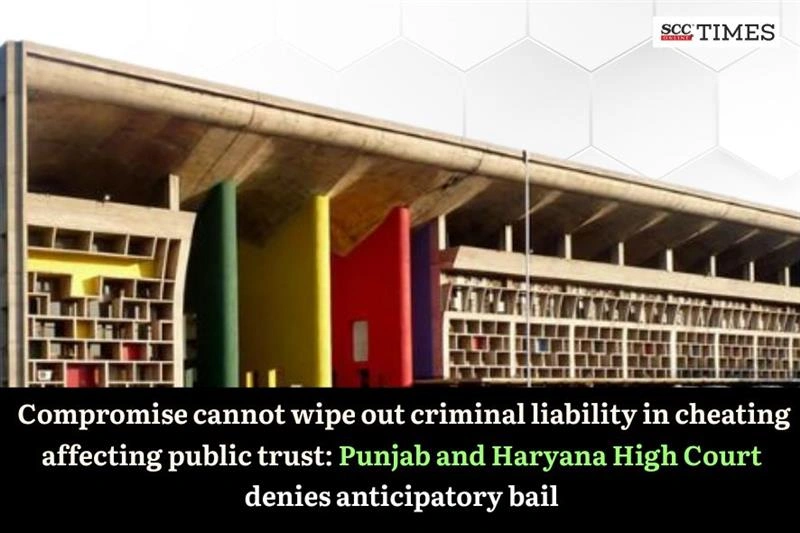
Punjab and Haryana High Court: A petition was filed by the petitioner-accused under Section 482 of the Bharatiya Nagarik Suraksha Sanhita, 2023 (‘BNSS’) for grant of anticipatory bail in case where he was accused of cheating and conspiracy involving deliberate deception and monetary fraud of Rs 4,50,000. Despite the petitioner-accused settling the matter with the complainant by returning the money, a Single Judge Bench of Sumeet Goel, J., held that the alleged compromise could not wipe out the criminal liability in offences of cheating which affected public trust and were not merely private in nature.
Accordingly, the Court dismissed the petition and stated that the accused did not deserve the concession of anticipatory bail as the alleged act, by its nature, constituted offence against the State as well as public at large.
Background
In the present case, the FIR was registered under Sections 420 and 120-B of the Penal Code, 1860 (‘IPC’) pertaining to defrauding the complainants who alleged that the accused along with the co-accused cheated them of Rs 4,50,000 by promising government jobs.
The complainant trusted their words because the accused was related to a politician and transferred the said amount. Rs 1,40,000 was transferred directly into the accused’s account. Thereafter, the accused stopped answering calls and made excuses instead of arranging the promised jobs.
The accused had earlier applied for anticipatory bail twice, but it was dismissed.
The accused contended that it was the co-accused, primarily responsible for the fraudulent activity, who got the money transferred to his account. Further, he submitted that he had already settled the matter with the complainant by returning Rs 1,40,000. Per contra, the respondent argued that the accused in collusion with co-accused induced the complainant to part with substantial amount of money under the pretext of securing government employment.
Analysis and Decision
On the issue of maintainability of successive bail applications, the Court stated that a second or third anticipatory bail petition was maintainable under law, but it required demonstration of a substantial change in circumstances since the earlier petition. The Court highlighted a settled proposition of law that such a change must be significant and not merely superficial or technical, to warrant reconsideration. Further, the Court stated that this standard ensured that the remedy of successive bail petitions was not misused through repeated filings but was available when new and material factors arose that altered the initial assessment of the case.
The Court held that no fresh substantial change in circumstance was brought forward, which could indicate that the accused was entitled to maintain his third petition for grant of anticipatory bail. Thus, there was no fresh ground or circumstance made out to enable the accused to file and maintain the third anticipatory bail petition.
The Court noted that the allegations revealed a premeditated and organized act of cheating under the guise of providing government jobs, and such an offence undermined public confidence and could not be taken lightly. The Court opined that by its very nature such an act constituted offence against the State as well as public at large. It struck the very root of public trust in the integrity of government institutions and the recruitment process. Therefore, the offence assumed a character that transcended the domain of individual grievance and attained the complexion of a societal wrong warranting strict judicial scrutiny.
Hence, considering the accused’s plea regarding his compromise with the complainant, the Court stated that it did not absolve the accused of criminal liability for an offence involving deception and public trust. The Court specified that it is a settled law that offences of cheating and criminal conspiracy are not compoundable at the anticipatory bail stage unless so permitted by statute. Further, whether the repayments were made is a question of fact, which requires thorough investigation and cannot be delved at summarily at this stage. It is trite law that repayment of money does not obliterate the offence of cheating once inducement and deception are prima facie established in particular, where the offence alleged cannot be said to have an adverse impact upon the duped victims alone.
The Court noted that the nature of deception employed not only caused pecuniary loss to the victims but also undermined the sanctity of public administration, thereby eroding confidence in fairness and transparency in public employment/recruitment processes. The Court further stated that it is well-settled that anticipatory bail is an extraordinary remedy to be granted sparingly in exceptional cases where the Court is satisfied that the accused has been falsely implicated or that custodial interrogation is wholly unnecessary. Considering the serious allegations involved in the present case supported by documentary material, the Court observed that the grant of pre-arrest bail could hamper the investigation.
Further, the Court stated that while considering a plea for grant of anticipatory bail, the Court had to equilibrate between safeguarding individual rights and protecting societal interests. The Court ought to reckon with the magnitude and nature of the offence; the role attributed to the accused; the need for fair and free investigation as also the deeper and wide impact of such alleged inequities on society.
Therefore, the Court stated that it was not appropriate to grant anticipatory bail to the accused as it would necessarily cause impediment in effective investigation which was still underway, and his custodial interrogation was necessary to trace the money trail and uncover the full extent of the conspiracy. The Court, thus, dismissed the petition at hand.
[Gurpreet Singh v. State of Punjab, 2025 SCC OnLine P&H 13597, decided on 30-10-2025]
Advocates who appeared in this case:
For the Petitioner: G.S. Verma, Advocate
For the Respondent: Amit Goyal, Additional Advocate General, Punjab
Buy Penal Code, 1860 HERE