Rajasthan High Court entertains appeal despite prima facie view on non-maintainability under MSMED Act
Rajasthan High Court decided to entertain the appeal due to the significant question of the application’s maintainability.
The instant matter is related to appeal against the writ petition challenging the election of respondent 14 to the West Bengal Assembly in the 2021 elections, based on falsifying his educational qualifications.
“When damages have been paid for unlawful use of land then plaintiff, being a wrong doer, cannot claim equitable relief for wrongful use of such land, in respect of which he has no right, title, interest.”
“If the Appellate Tribunal under Bihar Goods and Services Tax, 2017 is constituted and an appeal is filed there can be no further proceedings taken for recovery of the balance amounts till the appeal is disposed of.”
“An amending statute cannot be read in a manner to take away, alter, abrogate, impair or extinguish vested rights acquired under existing laws, or create a new obligation, impose a new duty or attach a new disability, in respect of transactions already past”
“If the goods are imported for any purpose other than consumption, use or sale within the State, then the importer has to prove how the goods imported were disposed of.”
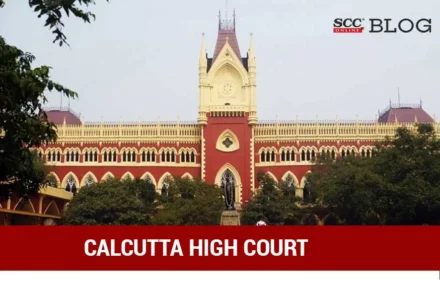
Calcutta High Court concurred with the trial court’s decision to acquit the accused under Section 366 of IPC due to absence of evidence supporting sexual assault.
Calcutta High Court observed that the Tribunal overlooked the direction issued by the High Court and failed to apply Rule 21 of the Employees Provident Fund Appellate Tribunal (Procedure) Rules, 1997, which grants flexibility in securing the ends of justice.
“The appellant submitted that the respondent was liable to imprisonment for not less than ten years and payment of fine of not less than Rs. 1,00,000. However, he was sentenced to undergo rigorous imprisonment for six months and payment of fine of Rs. 1,000.”
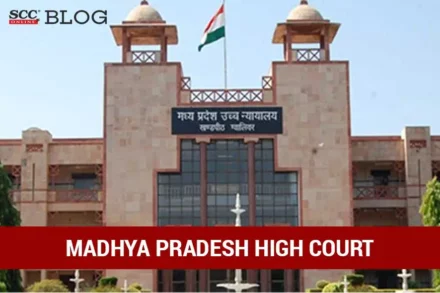
Madhya Pradesh High Court warned the appellants of consequences, including contempt of court, for non-compliance with the directions.
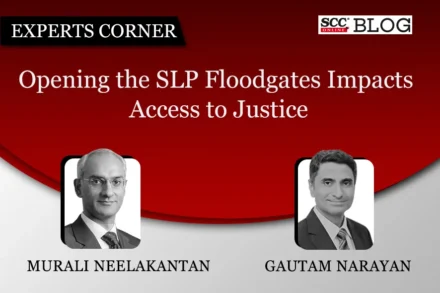
by Murali Neelakantan* and Gautam Narayan**
Cite as: 2023 SCC OnLine Blog Exp 81
The NCLAT directed the Adjudicating Authority to hear and decide the application under Section 7 of the IBC expeditiously, treating it as not covered by Section 10A of the IBC.
Supreme Court reiterated that a co-ordinate Bench cannot comment upon the judgment rendered by another co-ordinate Bench of equal strength and that subsequent decision or a judgment of a co-ordinate Bench or larger Bench by itself cannot be regarded as a ground for review.
Limitation shall commence from the date when order is passed and shall not depend on the date when Appellant came to know of the order.
The High Court observed that the object of Courts is to decide the rights of the parties and not to punish them for mistakes which are made in the conduct of the cases.
“Section 28 of the Hindu Marriage Act, 1955 and Section 19 of the Family Courts Act, 1984 operate in different spheres and apply to orders passed by different forums i.e., District Court and the Family Court respectively.”
To interpret ‘proceeding decided’ as entire proceedings and not a part of a proceeding would amount to restricting the exercise of revisional jurisdiction which is not as contemplated under Section 210 of UP Revenue Code.
“In application for condonation of delay in refiling of appeal, the applicant/appellant has to give sufficient reason for not re-filing the appeal within the time prescribed.”
This report covers the Supreme Court's Never Reported Judgment dating back to the year 1952 on duty of appellate court under Criminal Procedure Code, 1898.
Delhi High Court opined that the cause of death was found to be cranio cerebral damage consequent upon blunt force impact to the head which was sufficient to cause death in ordinary course of nature.