








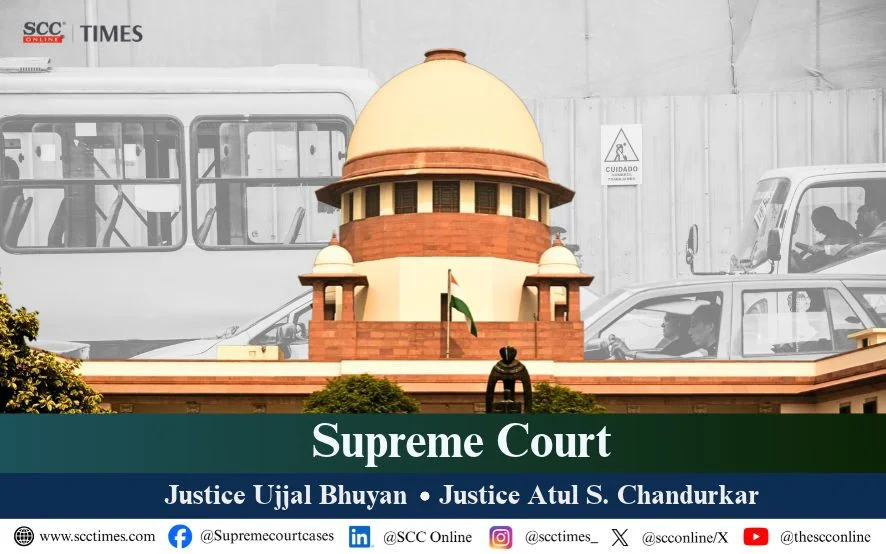
Supreme Court: While modifying and enhancing the compensation to ₹11,75,106 in a motor accident claim of 2013, a Division Bench comprising Ujjal Bhuyan and Atul S. Chandurkar* held that a composite increase in the amount of compensation without indicating the basis for the same could be termed an exercise of guesswork rather than applying the law laid down earlier.
The Court reiterated that an appellate court must examine each head of compensation awarded by the Tribunal and determine whether it is just, instead of granting a lump-sum increase without reasons. Relying on Raj Kumar v. Ajay Kumar, (2011) 1 SCC 343, it restated that just compensation comprises pecuniary and non-pecuniary heads. It also held that, in the absence of proof of income, minimum wages must be the basis. Functional disability must be assessed with reference to the claimant’s occupation, and future prospects must follow principles laid down in National Insurance Co. Ltd. v. Pranay Sethi, (2017) 16 SCC 680.
Also Read: HP HC on dependents of unmarried motor accident victim | SCC Times
Background
The claim was instituted under Section 166, Motor Vehicles Act, 1988 (MV Act) before the Motor Accident Claims Tribunal, Gwalior (Tribunal) against the respondent seeking compensation for the injuries suffered by the appellant on account of the accident which took place in 2013.
The appellant along with his wife was travelling on a motorcycle when they were hit by a truck driven by the Respondent 1 and owned by Respondent 2. Both appellant and his wife suffered injuries, and they underwent medical treatment thereafter. The appellant had suffered 50 per cent permanent disability on his right leg , as recorded in the disability certificate.
He further claimed that his monthly income was ₹15,000 through the collection and sale of milk. The appellant was aged between 27 to 30 years at the time of accident.
The Tribunal assessed his overall disability to be 20 per cent and considered his monthly income to be ₹4000 and awarded him a compensation of ₹2,33,130 with 7 per cent interest. Aggrieved by the same, the appellant filed an appeal under Section 173(1), MV Act seeking enhancement of the compensation amount. The appeal was dismissed on 29 April 2015 for failure to cure procedural defects. It was later restored on 26 April 2024, upon payment of ₹1000 costs, with the condition that any enhanced compensation would not carry interest for the dismissal-to-restoration period. The High Court subsequently enhanced the amount by ₹2,00,000 over and above the amount awarded by the Tribunal. The appellant, not being satisfied with the partial enhancement in the amount of compensation, has filed the present appeal.
Appellant’s Contentions
As per the appellant, the Tribunal and the High Court erred in assessing the monthly income as ₹4000, which is lower than the minimum wage of an unskilled labourer. He contended that the loss of earning capacity was assessed too low in view of the disability certificate. He further urged that higher compensation ought to have been awarded towards future prospects, medical expenses, attendant charges as well as for the pain and suffering of the appellant. The appellant stated that while the Tribunal awarded meagre compensation, the High Court enhanced the same by only ₹2,00,000. Appellant prayed for a higher compensation, keeping in view his injuries and age.
Respondents’ Contentions
The first and the second respondents have chosen not to contest the appeal. Respondent 3, the insurance company, submitted that the Tribunal as well as the High Court had rightly assessed the appellant’s income as ₹4000 in the absence of any evidence regarding the same. The calculation of earning capacity was appropriate since the doctor had opined that with further treatment, the percentage of disability would be reduced. Respondent 3 further submitted that there was no reason to enhance the amount of compensation and that the appeal was liable to be dismissed.
Also Read: Fraudulent Motor Accident Claims: SC Orders Pan-India SIT Probe | SCC Times
Court’s Analysis
The Court after perusing the documentary material on record, opined that the appellant would be entitled to higher compensation than what was awarded by the High Court. It observed that the Tribunal determined the amount of compensation after analysing appellant’s entitlement under various heads, but the High Court enhanced the amount without indicating the manner in which it arrived at the said figure.
The Court indicated that the High Court ought to have considered each head under which compensation was awarded by the Tribunal and then determined whether such grant was just or not. A composite increase in the amount of compensation without indicating the basis for the same could be termed an exercise of guesswork rather than applying the law laid down in this regard.
The Court placed reliance on its judgment in Raj Kumar, wherein it dealt in detail with the various heads under which damages have to be paid. The pecuniary damages included expenses related to hospitalisation, treatment, future medical expenses, nourishing food, transportation, loss of earnings including the ones that occurred during the period of treatment and the future earnings on account of permanent disability. The non-pecuniary damages included damages for pain, suffering and trauma, loss of amenities and loss of expectation of life. Applying these principles to the present case, the Court noted that the High Court failed to determine just compensation by undertaking such exercise.
The Court determined the amount of just compensation which the appellant would be entitled to. Since there was no proof of income of the appellant, it took into consideration the minimum wages drawn by an unskilled worker on the date of the accident, that is, 24 April 2013. It found the same to be ₹5270, bringing his annual income to ₹63,240. In view of his age, taken as 30 years, the appropriate multiplier of 17 was applicable. Regarding his disability, the Court observed that since the appellant claimed to have been engaged in collection and sale of milk, his functional disability was assessed at 50 per cent. The Court placed reliance on Indra Bai v. Oriental Insurance Co. Ltd., (2023) 8 SCC 217 for this proposition. Accordingly, it calculated the net annual income of the appellant at ₹5,37,540. While calculating the future prospects, it followed the principles laid down in Pranay Sethi and fixed it at 40 per cent, amounting to ₹2,15,016. Thus, the net income of the appellant was taken at ₹7,52,556.
The Court calculated the loss of earnings for 6 months at ₹31,620. An amount of ₹15,930 was awarded for medical expenses; ₹50,000 towards special diet and transportation; ₹1,00,000 under the head of pain and suffering; and ₹25,000 for attendant charges. After taking into consideration, the enhancement of ₹2,00,000 granted by the High Court, the total compensation now amounted to ₹11,75,106. An interest rate of 7 per cent was found to be reasonable. It further noted that the direction issued by the High Court regarding non-payment of interest for the dismissal-to-restoration period of the appeal would continue to operate.
Decision
The Court modified the judgment of the High Court and recalculated the total compensation to ₹11,75,106 with 7 per cent annual interest payable from 28 June 2013 till realisation. However, interest on the enhanced compensation would not be payable for the period from
29 April 2015 to 26 April 2024, during which the appeal remained dismissed before being restored. The Court accordingly allowed and disposed of the civil appeal, with no order as to costs
[Mohd. Sabir v. Ramesh Prasad, 2026 SCC OnLine SC 2465, decided on 20-11-2026]
*Judgment authored by Justice Atul S. Chandurkar
Advocates who appeared in this case:
For the Appellant: Praveen Swarup, Advocates.
For the Respondents: Pyoli, Sanathana Bhaarath, Advocates.






0 replies