








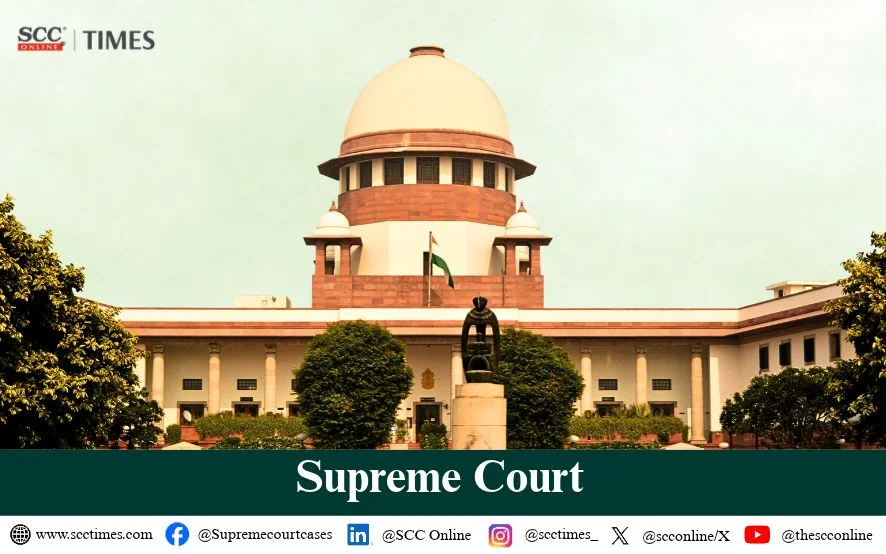
Supreme Court: In an appeal against a Delhi High Court judgment, which had dismissed the Delhi Development Authority’s (DDA) petition under Article 227 of the Constitution challenging the order dated 7 June 2024 of the National Consumer Disputes Redressal Commission (NCDRC) in Revision Petition No. 1621 of 2022, a Division Bench of Vikram Nath* and Aparesh Kumar Singh, JJ. allowed the appeal. The Court held that the NCDRC had adopted an unduly restrictive approach in assessing the explanation for the remaining delay of 95 days, and that the High Court had failed to give sufficient weight to the cumulative circumstances. It condoned the delay, restored the revision petition to the NCDRC for disposal on merits, and expressed no opinion on the merits of the dispute.
Background
Smt. Bachhi Devi, the predecessor-in-interest of the respondents, applied for a residential flat under the Expandable Housing Scheme, 1996 floated by the DDA. Pursuant to a draw of lots held on 21 March 1997, she was allotted Flat No. 286, Sector B-4, Pocket 6, Narela, Delhi. The DDA issued demand-cum-allotment letters between 12 January 2000 and 20 January 2000, requiring payment of the prescribed amount within the stipulated period.
According to the DDA, the demand-cum-allotment letter was sent to the correspondence address furnished by the allottee, whereas she denied having received it. Upon non-payment, the DDA issued a show cause notice dated 09 August 2001 proposing cancellation of the allotment. Despite her representations seeking issuance of a proper demand letter, the DDA informed her on 20 October 2003 that the allotment had been cancelled.
The allottee filed consumer complaint before the District Consumer Disputes Redressal Forum-II, New Delhi, alleging deficiency in service. By order dated 11 August 2015, the District Forum dismissed the complaint, holding that the letter had been sent to the correspondence address furnished by the allottee and that the cancellation was justified. In First Appeal No. 462 of 2015, the State Consumer Disputes Redressal Commission, Delhi, by order dated 9 April 2021, allowed the appeal, holding that the letter had not been duly served on the allottee, and directed the DDA to allot an alternative flat at the rates prevailing at the time of the original allotment.
The DDA filed Revision Petition before the NCDRC on 2 December 2022, with an application for condonation of delay. The delay was reported to be 512 days. The DDA sought exclusion of the period covered by the Supreme Court’s orders extending limitation during the COVID-19 pandemic and attributed the remaining delay of 95 days to administrative procedures, change of counsel and procurement of the certified copy. By order dated 7 June 2024, the NCDRC dismissed the application and the revision petition, holding that the DDA had failed to establish sufficient cause for the remaining 95 days. The DDA approached the High Court under Article 227, which dismissed its petition on 23 October 2024, holding that the DDA had failed to act with due diligence. The DDA then appealed to the Supreme Court.
Issues and Analysis
The Court was called upon to determine whether the NCDRC was justified in declining to condone the delay in filing the revision petition, and whether the High Court erred in affirming that decision.
The Court began by recalling the settled principles. In Collector, Land Acquisition, Anantnag v. Mst. Katiji, (1987) 2 SCC 107, it was held that the expression “sufficient cause” must receive a liberal interpretation so as to advance substantial justice. In N. Balakrishnan v. M. Krishnamurthy, (1998) 7 SCC 123, it was observed that the length of delay is not decisive and that the acceptability of the explanation is the relevant consideration. The Court held that the approach must therefore be pragmatic and justice-oriented, while ensuring that the requirement of sufficient cause is not rendered meaningless.
Applying these principles, the Court noted that the NCDRC had recorded a delay of 512 days, but that a substantial part of this period stood excluded under the orders in In Re: Cognizance for Extension of Limitation, Suo Motu Writ Petition (Civil) No. 3 of 2020, which directed that the period from 15 March 2020 to 28 February 2022 be excluded in computing limitation. The NCDRC itself acknowledged this exclusion and examined the explanation for the remaining 95 days.
The Court observed that, on the record, the delay occurred in the process of obtaining administrative approval, engaging panel counsel and procuring the certified copy of the order sought to be challenged. It accepted that the DDA ought to have acted with greater diligence, and that change of counsel or internal administrative procedures cannot by themselves justify every delay. It held, however, that these circumstances must be considered cumulatively and not in isolation. The explanation disclosed the steps taken in pursuing the remedy, and nothing on record suggested that the delay was deliberate or intended to secure any undue advantage.
The Court added that the District Forum and the State Commission had arrived at different conclusions, which made it appropriate for the challenge to be examined on merits, without expressing any opinion on the correctness of either decision. It held that the NCDRC had taken an unduly restrictive approach in assessing the explanation, and that the High Court, in affirming that decision, had also failed to give sufficient weight to the cumulative circumstances. While not approving of the DDA’s lack of diligence, the Court held that the interests of justice would be better served by allowing the revision petition to be considered on merits rather than terminating the proceedings at the threshold.
Decision
The Court allowed the appeal and set aside both the High Court’s judgment dated 23 October 2024 in CM(M) No. 3690 of 2024 and the NCDRC’s order dated 07 June 2024 in Revision Petition No. 1621 of 2022. The delay in filing the revision petition was condoned, and the revision petition was restored to the file of the NCDRC for consideration and disposal on merits, in accordance with law, after affording the parties an opportunity of hearing. The Court clarified that it had not expressed any opinion on the merits of the dispute and that all contentions of the parties were left open. Pending applications, if any, stood disposed of.
[Delhi Development Authority v. Sudarshan Manjhi, 2026 INSC 1254, decided on 20-11-2026]
*Judgment authored by Justice Vikram Nath
Advocates who appeared in this case: Not recorded in the judgment.





0 replies